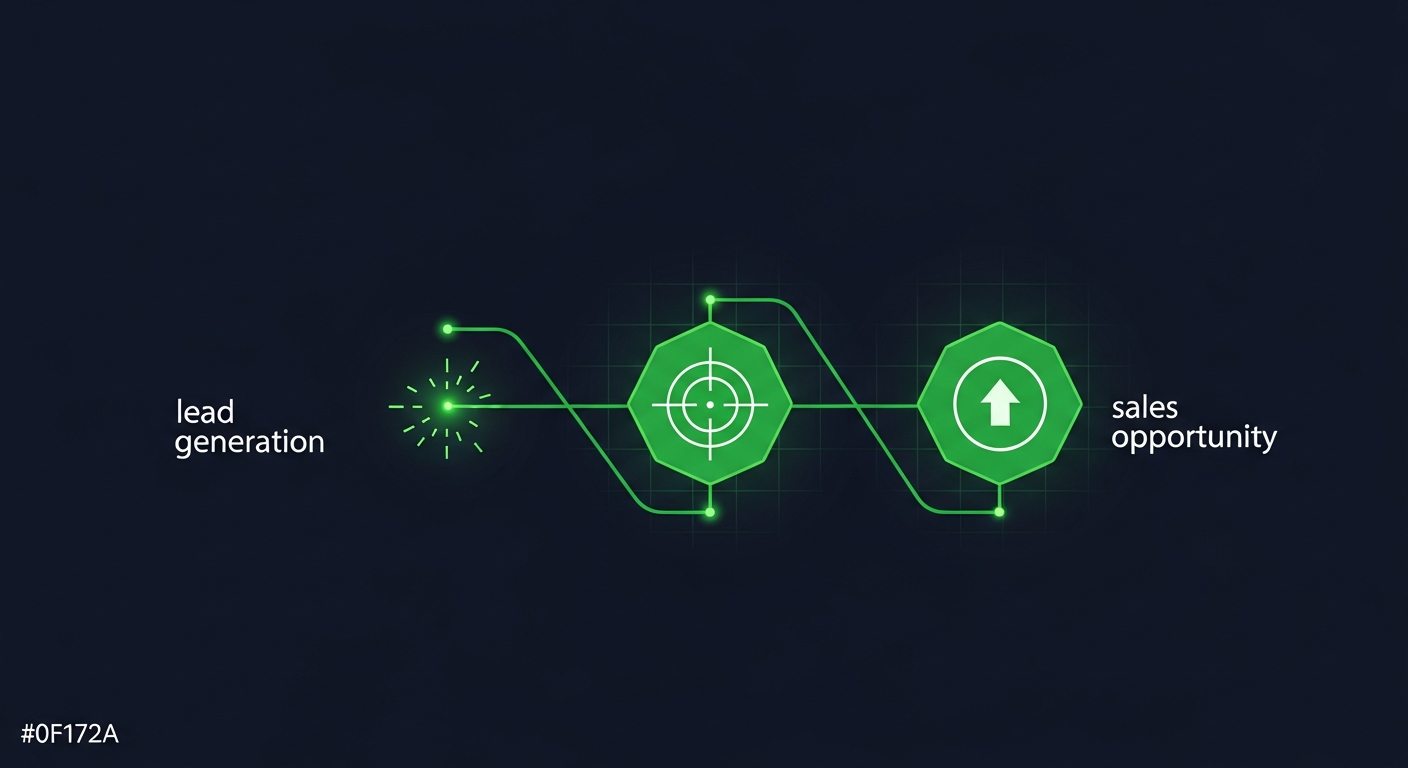
Direct Answer: "Lead generation prospecting sales opportunities" is not three labels for the same thing — it's a chain. Lead generation casts the net, prospecting works the named accounts the net misses, and a sales opportunity is what survives qualification on either side. Most revenue teams underperform at the top of the funnel because they treat the three as interchangeable, count them on the same dashboard, and lose visibility into the handoffs that actually decide pipeline.
The Short Answer
- Lead generation is a marketing-run response system. The buyer raises a hand.
- Prospecting is a sales-run search system. The rep raises the hand on the buyer's behalf.
- A sales opportunity is a qualified, accepted record with budget, authority, need, and timing — not every lead, and not every prospect.
- The chain leaks at the joins, not inside any one stage. Most lost pipeline is a handoff problem.
Why "Lead Generation Prospecting Sales Opportunities" Belongs in One Sentence
Treat the three stages as one connected workflow and the math gets honest. Treat them as separate dashboards and you end up with marketing celebrating lead volume, sales complaining about lead quality, and a pipeline review that can't trace a single deal back to its origin.
The compound phrase lead generation prospecting sales opportunities matters because the conversion that actually pays the company is lead-or-prospect → opportunity. Anything that improves a stage in isolation but breaks the handoff into the next one is a regression, not progress. A 40% jump in MQLs that ships with a 50% drop in MQL-to-SQL conversion is a worse quarter than no jump at all.
Stage One: Lead Generation, Defined Tightly
Lead generation is the marketing-run motion that captures buyers who have already shown some intent. The hand-raise is the defining feature — without it, you're doing prospecting and calling it lead gen.
What counts as lead generation:
- A form fill on a pricing page, demo page, or contact-sales page.
- A trial signup, freemium signup, or webinar registration.
- A gated-content download where the buyer chose to exchange contact info.
- An event scan, podcast subscription, or newsletter subscription tied to a real identity.
What does not count, even though teams sometimes label it lead gen:
- A list pulled from a database vendor and uploaded into the CRM.
- A scraped contact a rep added after seeing a LinkedIn post.
- An "intent" topic surge attached to an account that has not actually contacted you.
The line matters because lead gen and prospecting have different cost structures, different conversion rates, and different rep behaviors. If you can't tell which one produced a record, you can't price either one.
Stage Two: Prospecting, the Search Half
Prospecting is the rep-led work of finding the accounts and people the inbound net misses. It runs on three layers of data — firmographics (whether to ever work this account), verified contacts (who to talk to), and buying signals (whether to work it this week) — and it has six concrete steps: define the ICP, select named accounts, discover the buying committee, enrich the dossier, qualify out the wrong ones, and sequence the rest. We've covered the full motion in our B2B lead prospecting guide, including the workflow's failure modes.
The point worth repeating in this article: prospecting isn't lead generation done harder. It is structurally different work — the rep owns the search, the timing, and the opener. Conflating it with lead gen on the same dashboard hides which motion is paying off and lets underperforming spend hide inside healthy spend.
Stage Three: A Sales Opportunity, Defined Strictly
This is the term most likely to get fudged in a forecast call. A sales opportunity is not a meeting, a "good conversation," or a contact who asked a question. It is a CRM record that has cleared explicit acceptance criteria — typically some local version of BANT or MEDDIC (Budget, Economic buyer identified, Decision criteria known, Decision process mapped, Identified pain, Champion engaged), with a documented next step and a stage that maps to a forecast probability.
A useful working definition:
A sales opportunity is an accepted record that names a specific buying unit, a specific use case the buyer has acknowledged, a plausible budget envelope, an identified evaluator or champion, and an agreed-upon next step on a calendar.
If any of those five are missing, what you have is a prospected account in conversation — interesting, but not yet pipeline. Pretending otherwise inflates forecast and starves the prospecting queue, because reps stop sourcing while they "work" stage-1 records that won't convert.
How the Chain Actually Hands Off
Two transitions decide whether lead generation prospecting sales opportunities flow or stall:
Transition A: lead generation → opportunity (or back to nurture)
When marketing produces a lead, sales has to either accept it as an opportunity or send it back to nurture with a structured rejection reason. The pattern that works:
- Marketing-Qualified Lead (MQL) is promoted to Sales-Qualified Lead (SQL).
- An SDR or AE accepts the SQL within an SLA the team can actually meet (a 60-minute SLA met 95% of the time outperforms a 5-minute SLA met 30% of the time).
- The rep either disqualifies (with a reason that flows back to marketing) or progresses to a stage-1 opportunity with explicit acceptance fields populated.
The single most common failure here is the handoff payload — the SDR gets a name and an email but no source, no last touch, no signal, no recommended angle, so the first call is cold. Our MQL-to-SQL handoff playbook covers the contract, the payload fields, and the SLA design that keeps this transition from leaking.
Transition B: prospecting → opportunity
When prospecting produces a meeting, the rep has to convert that meeting into an accepted opportunity using the same acceptance bar as inbound. The mistake teams make is to apply a softer bar to outbound meetings ("we worked hard for this one") and a harder bar to inbound ("they should know what they want"). The bar should be the same; only the path to it differs.
The healthy pattern:
- Prospected meeting books from a real signal documented in the dossier.
- The first meeting tests the same five acceptance criteria above.
- If three of five clear, it becomes a stage-1 opportunity; if not, it goes back to nurture with the disqualification reason logged.
- The rep updates the dossier with what changed so the next signal on this account starts from the new baseline.
Where the Chain Leaks Most Often
Most underperforming top-of-funnels share the same handful of failures. You can usually diagnose which one your team has in a single pipeline review.
- Definition drift between stages. Marketing's "MQL" definition isn't the same as sales's "SQL acceptance" definition, and neither matches what the AE writes in stage 1. A signed, dated, one-page contract for each transition fixes this; nothing else reliably does.
- Empty handoff payloads. A lead arrives with name, email, and nothing else. The rep calls cold, the buyer disengages, and the metric blamed is "speed-to-lead" when the real issue is information.
- No de-MQL path. Leads sales rejects vanish. Marketing keeps sending the same shape of lead because no one closed the feedback loop.
- Confusing meetings with opportunities. Reps log every booked call as a stage-1 opp. Forecast inflates. The next quarter's prospecting target gets cut because "pipeline looks fine."
- Prospecting starved by inbound triage. Reps spend the morning on inbound follow-up and the prospecting queue silently empties. A separate AM/PM split or queue ownership rule prevents it.
- Opportunity acceptance drift. Stage-1 quietly becomes "any record the AE thinks is interesting." Win-rate falls. The fix is a quarterly audit of stage-1 records against the written acceptance criteria.
Lead vs. Prospect vs. Sales Opportunity: A Side-by-Side
Buyers and managers use these words interchangeably. Reps suffer for it. The table below pins each term to a single definition.
| Dimension | Lead | Prospect | Sales Opportunity |
|---|---|---|---|
| Origin | Marketing-run response (form, signup, event) | Sales-run search (ICP + signal + outreach) | Either path, after qualification |
| Defining feature | The buyer raised a hand | The rep identified the buyer based on fit and signal | Acceptance criteria cleared, next step on calendar |
| Owner of record | Marketing automation / CRM lead object | Rep dossier / CRM contact + account | CRM opportunity object with stage and amount |
| Acceptance bar | Engagement + ICP fit | ICP fit + workable signal | Five-point acceptance: buyer, use case, budget envelope, champion, next step |
| Forecast impact | None until accepted | None until accepted | Direct — feeds pipeline coverage |
| Healthy conversion next | 25–40% of MQLs become SQLs | 8–15% of prospected accounts become first meetings | 20–35% of stage-1 opps become closed-won |
| Most common failure | Empty handoff payload | No qualification step before sequencing | Acceptance bar drift |
The discipline is to never let one of these terms be used in a conversation where the participants haven't agreed which column they're talking about.
KPIs for the Whole Chain (Not Just One Stage)
Pick a small number, measure them weekly, and resist the urge to add more. The five below cover the chain end to end:
- MQL → SQL acceptance rate. Sales should accept ≥ 70% of MQLs. Below that, the contract has drifted; above 90%, the bar is too low.
- Prospected-account meeting rate. 8–15% of well-targeted prospected accounts should produce a first meeting per quarter. Per account, not per contact, to control for spammy multi-touch.
- Meeting → stage-1 opportunity rate. Across both inbound and outbound paths. Should be similar within 5 points; large gaps mean the acceptance bar is being applied unevenly.
- Stage-1 → closed-won rate. Tracked by source (lead gen vs. prospecting). This is the only number that lets you compare the two motions honestly.
- Cost per qualified opportunity. Total motion cost (campaigns, rep time, tooling, data) divided by stage-1 opportunities accepted. Compare lead gen and prospecting separately; they should both pay for themselves on this number.
Track these for at least eight weeks before you change the motion. Top-of-funnel data is noisy week-to-week; a single bad week is not a trend, and chasing it almost always makes the next quarter worse.
A Note on Scoring and Trust
Across all three stages the same principle applies: scores and signals are inputs, not decisions. An ICP score that reps can't explain in one sentence — using the contributing fields — gets ignored within a quarter, no matter how rigorous the model. We've written a longer piece on building ICP scoring that sales actually trusts; the relevant point here is that the chain only works if reps believe the inputs at every stage.
Frequently Asked Questions
What does "lead generation prospecting sales opportunities" actually mean?
It's a compact phrase for the top-of-funnel chain: lead generation captures buyers who raise a hand, prospecting goes after the accounts who haven't, and sales opportunities are the qualified records — from either path — that earn a spot in pipeline. The terms describe a sequence with handoffs, not three names for the same activity.
What is the difference between a lead, a prospect, and a sales opportunity?
A lead is a marketing-sourced contact who took an action. A prospect is a rep-identified account or contact who fits the ICP and shows a workable signal. A sales opportunity is the accepted, qualified record that follows from either, after the buyer, use case, budget envelope, champion, and next step are documented.
Where does the lead generation prospecting sales opportunities chain leak the most?
At the handoffs, not inside any one stage. The two highest-leak points are MQL-to-SQL (where definition drift and empty handoff payloads kill conversion) and meeting-to-opportunity (where reps log calls as stage-1 opps without clearing the acceptance bar). Fix the contracts at those two transitions before tuning anything else.
Should the same team run lead generation and prospecting?
Usually no. Lead generation is a marketing-run response system; prospecting is a sales-run search system. They have different cost structures, different KPIs, and different rep skills. Sharing a leader is fine; sharing a queue or a scoreboard hides which motion is paying.
What KPIs prove the lead generation prospecting sales opportunities chain is working?
Five numbers, tracked weekly: MQL-to-SQL acceptance rate, prospected meeting rate per 100 accounts, meeting-to-stage-1-opportunity rate, stage-1-to-closed-won by source, and cost per qualified opportunity. Activity counts (forms, dials, sends) are inputs, not outcomes; they belong on a separate dashboard.
How is "intent data" related to lead generation prospecting sales opportunities?
Intent data is one signal among many. It can sharpen prospecting account selection and route inbound leads faster, but it isn't a hand-raise and it doesn't qualify a sales opportunity on its own. Treat it as a queue ranker, never as a gating threshold or a forecast input.
References
- US Federal Trade Commission, CAN-SPAM Act compliance guide: https://www.ftc.gov/business-guidance/resources/can-spam-act-compliance-guide-business
- ICO (UK), Direct marketing guidance: https://ico.org.uk/for-organisations/direct-marketing-and-privacy-and-electronic-communications/
- European Commission, General Data Protection Regulation: https://commission.europa.eu/law/law-topic/data-protection_en
- Gartner, B2B Buying Journey research: https://www.gartner.com/en/sales/insights/b2b-buying-journey
- Forrester, B2B Marketing & Sales Alignment research: https://www.forrester.com/research/
Next Steps
If you've mapped the chain and want to see it instrumented end-to-end — a real lead gen capture, a prospecting queue ranked by ICP and signals, and a clean handoff into qualified opportunities — compare the transparent monthly pricing for TheLeadSeeker against your current cost per qualified opportunity. The trial is full-featured for 14 days, so reps can run a complete cycle on real accounts before you commit.