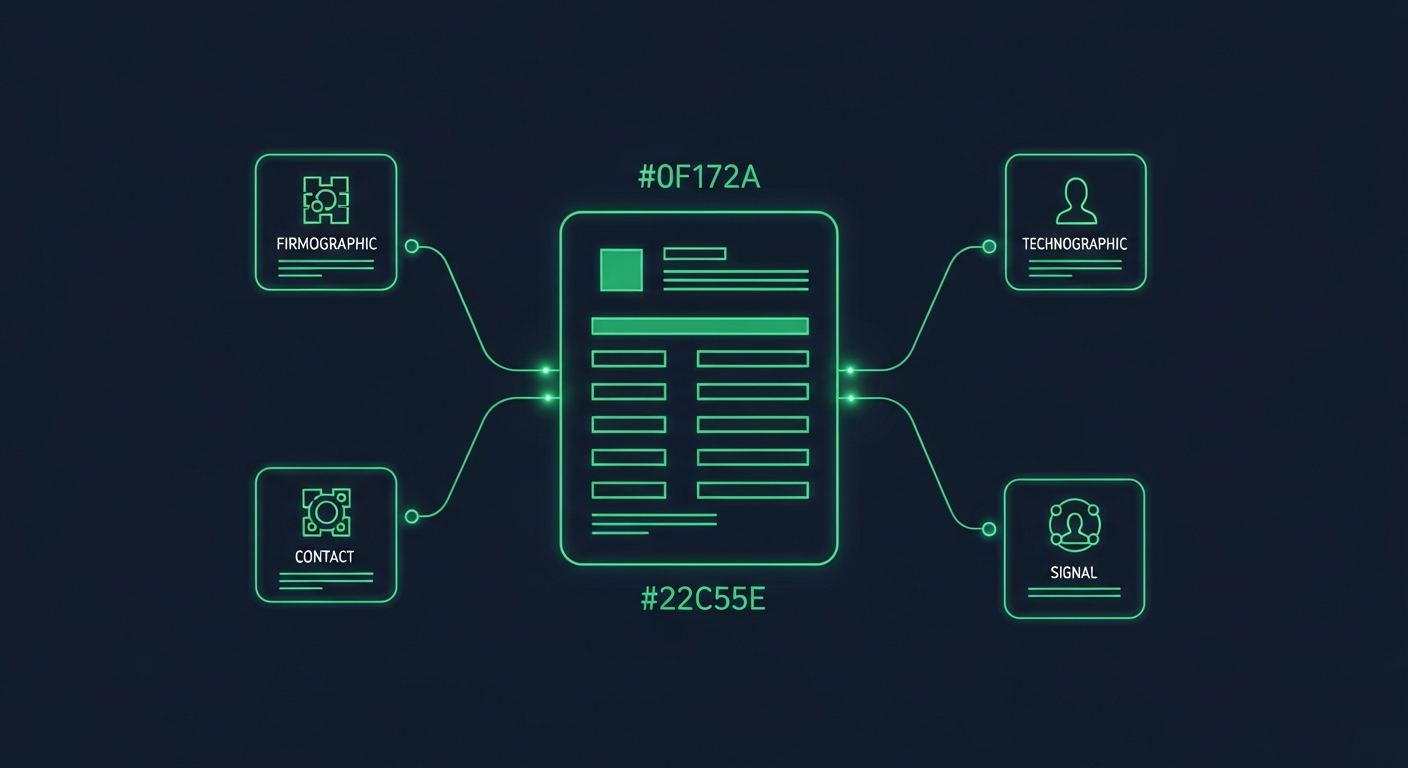
B2B data enrichment is the act of attaching verified, current context — firmographic, technographic, contact, and signal — to records you already have or are about to source. The point is not "more fields." The point is fresher fields tied to a buying decision, written into your CRM without trampling the human edits that already live there. Enrichment that ignores freshness or sync hygiene quietly degrades your data instead of improving it.
B2B Data Enrichment: The Short Answer
- It is verified context (firmographic, technographic, contact, signal) attached to the records you actually work.
- It is not "buy a 200-column data file and load it into your CRM."
- It works best when records are enriched at the moment of use, with the verification timestamp visible.
- It fails when the enrichment vendor refreshes monthly, the CRM writes blindly, and reps stop trusting the fields.
Common Misconceptions About Data Enrichment
Three patterns burn budget on every audit:
- "More fields = better enrichment." A record with 80 fields where half are 18 months old is worse than a record with 12 fields verified this week. Field count is a vanity metric. Per-field freshness is the real one.
- "Enrichment is a one-time job." Contact data decays at roughly 20–30% per year (job changes, role changes, company moves). A one-time enrichment run looks impressive on day one and is a stale list within two quarters. Enrichment has to be a continuous, on-use motion.
- "The enrichment API is the product." The API is the easy part. The hard parts are source provenance, confidence scoring, GDPR / US-state compliance posture, and how the writes hit your CRM without overwriting human edits. Most procurement evaluations weight the API and skip the rest. The same trap shows up when buyers evaluate whole platforms — see how to choose a B2B lead intelligence platform for the full criteria list.
What Actually Makes B2B Data Enrichment Useful?
Five qualities, in priority order:
- Verified-at-use freshness. Each field should carry a "verified on" date the rep can see. If the freshness stamp is older than 90 days, the field is context, not a fact.
- Source provenance per field. "Email verified via SMTP handshake
on 2026-04-30" is auditable. A flat
email: jane@acme.comwith no source is unfalsifiable. Reps stop trusting unfalsifiable fields. - Confidence scores, not booleans. A confidence score on every enriched field lets routing rules ignore weak detections instead of treating them as truth.
- Buying-relevant signal coverage. Hires, posted roles, funding, tech-stack changes, and earnings mentions are what tell the rep whether to act this week. Pure firmographic enrichment is qualification context, not a trigger. For a working scoring model across signal types, see how to prioritize buying signals for outbound and the deeper read on technographic data for B2B targeting.
- CRM-aware writes. The connector dedupes before write, respects ownership, surfaces conflicts to a RevOps owner, and never overwrites a human edit silently. The connector is part of the product, not a checkbox.
What to Check Before You Buy or Build a Data Enrichment Stack
Before signing a contract or staffing an internal build:
- Run a 25-record audit against accounts you know cold. Score precision per field type (email, phone, title, tech stack, hire, funding) — not an overall accuracy number. Weak categories will show up immediately.
- Ask the vendor for the median age of every enriched field across their corpus. "We refresh weekly" without a median age is a marketing answer, not an operational one.
- Confirm source provenance is exposed per field in the API response, not buried in vendor docs. Reps need to see why a value is what it is.
- Verify the enrichment API returns confidence scores on every field, not just a top-line "high/medium/low" tag.
- Audit the CRM-write contract: dedupe key, ownership semantics, conflict resolution, rollback. The cheapest field of the contract has been the most expensive bug we've seen on every CRM cleanup.
- Verify GDPR / UK GDPR posture: lawful basis per field type, data-subject request handling at the individual level, and how opt-outs propagate from your CRM back into the enrichment vendor.
- Compute cost per workable record (total cost ÷ records reps actually worked from the enriched output during a 30-day pilot), not seat or credit price. This number almost never appears on a pricing page.
Comparison: enrichment categories and what they're good for
| Category | Primary unit | Strength | Weakness | Best use |
|---|---|---|---|---|
| Firmographic enrichment | Company size, industry, HQ | Cheap, broad, stable | Low signal for timing | ICP qualification, routing |
| Technographic enrichment | Tools / stack detected | Useful fit signal for tech-adjacent products | Refresh cadence varies; long-tail noise | ICP fit, competitive replacement plays |
| Contact enrichment | Verified email, phone, title | High direct revenue impact when fresh | Decays 20–30% per year | Adding deliverable contacts to a target list |
| Signal enrichment | Hires, funding, postings | Tells you when to act | Most signals are weak alone | Trigger-driven outbound |
| Bulk file enrichment | CSV upload | Quick batch lifts | One-time, decays fast, no provenance | One-off list cleanup, never as a strategy |
| Verified-at-search-time dossier | A single working record | Freshness by construction; rep sees source | Higher unit cost than batch | Any time the rep is about to actually outreach |
The line that matters: enrichment that produces a workable record — verified contact + current signal + clear source + clean CRM write — is doing data enrichment. Enrichment that just inflates field counts on a dormant CRM is doing data exhaust.
The CRM-Write Trap
The most expensive enrichment failure isn't bad data — it's good data that quietly destroys your CRM. Common patterns:
- Blind upserts that overwrite human edits. A rep types in the correct title; the next nightly enrichment job overwrites it with a stale value from a vendor refresh. The rep stops trusting the field inside a week.
- No dedupe key alignment. The vendor matches on company name; the CRM keys on domain. Result: duplicate accounts, split histories, broken reporting.
- Ownership trampling. The connector reassigns owners on update. Pipeline reports break overnight.
- No conflict surfacing. When the enrichment value disagrees with the CRM value, somebody should see it. Auto-resolve-by-vendor is the failure mode.
The fix is procedural, not technical: every enrichment write is versioned, every conflict surfaces to a RevOps queue, and human edits always win unless explicitly overridden. Vendors that can't describe this contract in writing should be disqualified at the demo stage. For the field-tested CRM-write contract — dedupe keys, ownership semantics, and the conflict queue — see exporting prospects into your CRM cleanly.
Where Lead Seeker Fits
Lead Seeker's Prospect Dossier is built around verified-at-search-time enrichment: contact, role, DISC-style read, and the most recent buying signal are pulled and verified the moment you spend a Lead Unit, with the verification date stamped on every field. The result is a record that is fresh by construction — no nightly refresh, no stale CRM overwrite. For teams that want signal context first and dossiers second, Lead Compass turns market signals into search-ready prompts so reps only enrich the records they actually intend to work.
Frequently Asked Questions
What is B2B data enrichment?
B2B data enrichment is the process of attaching verified, current context to records you already have or are about to source — firmographic (company size, industry), technographic (stack), contact (email, phone, title), and signal (hires, funding, posted roles). The goal is to make the record workable for a rep, not to inflate field counts.
How is data enrichment different from list buying?
A purchased list is a one-time data drop, usually with no source provenance and no ongoing freshness guarantee. Enrichment is a continuous motion: records are updated as they age, decisions are backed by source provenance, and writes flow through a managed CRM contract instead of a CSV import.
What fields should I enrich first?
Start with the fields that drive a routing or messaging decision in the next 30 days: verified email and phone, current title and role, the most recent firmographic basics (employee count, industry, location), and at least one timing signal (hire, funding, posted role). Everything else is context that can wait.
How fresh does enriched data have to be?
Contact data should be verified within 30–90 days for active outbound use. Signals decay faster — a hire or funding event older than 30 days has limited "why now" power. Firmographic and technographic data can be older but still need a visible verification date so reps can judge.
What's the most common mistake with data enrichment?
Treating enrichment as a one-time bulk job. A CSV enriched in March is partly stale by June and largely stale by September. Enrichment has to be continuous and ideally tied to the moment a rep is about to use the record, not to a quarterly batch.
Are enrichment APIs GDPR-compliant?
They can be, but the burden is on the buyer. Verify the vendor's lawful basis per field type, that data-subject requests are honoured at the individual level (not just per-record), and that opt-outs propagate from your CRM back into the enrichment vendor's pipeline. Person-level enrichment from third-party panels in the EU/UK warrants legal review.
How should I price data enrichment?
The honest unit is cost per workable record — total cost (subscription + credits + connector + cleanup overhead) divided by records reps actually worked during a 30-day pilot. Per-credit and per-seat prices look cheap in isolation and are almost always the wrong unit for buying decisions.
References
- ICO (UK), Direct marketing guidance: https://ico.org.uk/for-organisations/direct-marketing-and-privacy-and-electronic-communications/
- European Commission, General Data Protection Regulation: https://commission.europa.eu/law/law-topic/data-protection_en
- US Federal Trade Commission, Data brokers — A look at the Vermont law: https://www.ftc.gov/business-guidance/privacy-security
- Forrester, B2B Data Provider research: https://www.forrester.com/research/
- Gartner, Market Guide for B2B Data Providers: https://www.gartner.com/en/marketing/research
Next Steps
If you're comparing vendors rather than concepts, our B2B data enrichment tools roundup sorts the market into seven categories and gives you an evaluation checklist to run on your own accounts. Or, if you'd rather skip the bulk-refresh-and-pray pattern and see enrichment that's verified the moment you use it — with source dates stamped on every field and a clean CRM write — see how Lead Seeker's Prospect Dossier works or browse the live opportunity briefs in Lead Compass.