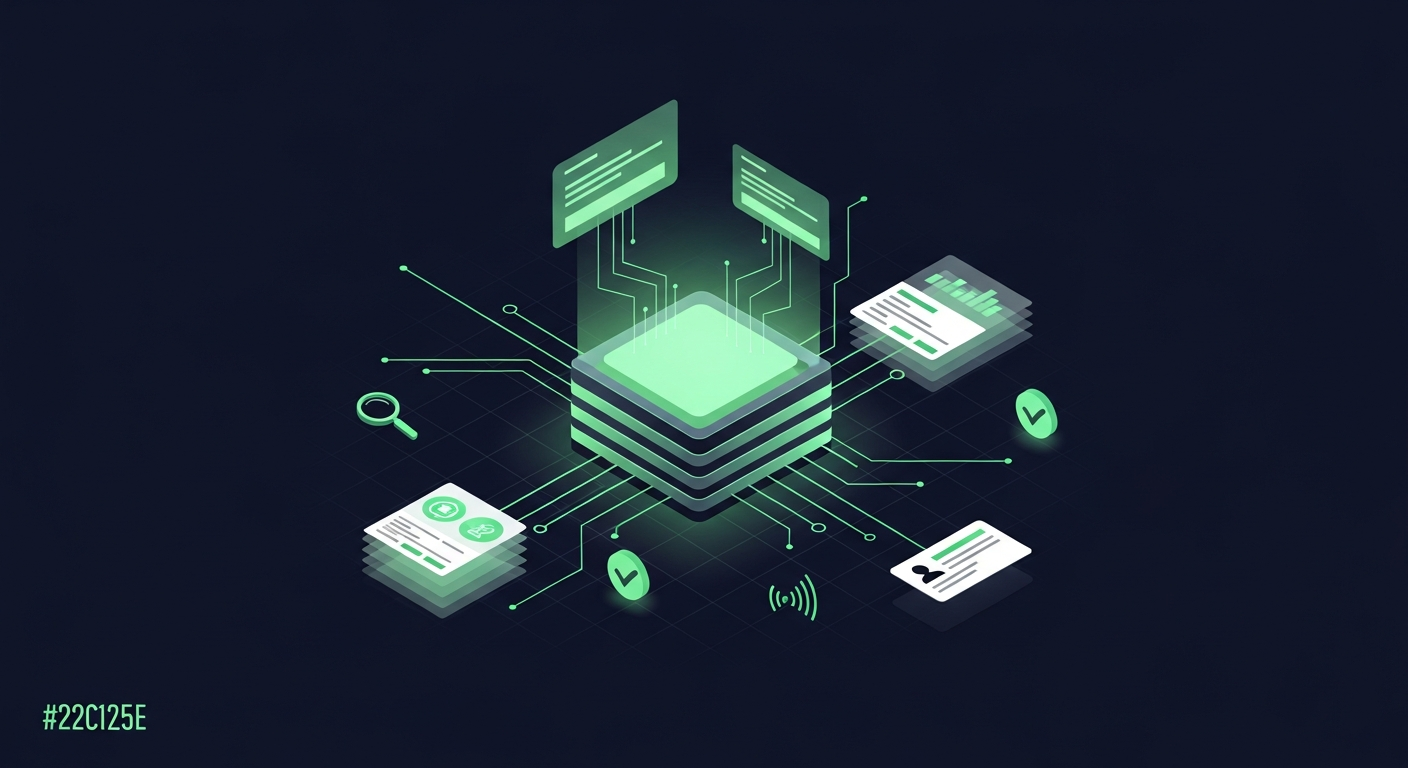
B2B sales intelligence software is the layer that turns raw company and contact data into decisions a rep can act on: who to call, what changed to make the timing right, and how to reach them without guessing. It sits between your data sources and your CRM, and the good ones are defined less by database size than by how cleanly they move a verified, signal-ranked record into a seller's hands.
What B2B Sales Intelligence Software Is
At its narrowest, sales intelligence software is a database with a search box. At its most useful, it is a synthesis engine: it ingests firmographics, technographics, contacts, and buying signals, resolves them to a single account and person, verifies they are real and current, ranks them against your ideal customer profile, and outputs a brief a rep can open and act on in under a minute.
The distinction matters because most of the market sells the first definition and prices it like the second. A tool that only hands you static fields — company, title, a maybe-valid email — is a contact database. B2B sales intelligence software earns the "intelligence" label only when it answers the two questions a database cannot: which of these people is likely to buy right now, and why.
If you are still mapping the wider category — contact databases, intent providers, technographics, verification, and signal-led platforms — start with our roundup of the top B2B sales intelligence tools, then come back here for what the software layer itself actually does.
The Jobs B2B Sales Intelligence Software Does
Good software collapses five jobs that used to live in five browser tabs into one workflow:
- Discovery. Surface accounts and people that match your ICP by firmographics, technographics, hiring patterns, or a named-account list — without exporting a CSV and re-importing it somewhere else.
- Resolution. Merge duplicate and partial records so one company and one person show up once, not five times with three spellings.
- Verification. Confirm the email and phone are valid for the person in that role today, not when the record was first scraped.
- Signal detection. Watch for job changes, new hires, posted roles, funding, technology shifts, and earnings mentions, then tie each signal to the account so a rep knows why now.
- Activation. Push a clean, deduped, field-mapped record into the CRM or sequencer so the seller acts without a copy-paste tax.
A tool that does only one of these is a component, not a platform. That is perfectly fine — but know which job it fills before you sign anything longer than a quarter. For a fuller comparison of how vendors package these jobs, see sales intelligence platforms.
How B2B Sales Intelligence Software Works
Under the interface, every serious platform runs the same pipeline. Understanding the stages is the fastest way to tell a synthesis engine from a search box.
1. Ingestion
Data arrives from public web crawls, licensed partnerships, opt-in panels, and contributor networks (reps who share their address book in exchange for credits). The provenance matters: contributor-network data is often fresher but raises the compliance questions covered below.
2. Entity resolution
The raw feeds are messy — "Acme, Inc.", "ACME Incorporated", and "acme.com" are the same account. Resolution collapses them into one canonical company and one canonical person, so downstream signals and verification attach to a single record instead of scattering.
3. Verification
Emails are tested against mail servers (and separated into valid versus catch-all), phone numbers are validated, and titles are checked against recent evidence. This is where freshness is won or lost: a record verified 30 days ago behaves very differently from one verified 18 months ago.
4. Signal detection and ranking
The platform monitors change events and topic research, dedupes them per account, and ranks them against your ICP so a rep sees the strongest timing first — not the noisiest feed. Raw intent is one input here, never the whole answer.
5. Synthesis and activation
Finally, the verified record and its ranked signals are assembled into a dossier and written to your CRM or sequencer with ownership rules respected and duplicates skipped. The output — not the database — is the product. Our explainer on prospect intelligence tools digs deeper into what a strong dossier should contain.
What to Look For When Evaluating
Walk any shortlist through the same five tests on your own data, not the vendor's curated sample:
- A 25-record verification audit. Hand-verify 25 representative contacts per vendor. Below 85% accuracy is a red flag no demo can explain away.
- Signal-to-alert latency. Pick two signal types you care about and compare the vendor's alert timestamp to the public record. Anything over 72 hours is too slow for outbound.
- A sandbox CRM sync. Load 100 records into a CRM sandbox and confirm dedupe, ownership respect, field-conflict handling, and rollback. A broken sandbox sync is a broken production sync.
- A clear billing unit. You should pay for records you save, not ones you view. Ambiguous credit models hide the real cost.
- Compliance in writing. Ask exactly how a contact requests removal and how fast that propagates to your downstream tools.
Score each on a grid. The freshest data with the cleanest CRM write almost always beats the longest feature list. For a side-by-side method rather than a checklist, see our sales intelligence platform comparison, and for a full decision framework, how to choose a B2B lead intelligence platform.
How Much B2B Sales Intelligence Software Costs
Pricing models vary wildly — per-seat, credit-based, and per-record are all common — which makes headline numbers close to meaningless. The only honest unit is price per workable dossier: total annual cost divided by the number of briefs your reps actually act on, compared against your current sourcing cost per qualified meeting.
A platform that lands materially below that benchmark pays for itself. One priced on database access you never fully use is a status purchase. Be especially wary of "unlimited" plans that meter exports, and of credit systems where viewing a record burns the same credit as saving it — the two behave very differently at the end of a quarter.
Where Lead Seeker Fits
Lead Seeker is a signal-led platform: it folds verification and ranked buying signals into the discovery step, so the record a rep receives is already deduped, verified, and explained. That collapses the data source, the verification layer, and the synthesis step into one workflow — usually cheaper than maintaining three point tools and asking reps to stitch the output together by hand.
Frequently Asked Questions
What is B2B sales intelligence software?
B2B sales intelligence software is a category of tools that ingest company and contact data, resolve and verify it, layer on buying signals, and synthesize the result into a brief a rep can act on. The strongest products go beyond a searchable database and answer which prospects are likely to buy now and why.
How is sales intelligence software different from a CRM?
A CRM is a system of record for relationships you already have. Sales intelligence software is a system of discovery for relationships you do not yet have. The CRM stores who you have talked to; sales intelligence software tells you who to talk to next, and why now, then writes that record cleanly into the CRM.
How does B2B sales intelligence software work?
It runs a pipeline: ingest data from public, licensed, and opt-in sources; resolve duplicates into one canonical account and person; verify emails, phones, and titles; detect and rank buying signals against your ICP; and synthesize a dossier that is pushed to your CRM or sequencer. The output brief, not the raw database, is the product.
Is intent data the same as sales intelligence software?
No. Intent data is one input. Most feeds only tell you a topic was researched somewhere inside an account — not who researched it, whether they have budget, or how to reach them. It becomes useful when combined with firmographics, verified contacts, and synthesis, and ranked against your ICP.
How much does B2B sales intelligence software cost?
Judge it by price per workable dossier: total annual cost divided by the briefs your reps actually act on, compared with your current sourcing cost per qualified meeting. A tool materially below that benchmark pays for itself; one priced on database access you never fully use is a status purchase.
Is B2B sales intelligence software GDPR-compliant?
It can be, when the vendor uses lawful sourcing, honors data-subject requests at the individual level, and propagates deletions to integrated tools quickly. Vendors that cannot describe their compliance posture in writing should be skipped, particularly if you operate in the EU or UK.
References
- US Federal Trade Commission, CAN-SPAM Act compliance guide: https://www.ftc.gov/business-guidance/resources/can-spam-act-compliance-guide-business
- ICO (UK), Direct marketing guidance: https://ico.org.uk/for-organisations/direct-marketing-and-privacy-and-electronic-communications/
- European Commission, General Data Protection Regulation: https://commission.europa.eu/law/law-topic/data-protection_en
- Gartner, Sales technology research: https://www.gartner.com/en/sales/insights
Next Steps
If you have run the workable-dossier math on your current stack and want a concrete benchmark, compare the transparent monthly pricing for Lead Seeker against your current sourcing cost per qualified meeting. The trial is full-featured for 14 days, so you can run the 25-record verification audit and the sandbox CRM sync on your own data before you commit.