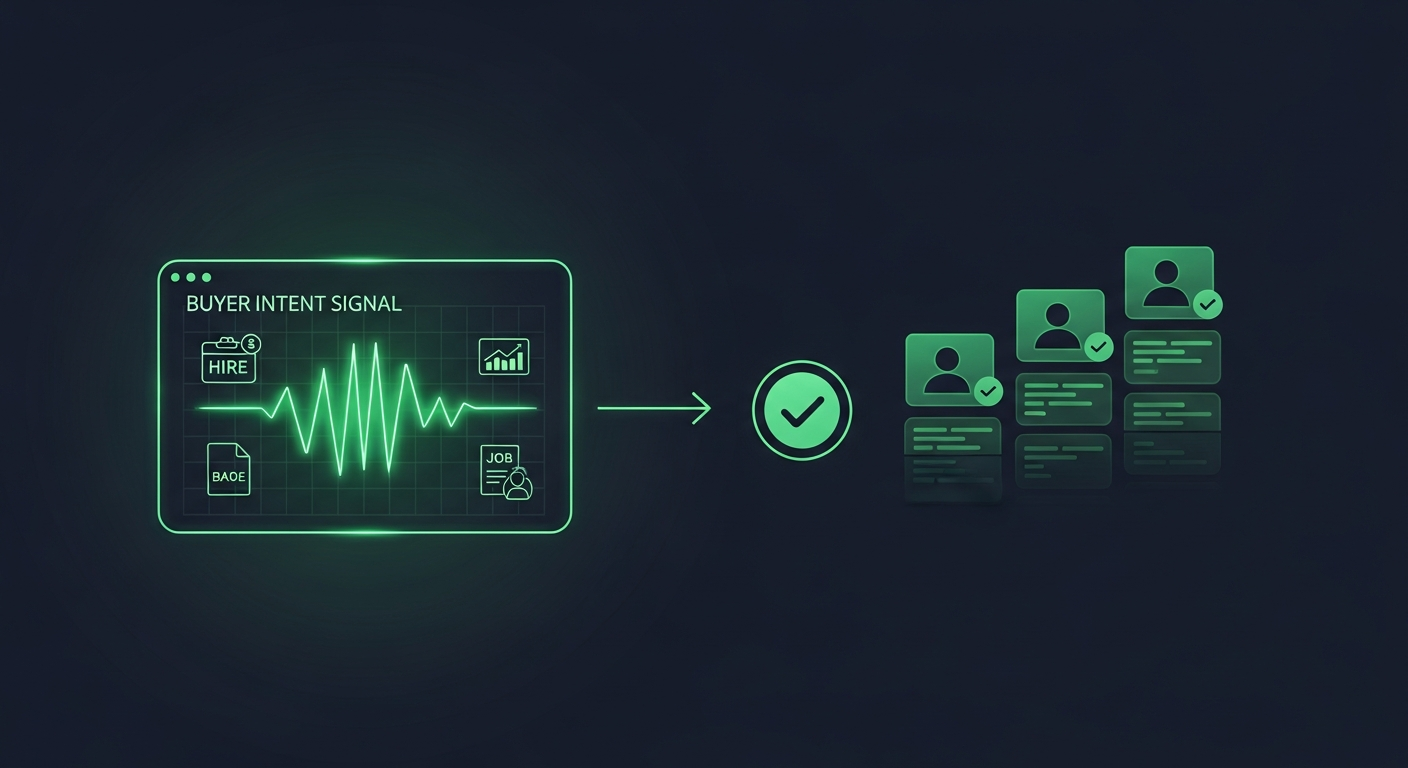
Buyer intent leads software is a tool that detects buyer-intent signals, scores them for relevance, resolves them to a real company and a contactable buyer, and delivers the result as an action-ready lead a rep can work today. The distinction that matters most: it's not just a signal feed that tells you an account is maybe researching — it closes the gap to a verified contact plus the reason to reach out. The category is broad, from raw topic-surge feeds to full lead-delivery platforms, so the useful question isn't "which software is best," it's "which capabilities do I need, and which category delivers a lead I can act on with proof I can audit." This guide breaks down what the software is, what it does, the categories of tools, and a checklist for choosing one. For the underlying signal layer that feeds these tools, pair this with our intent data software guide.
What Buyer Intent Leads Software Is
Buyer intent leads software sits at the intersection of three things most teams buy separately: buyer-intent signals, contact data, and a delivery workflow. On its own, an intent feed tells you an account is showing interest; a contact database tells you who works there; neither hands a rep a lead they can act on. Buyer intent leads software fuses them — it takes the signal, attaches the verified person it points to, and routes that lead into the rep's queue with the "why now" intact.
That fusion is the whole point. A topic-surge score is a probability, not a lead. A static contact record is a name, not a reason to call. The software earns its name only when it delivers both together — a buyer, a trigger, and a verified way to reach them. If you're still mapping the raw inputs underneath, the buyer intent data primer covers where the signals come from and how fast they decay.
What Buyer Intent Leads Software Actually Does
Strip away the branding and every buyer intent leads tool is assembling the same pipeline. The five capabilities below are what you're really buying — and the gap between an action-ready lead and an expensive list usually shows up in how transparently each step works.
- Signal detection. The software ingests buyer-intent signals — third-party topic-research surges, first-party activity on your own properties, and discrete public events like hires, funding rounds, and job postings. The breadth and freshness of this layer set the ceiling for everything downstream. The mechanics of how each signal type is gathered are covered in how intent data is collected and scored.
- Scoring and prioritization. Raw signals are noise until they're scored against a baseline — what's normal for this account — so a genuine surge is separated from a large company's constant background hum. Good software documents its model; weak software ships an opaque "high/medium/low" label a rep can't trust.
- Contact resolution and verification. A signal is useless if it can't be tied to a contactable, role-relevant buyer with a live email and phone. This is the step that turns intent data into an actual lead, and the step the cheapest tools quietly skip.
- ICP filtering. A surge at a company that will never buy is a distraction. Strong software filters triggers through your ideal customer profile before a lead ever reaches a rep's queue.
- Delivery and routing. The output has to land where reps work — your CRM, sequencing tools, and Slack — with deduplication so you don't pay twice for the same account or route one two teams already own, and an alert that turns a fresh signal into a task in hours, not a stale row in a weekly export.
If a tool is strong on detection but a black box on scoring, or great at scoring but never resolves a verified contact, you'll feel the gap every week. Evaluate all five, not just the headline feature.
The Categories of Buyer Intent Leads Software
"Buyer intent leads software" isn't one product — it's four structural categories defined by what they actually deliver. The unit of delivery decides freshness, false-positive risk, and how much work your reps still have to do, so pick the category that matches your motion before you compare logos.
Contact databases with intent overlays
These are large contact databases that bolt a topic-intent layer on top, so you can filter records by a surge score. Best for raw coverage and volume when you need to build lists at scale. Watch for the fact that the intent is a thin overlay — records decay fast, and a topic tag is not the same as a fresh, nameable trigger.
Third-party topic-surge platforms
These aggregate topic-research signals from publisher consortiums, bidstream telemetry, and opt-in panels, then score how far an account sits above baseline. Best for top-of-funnel breadth and discovering accounts outside your known universe. Watch for the noisiest category — false positives from analysts, students, and panel extrapolation, plus weekly batches that arrive stale. The trade-offs between these sources are laid out in how intent data sources differ.
Managed lead-gen services
These outsource the whole motion: a vendor sources the signal, resolves the contact, and often books the meeting for you. Best for hands-off pipeline when you lack the headcount to run the loop in-house. Watch for opaque sourcing and variable quality — without visibility into why a lead was deemed in-market, you can't tell pipeline from busywork.
Public-signal lead platforms
The newest category resolves intent from observable public events — hires, funding rounds, job postings, leadership changes, and tech-stack moves — then attaches a verified contact so each lead is action-ready. Every signal is a discrete, timestamped, verifiable fact. Best for teams who want triggers a rep will actually trust, with lower false positives and freshness that's a property of the event itself. Watch for the fact that these indicate a trigger (something changed) rather than topic-level research, so they pair best with ICP fit and verified contacts. This is the category Lead Seeker sits in — more below.
Quick comparison of software categories
| Category | What you actually get | Best for | Main risk |
|---|---|---|---|
| Contact database + intent | Records filtered by a topic score | Raw coverage and volume | Thin intent; records decay fast |
| Topic-surge platform | Account-level surge scores | Top-of-funnel breadth | False positives, stale batches |
| Managed lead-gen service | Outsourced, sometimes booked meetings | Hands-off pipeline | Opaque sourcing, variable quality |
| Public-signal lead platform | Event-triggered leads + verified contacts | Action-ready, auditable leads | Triggers, not topic research |
Most teams blend two of these — for example, public-signal triggers for prioritization plus a transparent topic-surge feed for breadth. The mistake is treating any single category as a complete program.
How to Evaluate Buyer Intent Leads Software: A Checklist
Once you've chosen a category, run every tool inside it through the same scorecard so you're comparing like for like rather than reacting to demo theater:
- What you actually receive. A score, a contact, or a booked meeting? Be explicit — the unit of delivery changes everything downstream.
- Sourcing transparency. Can they name the signal and contact sources and show how much of the feed is owned versus licensed?
- Baseline + scoring method. Is the calibration documented, or a black box you take on faith? Without a baseline, every large account looks like it's surging.
- Trigger auditability. Can a rep click through to the evidence behind a signal, or do they only get a colored label?
- Contact verification. How and how often are emails and direct dials verified, and what bounce rate is guaranteed?
- Freshness SLA. Observation-to-delivery measured in hours, not "weekly" — target under 72 hours, because buyer intent decays fast.
- ICP filtering. Can you constrain leads to your firmographics and exclude unfit accounts before they hit your CRM?
- CRM dedupe + routing. Will it dedupe against your CRM, MAP, and ABM platform and route to the right owner — or create duplicate work?
- Compliance posture. How are GDPR/UK GDPR and CCPA data-subject requests handled at both account and individual levels?
- Pricing unit. Per verified lead, per account watched, or per booked meeting — and does that unit align the vendor's incentives with yours?
- Proof. A 30-day pilot scoped to your top 200 accounts, with a control group, beats any case study.
Work the checklist top to bottom and the field narrows fast: most tools fail on transparency, verification, or freshness long before pricing becomes the deciding factor. For how to weight different triggers once they land, see how to prioritize buying signals for outbound.
Where Lead Seeker Fits
Lead Seeker is a public-signal buyer intent leads platform: it's built on observable events — hires, funding rounds, job postings, leadership and tech-stack changes — rather than an opaque topic-surge index extrapolated from panels, and it attaches a verified contact so each lead is action-ready rather than a raw score. Every signal in a Prospect Dossier is source-backed, so a rep can click straight through to the underlying evidence instead of trusting a label. That design changes the economics in three ways:
- Lower false positives. A funding announcement or a posted role is a discrete, verifiable event — it either happened or it didn't.
- Defensible freshness. Public events carry their own timestamps, so recency is a fact, not a batch schedule.
- Trust at the desk. Reps act on leads they can verify; black-box scores get ignored the first time a "hot" account turns out cold.
The Trigger Signals layer surfaces those events, Lead Compass maps them to your ICP, and the result arrives as a dossier with verified contacts attached — detection, scoring, resolution, and routing in one pass. We're not claiming public signals replace every category; broad topic-surge breadth still has a place at the very top of the funnel. See how the approach stacks up on our prospect intelligence platform comparison, or browse more intent data insights for the wider picture.
How to Roll Out Buyer Intent Leads Software
You don't need the most expensive platform to get the best result. Work through this order before signing anything:
- Wire up first-party intent first. Resolve and route the buying signals already happening on your pricing and docs pages. Highest ROI, mostly free, no vendor required.
- Add public-signal triggers with verified contacts. Hires, funding, and job postings are public, fresh, and verifiable — a strong, low-noise layer of action-ready leads.
- Layer a contact database or topic-surge feed for breadth. When you genuinely need top-of-funnel volume, add a transparent source — and treat its records as raw material to be corroborated, not a finished lead list.
- Consider a managed service only to scale a proven motion. Outsource booking once you already know which triggers convert, so the vendor is executing a playbook you can audit.
Most B2B teams get the majority of their value from steps one and two, so any paid breadth becomes additive rather than a crutch. If budget is the constraint, our guide to affordable B2B intent leads walks through getting intent-backed leads without overpaying. Whatever you pick, insist on a control-group pilot and measure meetings booked over 90 days. You can model the economics against our transparent monthly pricing before you commit, and once a tool is in place, see B2B intent leads for sales teams for how to turn that feed into a worklist your reps actually work.
Frequently Asked Questions
What is buyer intent leads software?
Buyer intent leads software is a tool that detects buyer-intent signals, scores them against an account's baseline, resolves them to a real company and a contactable buyer, and delivers the result as an action-ready lead in your CRM and sales workflow. The defining difference from a raw intent feed is the last mile: it doesn't just tell you an account is researching, it hands a rep a verified contact plus the discrete event that makes the outreach relevant, so the lead can be worked today instead of researched from scratch.
What does buyer intent leads software do?
Buyer intent leads software performs five jobs: it detects signals (third-party topic surges, first-party site activity, and public events like hires and funding), scores them against an account baseline, resolves and verifies a contactable buyer, filters the result against your ICP, and delivers and routes the lead into your CRM and sequencing tools with deduplication and alerting. The quality of a tool comes from how transparently each of those steps works — especially whether a rep can audit the evidence behind a signal and whether the attached contact is actually verified.
What are the types of buyer intent leads software?
There are four structural categories defined by what they deliver: contact databases with intent overlays (records filtered by a topic score), third-party topic-surge platforms (account-level surge scores from publisher consortiums, bidstream, and panels), managed lead-gen services (outsourced sourcing and sometimes booked meetings), and public-signal lead platforms like Lead Seeker (event-triggered leads with verified contacts attached). Most teams blend two — typically a public-signal platform for fresh, trusted triggers plus a database for top-of-funnel breadth.
How do I choose buyer intent leads software?
Decide what you need delivered — a score, a contact, or a booked meeting — then pick the matching category and run every tool inside it through the same scorecard: sourcing transparency, a documented baseline and scoring method, trigger auditability, contact-verification rate, a freshness SLA in hours, ICP filtering, CRM dedupe and routing, compliance posture, and a pricing unit that aligns incentives. Finish with a 30-day control-group pilot on your top accounts; the output on real ICP accounts beats any case study.
How much does buyer intent leads software cost?
Pricing varies widely and the unit shapes vendor behavior: per-account- watched pricing aligns the vendor's incentive with your focus, per- verified-lead pricing ties cost to usable output, and per-booked-meeting pricing can reward meetings that should never have happened. Rather than anchoring on a list price, model the cost against a control-group pilot measuring meetings booked over 90 days. If the intent-prioritized cohort doesn't show a material lift over a matched control, the software isn't earning its cost — and many teams find first-party and public signals deliver most of the value for far less.
How is Lead Seeker different from other buyer intent leads software?
Lead Seeker is public-signal buyer intent leads software built on observable events — hires, funding, job postings, and tech-stack changes — that are discrete, timestamped, and source-backed, with a verified contact attached so each lead is action-ready. Compared with a black-box topic- surge index extrapolated from panels or a static contact list with a thin intent overlay, that lowers false positives and earns rep trust, and it pairs every trigger with ICP fit rather than selling a standalone list of names.
Sources
- Gartner — The B2B Buying Journey: https://www.gartner.com/en/sales/insights/b2b-buying-journey
- GDPR.eu — What is GDPR, the EU's data protection law: https://gdpr.eu/what-is-gdpr/
- U.S. Federal Trade Commission — Privacy and Security guidance: https://www.ftc.gov/business-guidance/privacy-security
- California Attorney General — California Consumer Privacy Act (CCPA): https://oag.ca.gov/privacy/ccpa
Next Steps
The fastest way to tell genuinely useful buyer intent leads software from an expensive feed is to look at the evidence behind a single lead. See how source-backed events and a verified contact appear in a Prospect Dossier, then revisit the best B2B intent leads providers guide to pick a delivery model, or the high-intent lead generation playbook for the motion that turns these leads into booked meetings. When you're ready to scope an evaluation, talk to sales and we'll help you design a control-group pilot on your own accounts.