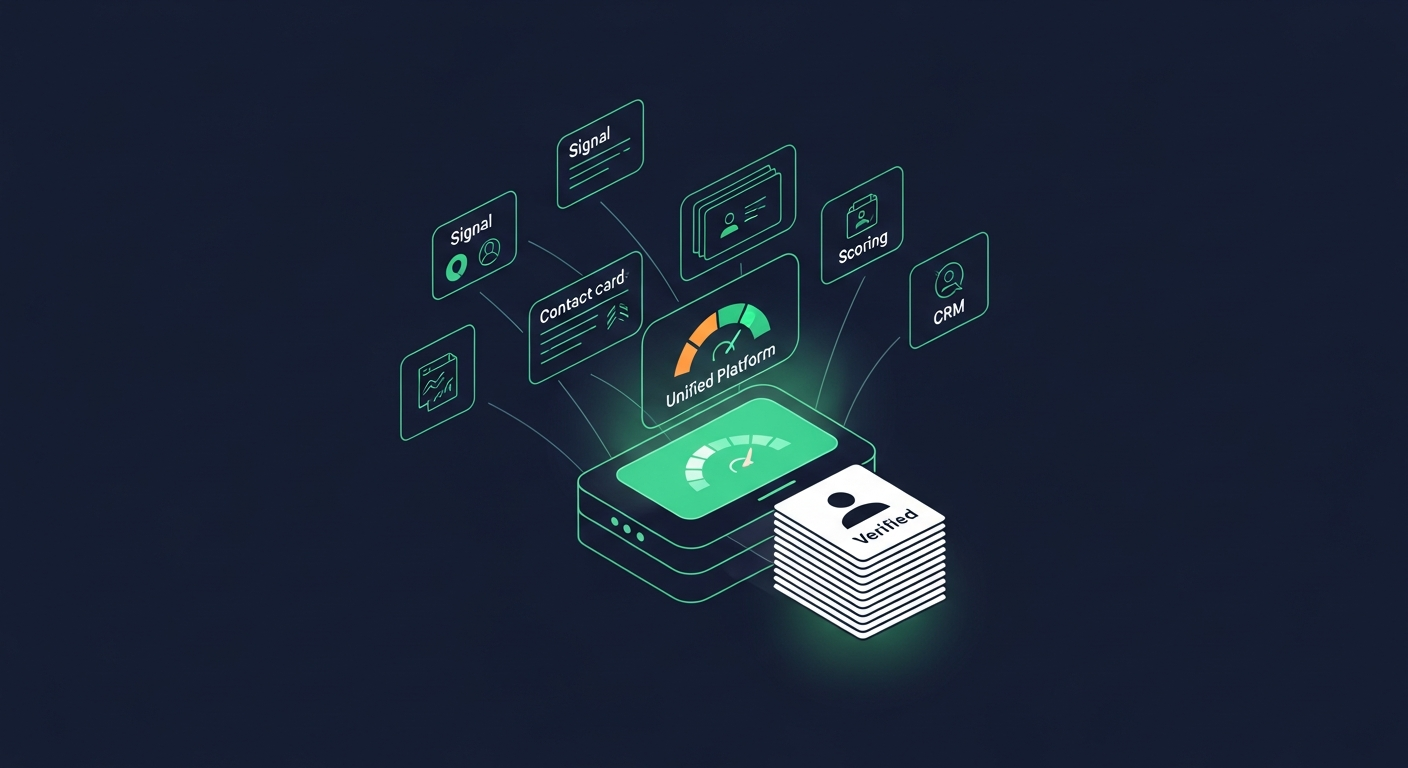
A buyer intent leads platform is one system for signals, contacts, scoring, and delivery — not a stack you stitch together
A buyer intent leads platform is a single, consolidated system that unifies buyer-intent signals, verified contact data, scoring and prioritization, delivery, and workflow integration — so the output is an action-ready lead a rep can work today, not raw material you still have to assemble. The word that matters is platform: not a signal feed you pair with a separate contact database and a scoring spreadsheet, but one connected pipeline that takes a signal from raw observation all the way to a routed task with the "why now" and a verified contact already attached. Once you see buyer intent leads as a platform problem rather than a data-shopping problem, the buying decision changes — you stop stitching point tools together and start evaluating how cleanly one system does the whole job. This guide defines the category, explains why the stitched stack fails, lists what a real platform consolidates, and gives you a buyer's checklist. For the narrower question of what the underlying tool does, pair this with our buyer intent leads software guide.
What a Buyer Intent Leads Platform Is
A buyer intent leads platform is defined by a single job: turning scattered buying signals into prioritized, contactable, routed leads — end to end, in one system. That's the distinction worth holding onto. A feed gives you signals. A list gives you contacts. A platform gives you the pipeline between them: it detects the signal, resolves and verifies the person it points to, scores it against a baseline, filters it through your ICP, and delivers it where reps work — with the evidence intact.
This is also where "platform" diverges from the broader intent data platform category. An intent data platform is the system of record for signals of every kind. A buyer intent leads platform is narrower and more concrete: its unit of delivery is a lead — a specific buyer, a specific trigger, and a verified way to reach them — not an account-level surge score you still have to work into a contactable opportunity.
Why the Stitched Stack Fails
Most teams don't decide to buy a platform. They back into a stack: a topic-surge feed here, a contact database there, a scoring rule in the CRM, an alert rule in Slack. On paper it covers the same capabilities. In practice, the seams between those tools are where leads die.
- Nobody owns the handoff. The feed says an account is surging; the database returns twelve contacts; nothing decides which buyer the signal actually implicates. The rep gets a surge and a list, not a lead.
- Freshness leaks at every seam. A signal that was fresh in the feed is a week old by the time it's matched to a contact, deduped, and routed. Each manual handoff adds latency, and buyer intent decays fast.
- You pay for the same account twice. Without one system deduping across sources, the topic feed and the contact database both bill you for the account your CRM already owns.
- The evidence gets stripped. By the time a "hot" lead reaches a rep, the reason it was flagged is a colored label three tools upstream — so reps stop trusting it.
A platform earns its name by owning those handoffs internally. The point isn't more features; it's that detection, resolution, scoring, and routing happen in one pass, so nothing decays or gets lost between vendors.
What a Buyer Intent Leads Platform Consolidates
Strip away the branding and a real platform consolidates six things that teams otherwise buy — and integrate — separately. The gap between an action-ready lead and an expensive list usually shows up in how transparently each of these works.
- Signal breadth. The platform ingests buyer-intent signals — third-party topic-research surges, first-party activity on your own properties, and discrete public events like hires, funding rounds, and job postings. The breadth and freshness of this layer set the ceiling for everything downstream; the mechanics are covered in how intent data is collected and scored.
- Contact verification. A signal is useless if it can't be tied to a contactable, role-relevant buyer with a live email and direct dial. This is the step that turns intent into a lead — and the one a stitched stack handles worst, because the feed and the database never actually meet.
- Scoring and prioritization. Raw signals are noise until they're scored against a baseline — what's normal for this account — so a genuine surge is separated from a large company's constant background hum. A platform documents its model instead of shipping an opaque label.
- Delivery and routing. The output has to land where reps work — your CRM, sequencing tools, and Slack — with deduplication so you don't route an account two teams already own, and alerting that turns a fresh signal into a task in hours, not a stale row in a weekly export.
- Integrations. A platform is only as useful as its connection to the systems you already run. Native CRM, MAP, and ABM sync — bidirectional, with field mapping and dedupe — is the difference between a platform and another data island.
- Evidence and auditability. Every lead should carry the source behind it, so a rep can click through to the underlying event rather than trusting a score. Auditability is what keeps reps working the leads instead of quietly ignoring them.
If a system is strong on breadth but a black box on scoring, or great at scoring but never resolves a verified contact, you've bought a feed with a dashboard — not a platform. Evaluate all six together.
Platform vs. Point Tools
The honest comparison isn't platform-versus-platform; it's one consolidated system versus the DIY stack most teams already run.
| Dimension | Stitched point tools | Buyer intent leads platform |
|---|---|---|
| Unit of delivery | A surge score plus a separate contact list | A verified buyer + trigger, ready to work |
| Freshness | Decays at every manual handoff | Preserved end to end in one pass |
| Deduplication | Per-tool; you pay twice for the same account | One dedupe across signals, contacts, and CRM |
| Evidence | Lost between vendors | Source-backed on every lead |
| Ownership | Nobody owns the seams | One system owns detection → routing |
| Total cost | Several subscriptions + integration labor | One line item, incentives aligned to output |
The stitched stack can match a platform's capability checklist and still lose on every row that matters, because the value is in the handoffs, not the features. That said, a platform doesn't have to be your only source — many teams pair one for prioritized, verified leads with a transparent topic-surge feed for top-of-funnel breadth.
How to Evaluate a Buyer Intent Leads Platform: A Checklist
Run every platform through the same scorecard so you're comparing like for like rather than reacting to demo theater:
- What you actually receive. A score, a contact, or an action-ready lead with both attached? Be explicit — the unit of delivery changes everything downstream.
- Signal breadth and sourcing. Can they name the signal and contact sources and show how much of the feed is owned versus licensed?
- Baseline + scoring method. Is the calibration documented, or a black box you take on faith? Without a baseline, every large account looks like it's surging.
- Contact verification. How and how often are emails and direct dials verified, and what bounce rate is guaranteed?
- Evidence and auditability. Can a rep click through to the event behind a signal, or do they only get a colored label?
- Freshness SLA. Observation-to-delivery measured in hours, not "weekly" — target under 72 hours, because buyer intent decays fast.
- ICP filtering. Can you constrain leads to your firmographics and exclude unfit accounts before they ever reach a rep's queue?
- Native integrations. Does it sync bidirectionally with your CRM, MAP, and ABM platform, with dedupe and field mapping — or just export a CSV?
- Compliance posture. How are GDPR/UK GDPR and CCPA data-subject requests handled at both account and individual levels?
- Pricing unit. Per verified lead, per account watched, or per booked meeting — and does that unit align the vendor's incentives with yours?
- Proof. A 30-day pilot scoped to your top 200 accounts, with a control group, beats any architecture diagram.
Work the checklist top to bottom and the field narrows fast: most systems fail on verification, evidence, or freshness long before pricing becomes the deciding factor. For how to weight different triggers once they land, see how to prioritize buying signals for outbound.
Where Lead Seeker Fits
Lead Seeker is a public-signal buyer intent leads platform: it's built on observable events — hires, funding rounds, job postings, leadership and tech-stack changes — rather than an opaque topic-surge index extrapolated from panels, and it consolidates detection, verification, scoring, and routing so each lead arrives action-ready rather than as a raw score. Every signal in a Prospect Dossier is source-backed, so a rep can click straight through to the underlying evidence instead of trusting a label. That consolidation changes the economics in three ways:
- Lower false positives. A funding announcement or a posted role is a discrete, verifiable event — it either happened or it didn't.
- Defensible freshness. Public events carry their own timestamps, and because everything happens in one pass, recency isn't lost between tools.
- Trust at the desk. Reps act on leads they can verify; black-box scores get ignored the first time a "hot" account turns out cold.
The Trigger Signals layer surfaces those events, Lead Compass maps them to your ICP, and the result arrives as a dossier with verified contacts attached — the whole pipeline in one system rather than four subscriptions you integrate yourself. We're not claiming public signals replace every source; broad topic-surge breadth still has a place at the very top of the funnel. See how the approach stacks up on our prospect intelligence platform comparison, or browse more intent data insights for the wider picture.
How to Adopt a Buyer Intent Leads Platform
You don't need the most expensive platform to get the best result. Work through this order before signing anything:
- Wire up first-party intent first. Resolve and route the buying signals already happening on your pricing and docs pages. Highest ROI, mostly free, no vendor required.
- Consolidate onto public-signal triggers with verified contacts. Hires, funding, and job postings are public, fresh, and verifiable — a strong, low-noise core of action-ready leads in one system.
- Add a topic-surge feed for breadth only when you need it. When you genuinely need top-of-funnel volume, layer a transparent source — and treat its records as raw material to be corroborated, not finished leads.
- Retire the seams as the platform proves out. Every handoff you can move inside one system is latency and duplicate spend you stop paying.
Most B2B teams get the majority of their value from steps one and two, so any paid breadth becomes additive rather than a crutch. If budget is the constraint, our guide to affordable B2B intent leads walks through getting intent-backed leads without overpaying. Whatever you pick, insist on a control-group pilot and measure meetings booked over 90 days. You can model the economics against our transparent monthly pricing before you commit, and once a platform is in place, see B2B intent leads for sales teams for how to turn that feed into a worklist your reps actually work.
Frequently Asked Questions
What is a buyer intent leads platform?
A buyer intent leads platform is a single, consolidated system that detects buyer-intent signals, scores them against an account's baseline, resolves and verifies the contactable buyer they point to, and delivers the result as an action-ready lead in your CRM and sales workflow. The defining difference from a raw intent feed or a contact database is that one system owns the whole pipeline — so instead of a surge score and a separate list, a rep receives a specific buyer, the discrete event that makes outreach relevant, and a verified way to reach them, ready to work today.
How is a buyer intent leads platform different from buyer intent leads software?
They describe the same category from two angles. "Software" asks which capabilities does the tool perform — detection, scoring, resolution, delivery. "Platform" asks how cleanly those capabilities compose into one system you can run, trust, and connect to everything else you own. Two products can tick the same capability checklist and still be very different platforms: the value is in how the layers hand off to each other, how much of the stack you can audit, and whether the whole pipeline runs in one pass rather than across several stitched-together tools.
What should a buyer intent leads platform include?
A real platform consolidates six things teams otherwise buy separately: signal breadth (third-party surges, first-party activity, and public events), contact verification (live emails and direct dials), scoring against a documented baseline, delivery and routing into your CRM with deduplication and alerting, native bidirectional integrations with your CRM/MAP/ABM stack, and evidence or auditability so a rep can click through to the event behind every lead. If any of those is missing, you've bought a feed with a dashboard rather than a platform.
Do I need a platform or can I stitch point tools together?
You can stitch a topic-surge feed, a contact database, a scoring rule, and an alert rule together, and on paper it covers the same capabilities. In practice the seams are where leads die: nobody owns the handoff from signal to contact, freshness leaks at every manual step, you pay twice for the same account across tools, and the evidence gets stripped before it reaches a rep. A platform earns its cost by owning those handoffs internally — the value is in the integration, not the individual features — though many teams still pair a platform with a transparent breadth feed at the top of the funnel.
How much does a buyer intent leads platform cost?
Pricing varies widely and the unit shapes vendor behavior: per-account- watched pricing aligns the vendor's incentive with your focus, per-verified- lead pricing ties cost to usable output, and per-booked-meeting pricing can reward meetings that should never have happened. Compare a platform's total cost against the stitched stack it replaces — several subscriptions plus the integration labor to keep them in sync — not just its list price. Then model it against a control-group pilot measuring meetings booked over 90 days; if the intent-prioritized cohort doesn't show a material lift over a matched control, the platform isn't earning its cost.
How is Lead Seeker different from other buyer intent leads platforms?
Lead Seeker is a public-signal buyer intent leads platform built on observable events — hires, funding, job postings, and tech-stack changes — that are discrete, timestamped, and source-backed, with a verified contact attached so each lead is action-ready. Compared with a black-box topic-surge index extrapolated from panels or a static contact list with a thin intent overlay, that lowers false positives and earns rep trust, and it consolidates detection, verification, scoring, and routing in one pass rather than leaving you to integrate point tools yourself.
Sources
- Gartner — The B2B Buying Journey: https://www.gartner.com/en/sales/insights/b2b-buying-journey
- GDPR.eu — What is GDPR, the EU's data protection law: https://gdpr.eu/what-is-gdpr/
- U.S. Federal Trade Commission — Privacy and Security guidance: https://www.ftc.gov/business-guidance/privacy-security
- California Attorney General — California Consumer Privacy Act (CCPA): https://oag.ca.gov/privacy/ccpa
Next Steps
The fastest way to tell a genuine buyer intent leads platform from a stitched stack is to look at the evidence behind a single lead. See how source-backed events and a verified contact appear in a Prospect Dossier, then revisit the buyer intent leads software guide for the capability lens, or compare the underlying categories in our intent data platforms overview. When you're ready to scope an evaluation, talk to sales and we'll help you design a control-group pilot on your own accounts.