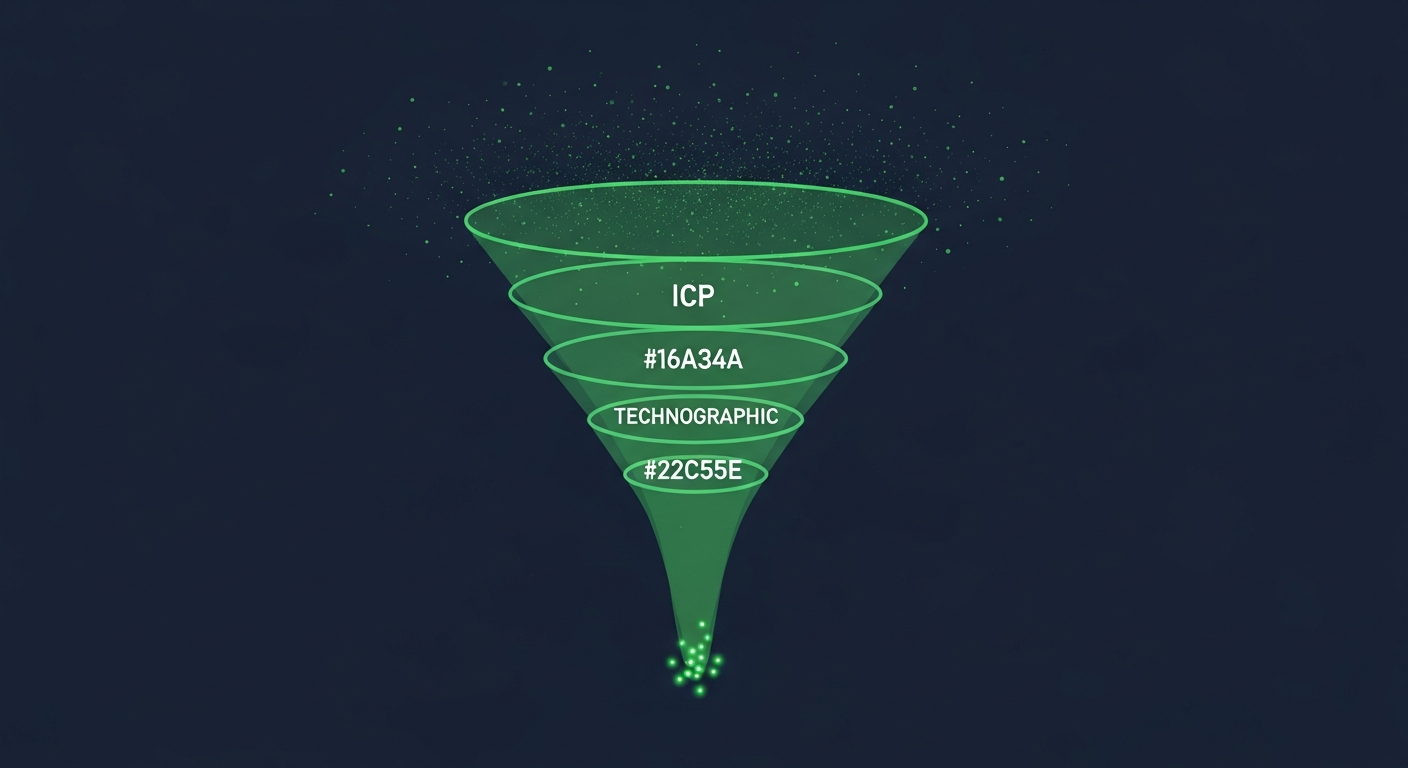
The way to combine intent data with your ICP, firmographic, and technographic filters is to apply them as an ordered funnel, not a flat AND query. Define the ICP slice first, narrow it with firmographic and technographic fit, and only then score intent signal clusters inside that surviving slice. Intent is the last filter, never the first — because intent applied to the whole market surfaces in-market accounts you would never sell to, and that noise is exactly what trains reps to ignore the feed.
Combining the Filters: The Short Answer
- Order matters more than the filters themselves. ICP → firmographic → technographic → intent. Run intent first and you re-introduce the noise the other three exist to remove.
- Fit filters are durable; intent is perishable. ICP, firmographic, and technographic fit barely change month to month. Intent decays in days. Cache the fit slice and re-score intent against it on a fast cadence.
- Score clusters, not single signals. One intent surge inside your fit slice is a maybe; a surge plus a hire plus a tech change at the same account is a working priority.
- The output is a shortlist, not a dashboard. Each surviving cluster becomes one runnable, search-ready prompt a rep can act on without re-deriving the filters.
- Measure noise, not coverage. Track the share of surfaced accounts a rep actually works. If it is under half, a filter upstream of intent is too loose.
Why "Intent First" Is the Mistake Most Teams Make
The default failure mode is to buy an intent feed, point it at a topic, and hand reps whatever surges. It feels like signal — accounts are "in-market" — but it ignores that in-market for a topic is not the same as a fit for you. A 40-person agency researching "data enrichment" is in-market; if you sell a six-figure platform to the enterprise, that surge is pure noise.
Intent answers when. It does not answer who. Fit filters — ICP, firmographic, technographic — answer who, and they have to run first because they are the cheap, stable filters that shrink the universe before you spend scoring effort (and credits) on it. Intent is the expensive, perishable filter you apply last, to the small surviving set, to decide order of attack.
If your intent feed regularly surfaces the wrong segment, the wrong company size, or accounts running the wrong stack, the problem is almost never the intent vendor. It is that intent is doing the filtering that ICP and firmographics should have done first. For the groundwork on encoding that fit definition, see ICP-aware market signal discovery.
Step 1 — Define the ICP Slice First
The ICP is the outermost filter and the one most teams leave implicit. Encode it once, explicitly, so every later filter narrows a known universe instead of the whole web:
- Segment and vertical. Which industries you win in, stated as codes (NAICS/SIC) or named verticals, not a vibe.
- Size band. Revenue and headcount ranges where your pricing and value proposition actually land.
- Geography. The regions you can sell, support, and legally market into.
- Buying-committee shape. The roles that own the problem — this drives who you contact later, and it filters out accounts structured in a way you can't sell to.
The ICP slice is the denominator for everything downstream. If it is loose, no amount of intent scoring rescues the list — you are just ranking the wrong accounts more precisely.
Step 2 — Narrow With Firmographic and Technographic Fit
Inside the ICP slice, apply the two fit layers that confirm an account is workable, not just plausible:
- Firmographic fit sharpens the ICP with company-level facts: exact revenue and headcount (not just the band), funding stage, corporate hierarchy (so a parent and its 40 subsidiaries resolve to one account, not 40), and location specifics. This is where a broad ICP becomes a concrete account set.
- Technographic fit confirms the account runs a stack your product fits — a competitor you displace, a complementary tool you integrate with, or the absence of a capability you provide. Tech-stack signals are a qualification layer, not an intent layer: they tell you the account can buy, not that it will. For a worked example of how a single accounting-software technographic segment is built and verified, see that guide.
Depth and accuracy of these two layers come from different data pipelines, so verify them separately against accounts you know cold. The mechanics — and why no single vendor is deepest at both — are covered in data enrichment platforms: firmographic and technographic depth and, for the detection methods and their blind spots, technographic data for B2B targeting.
After Steps 1 and 2 you have a fit slice: the set of accounts that match who you sell to and can actually buy. It changes slowly, which is exactly why you compute it once and cache it.
Step 3 — Score Intent Signal Clusters Inside the Slice
Only now does intent enter — and only against the fit slice, never the open market. Two rules keep this layer honest:
- Score clusters, not single events. A single topic surge or a lone job posting is noise. A cluster — two or more independent signals at the same account inside a short window (a topic surge plus a relevant hire plus a tech change) — is what justifies a rep's attention. Clusters are rarer and far higher-precision than raw surges.
- Weight signal types by how well they predict your sale. Not all intent is equal: a posted role that names your category usually beats an anonymous third-party topic surge. Rank the signals that have historically preceded your closed-won deals highest. The prioritization framework in how to prioritize buying signals for outbound walks through scoring signals by reliability and recency.
Because intent decays — most signals are stale within two to three weeks — you re-score this layer on a fast cadence (weekly, with on-demand re-runs) while the fit slice underneath stays cached. Fast filter on top, slow filter underneath.
Step 4 — Turn Each Surviving Cluster Into a Runnable Shortlist
A filtered list a rep still has to interpret is one step short of useful. The unit of action is a search-ready prompt: one or two sentences a rep can run to pull a fresh, signal-aware contact list, with the fit filters already baked in. For example:
"VP RevOps and Director of Sales Ops at US mid-market logistics companies (200–1,000 employees) running a legacy TMS, that posted a RevOps or sales-ops role in the last 30 days."
Every clause in that prompt traces back to a filter: the roles come from the ICP's buying-committee shape, the size and geography from the ICP and firmographics, the legacy-TMS clause from technographic fit, and the recent-role-posting clause from the intent cluster. The rep runs it and gets a shortlist of in-market, well-fit accounts — without re-deriving any of the filtering themselves.
Once the order is right, the next job is turning that surviving slice into a finite, maintained deliverable — a list where every row is fit, fresh, and reachable, and stale rows expire on a clock. For that build-and-refresh workflow, see how to build a prospecting list that combines ICP fit with verified intent signals.
Comparison: how the filter order changes what reps see
| Approach | Filter order | What reps see | Noise level |
|---|---|---|---|
| Intent-first feed | Intent → (maybe) ICP | In-market accounts of every size & segment | High |
| Flat AND query | All four at once, unweighted | Brittle list; one missing field drops fits | Medium |
| Fit slice, no intent | ICP → firmographic → technographic | Right accounts, no timing | Low but cold |
| Layered funnel (recommended) | ICP → firmographic → technographic → intent clusters | In-market accounts that fit and can buy | Lowest |
How to Tell Your Layering Is Actually Working
Before you push the combined feed into reps' workflows, pressure-test it:
- Track work-rate, not volume. The honest metric is the share of surfaced accounts a rep actually contacts. Under ~50% means a filter upstream of intent is too loose.
- Backtest a quarter. Pull the clusters the system would have surfaced 90 days ago against today's fit slice and ask whether your team would have worked them. "We'd have skipped most" means the ICP or fit layer is decorative.
- Audit dropped accounts. Periodically read the accounts the fit filters removed despite strong intent. If reps would have wanted some of them, your ICP is too tight — tune it deliberately, don't let intent quietly override it.
- Keep fit and intent on separate refresh clocks. If your system re-computes the whole stack every time intent updates, you are burning compute and credits re-deriving filters that didn't change.
- Cap clusters per rep. Five to seven worked clusters a week beats twenty surfaced. Capacity is the binding constraint; the layering exists to spend it on the highest-fit, best-timed accounts.
Frequently Asked Questions
Should I apply intent data before or after my ICP filter?
After. Always run ICP, firmographic, and technographic fit first, then score intent against the surviving slice. Intent answers when an account is active; it does not answer whether the account fits you. Applied to the open market, intent surfaces in-market accounts of every size and segment — including ones you would never sell to — which is the exact noise the fit filters exist to remove.
What is the right order to combine the four filters?
ICP first (segment, size band, geography, buying-committee shape), then firmographic fit (exact revenue, headcount, hierarchy, funding), then technographic fit (the stack the account runs), and finally intent signal clusters scored only inside that surviving fit slice. The fit filters are stable and cheap, so they shrink the universe first; intent is perishable and expensive, so it runs last on the smallest set.
Why does combining intent with ICP filters reduce noise?
Because most intent "noise" is really fit noise — accounts that are genuinely researching a topic but are the wrong size, segment, or stack for you. Filtering by ICP, firmographic, and technographic fit before scoring intent removes those accounts up front, so the intent layer only ranks accounts that could realistically buy. Reps stop seeing in-market-but-irrelevant accounts and stop ignoring the feed.
What is a signal cluster and why score clusters instead of single signals?
A signal cluster is two or more independent signals — a topic surge, a relevant hire, a tech-stack change, a funding round — at the same account inside a short window. A single signal is usually noise; a cluster is rarer and far more predictive because multiple independent signals pointing the same direction are unlikely to all be false. Scoring clusters inside your fit slice gives you a high-precision priority list instead of a long, low-confidence one.
How often should I refresh intent versus fit filters?
On different clocks. Firmographic and technographic fit change slowly, so compute the fit slice and cache it — monthly to quarterly is fine. Intent decays within two to three weeks, so re-score it weekly against the cached slice, with on-demand re-runs when themes change. Running the whole stack every time intent updates wastes compute and credits re-deriving filters that didn't move.
Can technographic data act as an intent signal?
Not on its own. Technographic data is a fit/qualification layer — it tells you the account runs a stack your product fits, which means it can buy, not that it will. A technographic change (ripping out a competitor, adding a complementary tool) can become an intent signal because it is timestamped and directional. Static install data filters; install changes signal. Keep the two roles distinct when you layer them.
What metric tells me my filter stack is too loose?
Work-rate: the share of surfaced accounts a rep actually contacts. If reps work fewer than roughly half of the accounts the system surfaces, a filter upstream of intent is too permissive — usually the ICP or firmographic layer. Tightening the fit filters raises work-rate far more reliably than tuning the intent score, because the dropped accounts were fit failures, not timing failures.
References
- U.S. Census Bureau, North American Industry Classification System (NAICS): https://www.census.gov/naics/
- Gartner, B2B Buying Journey research: https://www.gartner.com/en/sales/insights/b2b-buying-journey
- Forrester, B2B Marketing & Sales research: https://www.forrester.com/research/
- European Commission, General Data Protection Regulation: https://commission.europa.eu/law/law-topic/data-protection_en
- ICO (UK), Direct marketing guidance: https://ico.org.uk/for-organisations/direct-marketing-and-privacy-and-electronic-communications/
Next Steps
If you would rather not build and maintain a four-layer filter stack in-house, see how Lead Seeker layers ICP, firmographic, and technographic fit with live intent signals so the accounts your reps work are both well-matched and well-timed — and pull a free batch of verified, in-market prospects to check the quality before you commit.