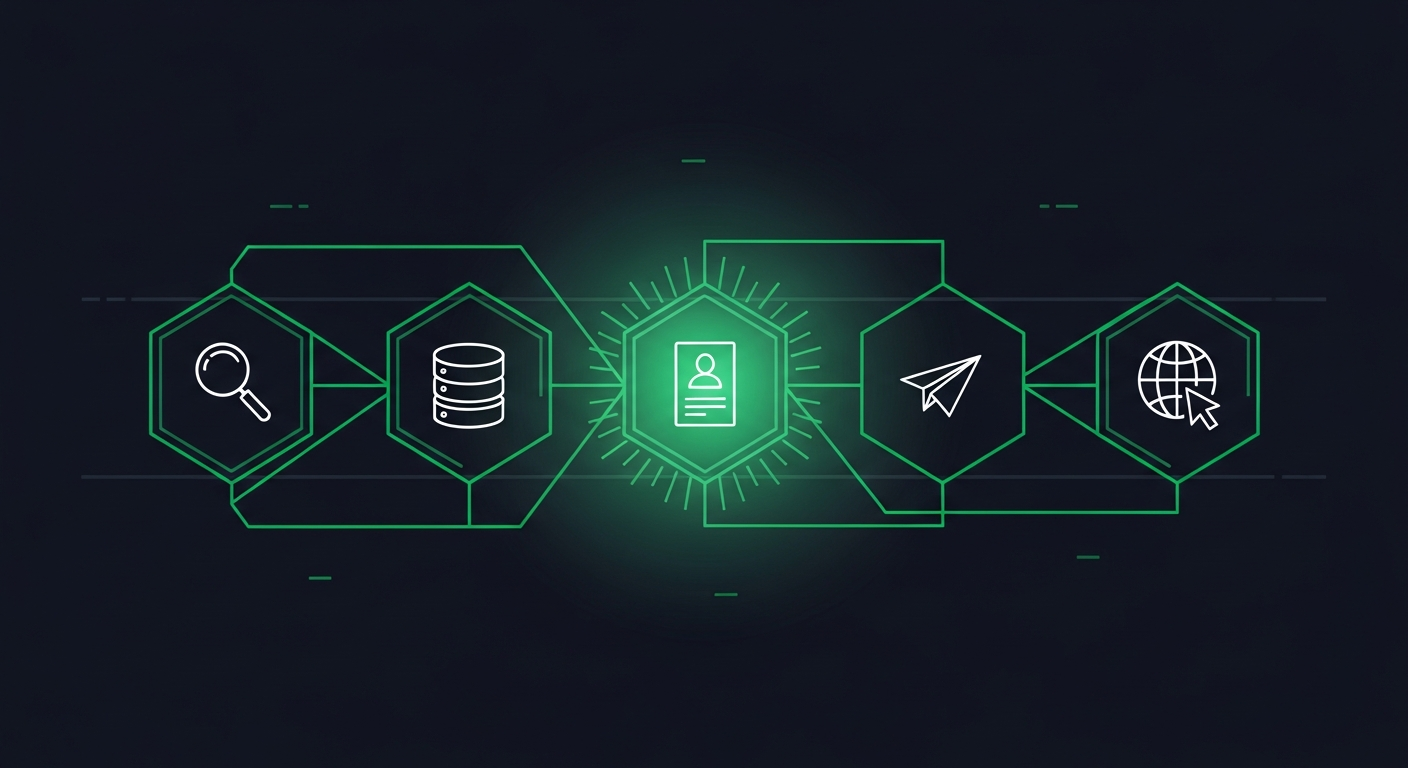
Lead generation tools for B2B companies are not a single product — they are a stack of five jobs wired together: prospecting and intent, enrichment, CRM, outreach, and web capture. The teams that win don't buy the longest feature list; they assemble a small set of best-of-breed tools around one source of fresh, verified data and judge every layer on workable dossiers per dollar.
Lead Generation Tools for B2B Companies: The Short Answer
- Prospecting + intent is the layer to get right first — bad data poisons every tool downstream of it.
- Enrichment, CRM, outreach, and capture are the other four jobs; most B2B companies need one tool per job, not three.
- Buy best-of-breed and wire it together, unless you have a RevOps team that genuinely needs a single bundled suite.
- Never evaluate on database size or demo polish — score on data freshness, signal latency, and clean CRM sync.
Common Misconceptions About B2B Lead Generation Tools
B2B revenue teams burn budget on the same four assumptions every year:
- "One platform can do all five jobs well." Bundled suites almost always have one strong capability and four mediocre satellites. A pointed best-of-breed combination beats a one-throat-to-choke purchase on workable-dossier economics far more often than vendors admit.
- "More tools means more pipeline." Past a point, the opposite is true. Every extra tool adds a login, a sync, a field map, and a silent failure mode. Five well-wired tools out-produce eleven badly integrated ones.
- "Intent data tells us who is ready to buy." Most intent feeds tell you who researched a topic, not who is in-market with budget. Intent is one input to account ranking — never the queue ranker by itself.
- "AI tooling makes the data layer less important." The reverse. An LLM amplifies whatever it is pointed at; a wrong title or a stale company turns into a confidently wrong cold email at scale. The AI lead generation guide walks through where AI actually helps in a B2B motion — and where it just multiplies bad data.
The Five Jobs in a B2B Lead Generation Stack
Almost every effective B2B stack is the same five jobs, regardless of the logos on the contract. Map your tools to these jobs first; if any job has two tools or none, that is where your pipeline leaks.
1. Prospecting & intent data
This is the engine. It finds accounts and contacts that match your ICP by firmographics, technographics, and hiring patterns, then layers on buying signals — job changes, new hires, posted roles, funding, tech-stack changes, earnings mentions — so reps know why now. For a B2B company, this layer must do account-level and contact-level work, because B2B buying is a committee, not a person. See the deeper lead prospecting tools breakdown for how to score this category, and the B2B lead generation software buyer's guide for the full capability checklist.
2. Enrichment & verification
Discovery without verification is a deliverability problem waiting to happen. The enrichment layer fills missing fields and — critically for B2B — confirms the email and direct dial are valid for the person in the role today, not when the record was first scraped. Re-verification cadence matters more than database size: a 10M-record index re-verified monthly beats a 200M-record one with 18-month-old emails. If you'd rather buy this layer as a finished deliverable, the B2B contact list building service buyer's guide covers done-for-you vs. self-serve options for verified contact lists.
3. CRM (the system of record)
The CRM is where every relationship lives once a rep touches it. For B2B, the non-negotiable is two-way sync that respects ownership rules, skips duplicates instead of overwriting human edits, and can be scoped to A-tier accounts rather than firing all-or-nothing. The CRM is not a lead source — it is the record of relationships you already have.
4. Outreach & sequencing
The sales engagement platform runs multi-channel cadences — email, phone, LinkedIn — and tracks replies and deliverability. It assumes you bring clean, verified contacts; it does not source them. In B2B, the sequencer is where personalization at scale lives, which is exactly why the data feeding it has to be right.
5. Web capture & conversion
The last job turns the traffic your marketing already earns into contact records: forms, chat, and visitor de-anonymization that ties known accounts to anonymous sessions. It is the highest-intent layer in the stack because the prospect raised their hand — but it only captures people already on your site, so it complements outbound rather than replacing it.
How to Evaluate Each Tool for a B2B Company
B2B buying is higher-stakes and longer-cycle than SMB, so the evaluation bar is different. Walk every shortlisted tool through these five questions before a demo becomes a contract.
Data sourcing & freshness
- Where does the data originate, and what is the median age of an email in the index?
- On what cadence are records re-verified, and what evidence triggers re-verification?
- Is the "valid" mailbox separated from the "catch-all" before reps send?
Signal coverage & latency
- Which signals are first-class versus merely passed through from a third party?
- What is the median signal-to-alert latency? Anything over 72 hours is too slow for outbound.
- Are signals deduped per account before they reach a rep's inbox or Slack?
CRM & integration depth
- Does the connector respect ownership and skip duplicates, or does it overwrite?
- Are sync errors surfaced where a RevOps owner can see them, not buried in a vendor admin panel?
- Are the integrations native, or Zapier-only? Zapier-only connectors break quietly and cost more at B2B volume.
Compliance & deliverability
- How are GDPR / UK GDPR data-subject requests handled at the individual level, and how fast do deletions propagate downstream?
- Is there a documented bounce rate with a contractual SLA for a clean run on this dataset?
Total cost per workable dossier
- Take total annual spend — seats, data, add-ons — and divide by the number of dossiers a rep actually contacts. That number, not the seat price, is the honest unit. Compare it against your current sourcing cost per qualified meeting.
A tool that scores well on three of these and "we'll get back to you" on the other two is a tool you will outgrow inside a year. Score each group 0–3 and add them up; anything under 10 is a no-go.
A Two-Week Test, Not a Two-Quarter Pilot
You do not need a six-month committee evaluation to surface the tools that will fail you. Three artifacts produce most of the signal:
- The 25-record verification audit. Pull 25 representative contacts per shortlisted vendor in your exact ICP. Verify the email and direct dial yourself. This one accuracy number disqualifies most vendors before pricing matters.
- The sandbox CRM sync. Load 100 records into a CRM sandbox via the vendor's connector and watch how dedupe, ownership, and field-conflict resolution behave. A broken sandbox sync is a broken pilot.
- The price-per-workable-dossier calculation. Compute total trial spend divided by dossiers your reps actually contacted. If it isn't materially better than your current cost per qualified meeting, the spend is a status purchase.
If a vendor refuses any of the three, treat it as a disqualifier rather than a negotiation point.
Common Mistakes B2B Companies Make Buying Lead Gen Tools
- Buying the suite before the data. Teams sign a bundled platform for the workflow features and inherit a weak data core. Buy the fresh-data and signals layer first; everything downstream depends on it.
- Letting tools overlap. Two tools claiming the same job — say, two "enrichment" sources — means you pay twice and argue about the source of truth. One tool per job.
- Treating intent as a buy signal. Account-level topic surges are an input to ranking, not proof of in-market budget. Combine intent with firmographic and ICP fit before it touches a rep's queue.
- Skipping the CRM-sync trial. Demos look clean; production syncs break on legacy custom fields, ownership rules, and dupes the vendor never imagined. Always run the sandbox sync.
- Fire-hosing reps with alerts. A platform that pings Slack on every signal gets muted in a week. Insist on per-account dedupe and ICP-aware ranking before signals reach reps.
- Buying per-seat without measuring per-dossier. Two cheap seats can cost more than one expensive seat depending on how many dossiers each rep actually works. Always normalize to the workable-dossier unit.
Frequently Asked Questions
What lead generation tools do B2B companies actually need?
Most B2B companies need one tool for each of five jobs: prospecting and intent data, enrichment and verification, a CRM as the system of record, a sales engagement platform for outreach, and web capture for inbound traffic. The data layer — prospecting plus enrichment — is the one to get right first, because every other tool consumes its output.
Should B2B companies buy an all-in-one platform or best-of-breed tools?
Best-of-breed wins for most teams. Bundled suites usually have one strong capability and several weaker satellites, so a pointed combination of specialist tools outperforms them on workable-dossier economics. An all-in-one suite only makes sense when you have a RevOps team that needs centralized administration more than peak capability in each layer.
How much should a B2B company spend on lead generation tools?
The honest unit is not seat price — it is price per workable dossier. Add up total annual spend across the stack (seats, data, add-ons), divide by the number of dossiers your reps actually contact, and compare that against your current sourcing cost per qualified meeting. A stack that lands materially below that benchmark pays for itself; one above it is a status purchase.
Is intent data worth it for B2B lead generation?
Yes, as an input — not as a verdict. Most intent feeds tell you which accounts researched a topic, which is a useful ranking signal when combined with firmographic and ICP fit. It becomes a liability when teams treat a topic surge as proof that an account is in-market and let it rank the outbound queue on its own.
How do B2B companies evaluate lead generation tools without a long pilot?
Three artifacts in two weeks produce most of the signal: a 25-record verification audit on your real ICP, a sandbox CRM sync that exercises dedupe and ownership rules, and a price-per-workable-dossier calculation. If a vendor refuses any of the three, treat it as a disqualifier rather than a negotiation point.
Do B2B lead generation tools replace a CRM or a sales engagement platform?
No. Lead generation tools are the data, signals, and dossier layer. The CRM is the system of record for relationships you already have, and the sales engagement platform runs the multi-channel cadences. Most B2B teams run all three and let the data tool feed clean, deduped, field-mapped contacts into the CRM and the sequencer.
Which lead generation tool features are overrated for B2B?
Database size, AI-generated cold-email copy, and browser extensions top the list. Each looks impressive in a demo and rarely correlates with booked meetings. Verification recency, signal-to-alert latency, and CRM sync quality are the features that actually move B2B pipeline.
References
- US Federal Trade Commission, CAN-SPAM Act compliance guide: https://www.ftc.gov/business-guidance/resources/can-spam-act-compliance-guide-business
- ICO (UK), Direct marketing guidance: https://ico.org.uk/for-organisations/direct-marketing-and-privacy-and-electronic-communications/
- European Commission, General Data Protection Regulation: https://commission.europa.eu/law/law-topic/data-protection_en
- Gartner, Sales technology research: https://www.gartner.com/en/sales/insights
Next Steps
If you are assembling or rebuilding a B2B stack and want to pressure- test the data layer first, compare the transparent monthly pricing for Lead Seeker against your current sourcing cost per qualified meeting. The trial is full-featured for 14 days, so you can run the 25-record verification audit and the sandbox CRM sync on your own data before you commit to a single tool.