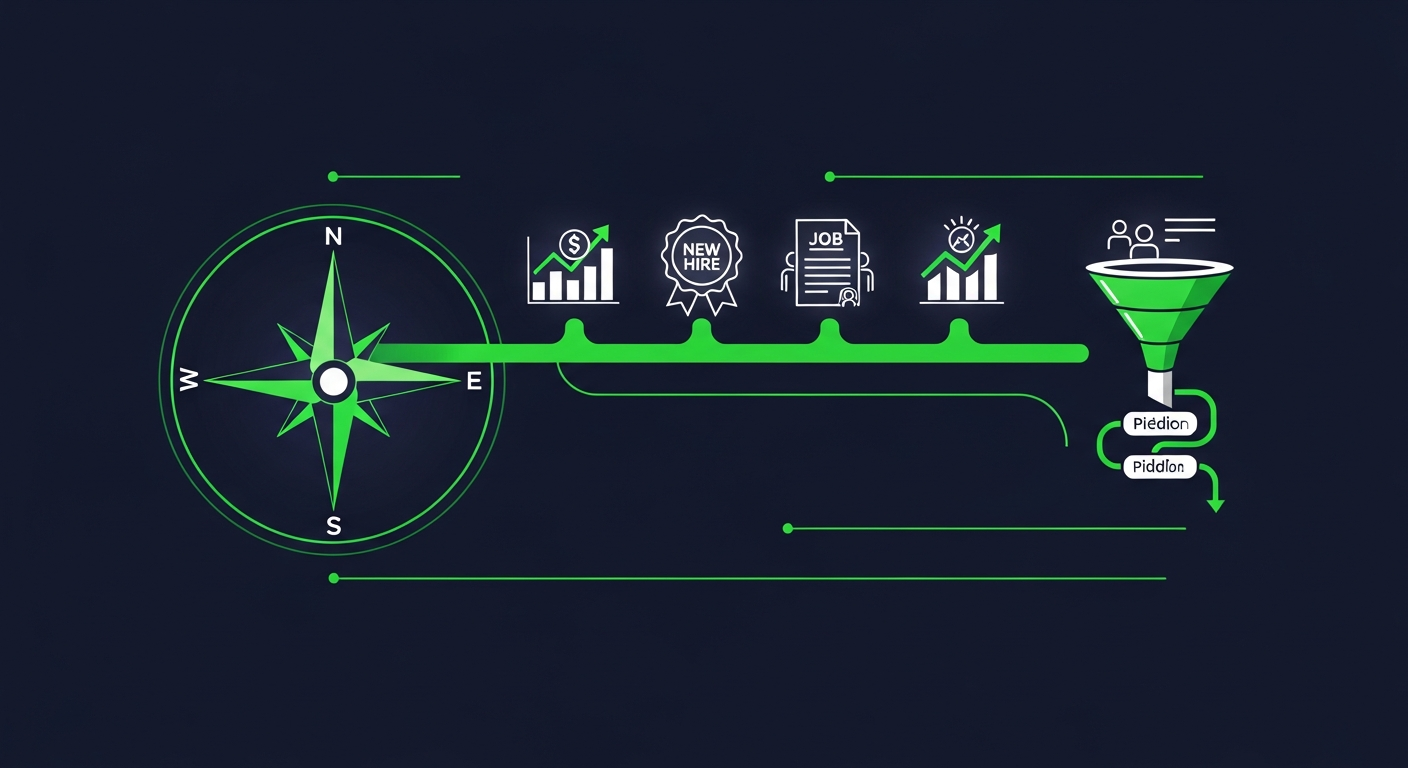
Intent data for sales is the set of buying signals that tells a rep which accounts are moving right now — so the team can spend its limited hours on the companies most likely to buy, instead of blasting a static list and hoping. The promise is simple: stop guessing who to call, and let real behavior and public events point you at the account with a reason to talk today. The reality is that most teams buy a signal feed, watch it light up with "in-market" accounts, and then quietly work the same list the same way as before.
This page is the plain-English overview of intent data for sales: what it actually is when you're the one carrying a number, why it matters, which buying signals to prioritize, how reps act on them, and how a leader proves the whole thing lifted results. It is the starting point — once the concept clicks, the deeper mechanics live in how to use intent data in sales and, at the team level, in how to operationalize intent data for sales.
What Intent Data Means for a Sales Team
Strip away the vendor language and intent data for sales is just evidence that an account is in motion — evidence a rep can act on. It comes in two broad forms, and the difference matters more than any single provider's scoring model:
- First-party signals. Behavior on your own properties — pricing-page visits, a demo request that stalled, repeated docs reads, a trial that went quiet. You already have partial identity and explicit interest, so these are the highest-converting signals a sales team ever sees.
- Third-party and public signals. Evidence gathered off your site — a new hire into a buying role, a funding round, a relevant job posting, a tech-stack change, a research surge on your category. These reveal accounts that aren't on your radar yet but just did something that creates a reason to reach out.
The crucial mindset shift: a signal is a probability, not a purchase order. A surging account is more likely to buy than a random one, but the signal only sets the timing and the opening line — the rep still has to run the conversation. Intent data for sales replaces "who should I call?" with "who has a reason to talk this week, and what is it?"
Why Intent Data Matters for Sales
Rep attention is the scarcest resource on any team. A seller can research and personalize maybe a handful of accounts a day; everything past that collapses into templates. Intent data matters because it decides where that scarce attention goes:
- It ranks a flat list. Without signals, every account in the territory looks equally worth working, so reps default to whoever is alphabetically first or most familiar. Intent data promotes the accounts that just moved.
- It supplies a "why now." A cold account has no natural reason for the call to happen today. A triggering event — a raise, a hire, a launch — gives the rep a real, defensible opener the prospect recognizes.
- It compounds with fit. Intent on an on-ICP account is gold; intent on an off-ICP account is a distraction that produces a customer who churns. Used well, intent sharpens targeting rather than widening it.
The teams that get the most from intent data for sales treat it as a prioritization layer on top of a tight ICP — not as a replacement for targeting, and never as an excuse to email every surging company at once.
The Buying Signals Sales Teams Should Prioritize
Not every signal earns the same response. Rank them by how directly they point at a real, contactable buyer with a reason to talk, and let that ranking decide what gets a touch today versus a place in the queue:
- First-party behavior. A pricing visit or a stalled trial is a near-hand-raise. Work these first and fast — most teams badly under-use their own site signals.
- Discrete buying events. Nameable, verifiable changes — a new RevOps hire, a funding round, a posted role, a tooling migration. They're timestamped, hard to fake, and hand the rep a concrete opener. This is the core of B2B buyer intent for outbound teams.
- Topic and keyword research surges. Third-party evidence that an account is researching your category above its own baseline. Useful for breadth and as a tiebreaker, but weak alone — a lone category surge earns a spot in the queue, not a cold call.
The rule for sales specifically: the higher a signal sits on this list, the more independently it justifies reaching out. Score each account against its own baseline, not absolute volume, or every large company will always look like it's surging.
How Reps Act on Intent Data
A feed of triggered accounts is not a worklist yet. Turning intent data for sales into pipeline comes down to a short, repeatable loop a rep can run every morning:
- Filter to fit first. Fit is a gate, not a tiebreaker. Drop anything off-ICP before you look at signal strength, no matter how hot it looks.
- Score on strength, recency, and reachability. Promote only the accounts that clear all three — a strong, fresh signal on a company where you can reach a verified contact in the buying unit.
- Keep the queue short. Roughly five to eight accounts per rep per day. Above that, reps stop researching each account and fall back on generic templates, throwing away the relevance the signal bought.
- Attach the "why now" to the record. The triggering signal, the verified contact, and the supporting context should travel together, so the rep opens with a defensible reason already in hand.
A source-backed Prospect Dossier is built for exactly this hand-off: the triggering signal, the verified contacts, and the context arrive together instead of getting stripped apart in a CRM export, so the rep never has to reconstruct why the account surfaced.
Timing: Reach Out While the Signal Is Warm
Timing is the multiplier most teams ignore. A triggered account worked within 48 hours converts far better than the same account worked three weeks later, when the signal has cooled and a competitor may already be in the conversation. Two rules keep this honest:
- Match speed to decay. Intent decays at different rates. A role change buys you weeks; a funding event a month or two; a topic surge only days. Set follow-up urgency by the signal type, and measure observation-to-outreach in hours, not by the end of the sprint.
- Match the message to the stage. An early-research account needs a helpful, educational first touch; a late-stage account needs proof and a fast path to a conversation. The same signal handled with the wrong-stage message reads as out of touch.
If you can only fix one thing about how your team uses intent data for sales, fix speed. Slow observation-to-outreach quietly caps every other metric that follows.
Personalize on the "Why Now"
This is where intent data stops being a list and becomes a conversation opener. The single highest-leverage edit to any signal-driven outreach is opening with the triggering event instead of a template — but there is a right and a wrong way to reference a signal:
- Reference the event, never the surveillance. "Congrats on the new VP role" is welcome. "Our data shows you've been researching us" is creepy. Name the underlying, public event the prospect would recognize as real.
- Map the signal to the right person. A funding round points at the economic buyer; a new RevOps hire is the champion; a tooling change points at the practitioner who owns it. Let the signal pick the contact rather than defaulting to the most senior title.
- Templatize the structure, personalize the trigger. Build a small library of trigger-specific frameworks — one for role changes, one for funding, one for tech-stack moves — where the skeleton is reusable but the opening "why now" is unique to the account. That keeps relevance high without writing every email from scratch.
Measuring the Lift Intent Data Adds to Sales
If you can't prove the signals improved results, you can't defend the spend or the workflow. Measure intent data's contribution with a small, honest scorecard — and always against a control:
- Conversion lift vs. control. Run intent-prioritized accounts against a matched control list worked without signals, and compare meetings booked and pipeline created over 90 days. Lift is the headline number; everything else is diagnostic.
- Speed to first touch. Median hours from signal observed to first outreach. Slow speed quietly caps every other metric.
- Signal-to-meeting rate. Of triggered accounts the team worked, how many booked a meeting — the cleanest read on whether a signal type earns its place in the queue.
- Contact verification rate. Share of prioritized accounts where you reached a verified, role-correct contact. Low rates mean your "hot" accounts were never actually reachable.
If the intent-treated cohort doesn't beat the control over a full quarter, change the signal mix or the workflow before you renew. To model the economics first, review the transparent monthly pricing, or claim a free batch of verified, signal-backed accounts and run the moves above on your own ICP this week.
Common Mistakes With Intent Data for Sales
The same mistakes sink most intent programs, no matter how good the data:
- Treating intent as a list, not a trigger. Bulk-blasting every surging account ignores fit and timing and torches deliverability. Intent prioritizes; it does not replace targeting.
- Acting too late. A weekly batch with a multi-day lag means you reach accounts after the signal cooled. Insist on observation-to-outreach in hours.
- One opener for every signal. A funding round and a new hire are different reasons to reach out. Reusing a single template across signal types throws away the relevance the signal bought.
- No verified contact. A perfect signal with a bounced email is a story, not a meeting. Reachability is part of qualification, not an afterthought.
- No control group. Without a matched control you can't tell whether intent lifted results or you'd have booked those meetings anyway.
Frequently Asked Questions
What is intent data for sales?
Intent data for sales is the collection of buying signals — first-party behavior on your own site plus public events like hires, funding, posted roles, and research surges — that shows which accounts are actively in motion. Sales teams use it to prioritize the accounts most likely to buy right now and to open outreach with a concrete "why now," instead of working a flat, static list. A signal is a probability, not a purchase order: it sets the timing and the opening line, but the rep still runs the conversation.
Why does intent data matter for sales teams?
Rep attention is the scarcest resource on a sales team — a seller can genuinely research and personalize only a handful of accounts a day. Intent data matters because it decides where that attention goes: it ranks an otherwise flat territory by which accounts just moved, supplies a defensible reason for the call to happen today, and compounds with ICP fit so reps work the right accounts at the right time rather than blasting everyone at once.
Which buying signals should sales reps prioritize?
Rank signals by how directly they point at a contactable buyer with a reason to talk. First-party behavior on your own properties (pricing visits, stalled trials) converts highest and should be worked first. Discrete, verifiable buying events come next — a new hire into a buying role, a funding round, a posted role, or a tech-stack change — because they are timestamped and hand the rep a concrete opener. Broad third-party topic surges rank last: useful for breadth and as a tiebreaker, but weak enough on their own to earn a queue spot rather than a cold call.
How quickly should sales reps act on an intent signal?
As fast as the signal decays — ideally within 48 hours of a strong signal, with observation-to-outreach measured in hours rather than days. A role change buys you a few weeks, a funding event a month or two, and a topic surge only days, so set urgency by signal type. Acting late is the most common reason intent data underperforms, because the account has cooled or a competitor has already reached it first.
How do you measure whether intent data is working for sales?
Run intent-prioritized accounts against a matched control list worked without signals and compare meetings booked and pipeline created over 90 days — that lift is the headline number. Support it with speed to first touch, signal-to-meeting rate, and contact verification rate. If the intent-treated cohort doesn't beat the control over a full quarter, change the signal mix or the workflow before you renew.
Sources
- US Federal Trade Commission, CAN-SPAM Act compliance guide: https://www.ftc.gov/business-guidance/resources/can-spam-act-compliance-guide-business
- ICO (UK), Direct marketing guidance: https://ico.org.uk/for-organisations/direct-marketing-and-privacy-and-electronic-communications/
- European Commission, General Data Protection Regulation: https://commission.europa.eu/law/law-topic/data-protection_en
- Gartner, B2B Buying Journey (industry overview): https://www.gartner.com/en/sales/insights/b2b-buying-journey
Next Steps
The fastest way to see what intent data for sales can do is to run it on a single ICP segment for one week: pick one signal type, filter to fit, score for recency and reachability, reach out within 48 hours on the "why now," and check signal-to-meeting rate against a control. When you're ready to go deeper, how to use intent data in sales walks the six decisions a rep makes after a signal fires, while how to operationalize intent data for sales turns those decisions into a repeatable team operating model. For the outbound-specific cadence, see B2B intent data for outbound sales, and to see source-backed signals and verified contacts arrive together, explore the Prospect Dossier. Browse more intent data insights for the full playbook.