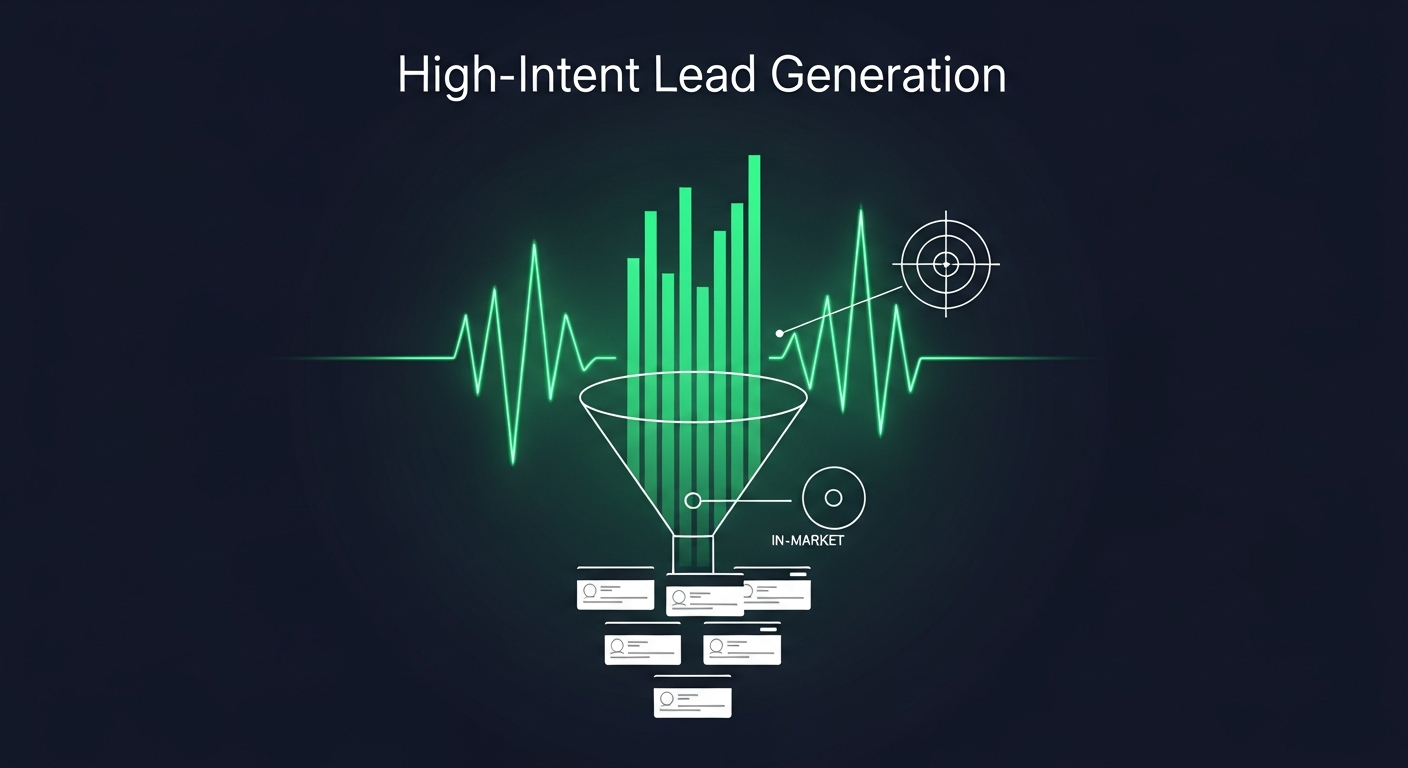
Most pipelines are full of leads that will never buy — names scraped from a list, form-fills chasing a gated PDF, accounts that fit the ICP on paper but have zero reason to move. High intent lead generation flips that ratio: instead of starting with a list and hoping someone is ready, you start with the evidence that an account is already in-market and work backward to the person you should call. The result is fewer leads, but dramatically more of them convert — because the timing is right before the rep ever picks up the phone.
This guide covers what actually makes a lead "high-intent," which signals are worth trusting, how to source and score them, how to pair intent with a verified contact, and the play that turns a warm signal into a booked meeting. If you want the broader mechanics of working signals end to end, our guide on B2B intent data for lead generation goes deep on the full pipeline, and intent data for pipeline generation covers how those signals become forecastable revenue; this article is specifically about the high-intent slice — the leads closest to a decision. For the B2B-specific cut — how to find, score, and win high intent B2B leads — see the dedicated guide.
What Makes a Lead High-Intent
Intent is a spectrum, not a switch. A lead is "high-intent" when its behavior signals active, near-term buying interest rather than passive curiosity. The clearest markers:
- Bottom-of-funnel behavior. Pricing-page visits, demo requests, comparison-page reads, and repeat product-doc views indicate someone evaluating, not just learning. These outrank a single blog read by an order of magnitude.
- Recency and acceleration. A surge that's three days old and climbing beats a bigger spike from a month ago. High intent is as much about velocity as volume — the account is moving toward a decision right now.
- A concrete "why now" event. A new VP in the buying role, a funding round, a relevant job posting, or a competitor switch each give a defensible reason the account is active this quarter, not someday.
- ICP fit. Strong intent from an account you can't sell to is noise. A high-intent lead is in-market and matches the profile of customers who actually close and stay.
Contrast that with low-intent leads — broad topic reads, gated-content downloads, or cold list entries with no behavioral evidence. They may convert eventually, but they belong in nurture, not in a rep's daily worklist. The discipline of high intent lead generation is refusing to treat the two the same. The middle of that spectrum — a real signal but no explicit buying action yet — is covered in the dedicated guide to warm B2B leads.
Which Buying Signals Indicate High Intent
Not all signals carry equal weight. Rank them by how directly they map to a contactable, in-market person:
- First-party signals. Behavior on your own properties — pricing visits, demo-request abandons, a stalled trial, repeat docs reads. You already have partial identity and explicit interest, so these are the highest-intent leads you own and the most under-worked.
- Discrete public events. Timestamped, hard-to-fake moments — leadership hires into a buying role, funding, expansion, tech-stack changes, relevant job reqs. They map cleanly to a "why now" reason for reaching out.
- Second-party intent. Another company's first-party data shared with you (a review site's in-market buyers, a publisher's engaged readers). Narrow but strong when the topic fits your buyer.
- Third-party topic surges. Aggregated research signals from publisher panels and bidstream. Highest volume, noisiest, and weakest as a standalone high-intent source — best used for breadth once the sources above are fully worked.
For the deeper distinction between someone just starting to look and someone actively evaluating, see early research vs in-market intent and the wider primer on B2B buyer intent. The takeaway for high-intent work: weight the signals closest to a real person and a real "why now," and discount broad topic noise.
How to Source High-Intent Signals
Sourcing high-intent leads means instrumenting the places where genuine buying behavior shows up — not buying the biggest list you can find.
- Wire up your own funnel first. Most teams sit on first-party signals they never action: pricing-page visits, demo abandons, trial stalls. Capture these and route them to sales the same day. This is the cheapest, highest-converting high-intent source you have.
- Monitor discrete events at ICP accounts. Track hires, funding, postings, and stack changes across your addressable market so a "why now" event surfaces the moment it happens.
- Add purchase-intent layers selectively. Topic-level purchase intent data broadens coverage, but treat it as a prioritization input on top of fit — not a lead list on its own.
- Resolve identity, don't buy it. Account-level intent plus a contact you verify beats buying resolved person-level intent, which is fragile and often non-compliant.
The goal is a steady feed of accounts showing real buying behavior, each carrying the event that explains why now.
Scoring and Prioritizing High-Intent Leads
A feed of "hot" accounts is not a worklist. Score every lead on three axes and promote only the intersection:
- Fit. Does the account match your ICP — size, industry, region, tech stack? Off-ICP intent is noise no matter how strong.
- Intent strength and recency. How far above baseline is the signal, and how fresh? A modest, two-day-old surge usually beats a huge, three-week-old one.
- Reachability. Can you get a verified contact in the buying unit? An account you can't reach is not a lead.
Leads that clear all three are your daily worklist. The middle tier (fit + intent, weak reachability) goes to enrichment; everything else waits. This is the same prioritization discipline covered in how to prioritize buying signals for outbound, applied specifically to the highest-intent slice. If you'd rather not build scoring from scratch, a source-backed Prospect Dossier arrives with the triggering signal, verified contacts, and supporting context already assembled.
Pairing High Intent With Verified Contacts
This is the step that turns a signal into an actual lead. Account-level intent tells you a company is in-market; a high-intent lead needs a person — name, title, verified email or phone.
For each prioritized account:
- Map the buying unit. Identify the economic buyer, the champion, and the likely blocker for your category — not just the most senior title.
- Verify before you send. A bounced email on a hot account wastes the entire signal. Confirm the address and phone are live before the rep touches the record.
- Carry the "why now" into the record. The triggering event is the opening line of the outreach. Strip it out and you're back to cold spam — see the signals the platform tracks for what feeds those records.
The Play to Convert High-Intent Leads While Warm
High intent decays fast, so the conversion play is about speed and relevance, not volume:
- Reach out in hours, not weeks. The half-life of a buying signal is measured in days; a same-week first touch is the single biggest lever on conversion.
- Lead with the trigger. Open on the specific "why now" — the new hire, the funding, the pricing visit — not a generic value prop.
- Multi-touch across channels. Sequence email, phone, and social so the warm account hears from you more than once while intent is still high.
- Match the message to the journey stage. A first-touch "saw you're researching X" fits early evaluation; a late-stage account needs proof, references, and a clear next step.
- Route and log cleanly. Push the qualified, verified lead into the CRM with the source signal attached so attribution survives — the hygiene covered in exporting prospects into your CRM cleanly.
If you want intent detection, resolution, and the warm hand-off handled for you rather than built in-house, the prospect intelligence platform does the sourcing and verification and hands the rep a ready-to-work record. For a wider view of how AI is reshaping this whole motion, see our guide to AI lead generation.
Measuring High-Intent Lead Generation
If you can't prove lift, you can't defend the spend. Measure the program with a small, honest scorecard:
- Conversion lift vs. control. Run high-intent leads against a matched control and compare meetings booked over 90 days. Lift is the headline; everything else is diagnostic.
- Speed to first touch. Median hours from signal observed to first outreach. Slow speed quietly caps every other number.
- Contact verification rate. Share of prioritized accounts where you resolved a verified, role-correct contact. Low rates mean your "leads" aren't reachable.
- Signal-to-meeting rate. Of high-intent accounts worked, how many converted to a booked meeting — the cleanest read on whether the source earns its cost.
If the high-intent cohort doesn't beat the control over a full quarter, change the source or the play before you renew. To model the economics first, review the transparent monthly pricing, or claim a free batch of verified leads and run the play on your own ICP this week.
Frequently Asked Questions
What is high intent lead generation?
High intent lead generation is the practice of sourcing leads from evidence that an account is already in-market — pricing-page visits, demo requests, a new buying-role hire, funding — rather than starting with a static list and hoping someone is ready. You begin with the buying signal, confirm ICP fit, resolve a verified contact, and reach out while the intent is still warm, so far more of your leads convert.
What makes a lead high-intent?
A lead is high-intent when its behavior signals active, near-term buying interest: bottom-of-funnel actions like pricing or demo views, a recent and accelerating surge, a concrete "why now" event, and strong ICP fit. Low-intent leads — broad topic reads or cold list entries with no behavioral evidence — belong in nurture, not a rep's daily worklist.
Which buying signals indicate high intent?
The strongest signals are first-party behaviors on your own properties (pricing visits, demo abandons, stalled trials), followed by discrete public events (leadership hires, funding, job postings, tech-stack changes), then second-party shared data. Broad third-party topic surges are the noisiest and weakest as a standalone high-intent source — useful for breadth, not for prioritizing a worklist.
How do you generate high-intent leads?
Instrument the places real buying behavior shows up: capture your own first-party funnel signals and route them to sales the same day, monitor discrete events across ICP accounts, and layer purchase-intent data as a prioritization input on top of fit. Score each lead on fit, intent recency, and reachability, resolve a verified contact in the buying unit, and reach out fast on the triggering event.
How fast do you have to act on high-intent leads?
Quickly. Buying intent decays materially within 7–14 days, and a surge older than three weeks is effectively background context. Aim for an observation-to-delivery SLA under 72 hours and a first outreach measured in hours, so you reach the account while it's still actively evaluating rather than after it has moved on.
How do you measure high-intent lead generation?
Compare high-intent leads against a matched control list and track meetings booked over 90 days for the headline lift number. Support it with speed to first touch, contact verification rate, and signal-to-meeting rate. If the high-intent cohort doesn't beat the control over a quarter, change the source or the play before you renew.
References
- ICO (UK), Direct marketing guidance: https://ico.org.uk/for-organisations/direct-marketing-and-privacy-and-electronic-communications/
- European Commission, General Data Protection Regulation: https://commission.europa.eu/law/law-topic/data-protection_en
- Gartner, B2B Buying Journey (industry overview): https://www.gartner.com/en/sales/insights/b2b-buying-journey
- IAB Tech Lab, OpenRTB and bidstream context (technical reference): https://iabtechlab.com/standards/openrtb/
Next Steps
The fastest way to see whether high intent lead generation works for your team is to run the play on one ICP segment for a week: capture the in-market signals, filter to fit, resolve verified contacts, and reach out on the trigger — then check the signal-to-meeting rate against a control. If you'd rather skip the build, see how source-backed signals and verified contacts arrive together in a Prospect Dossier, or browse more intent data insights for the wider playbook.