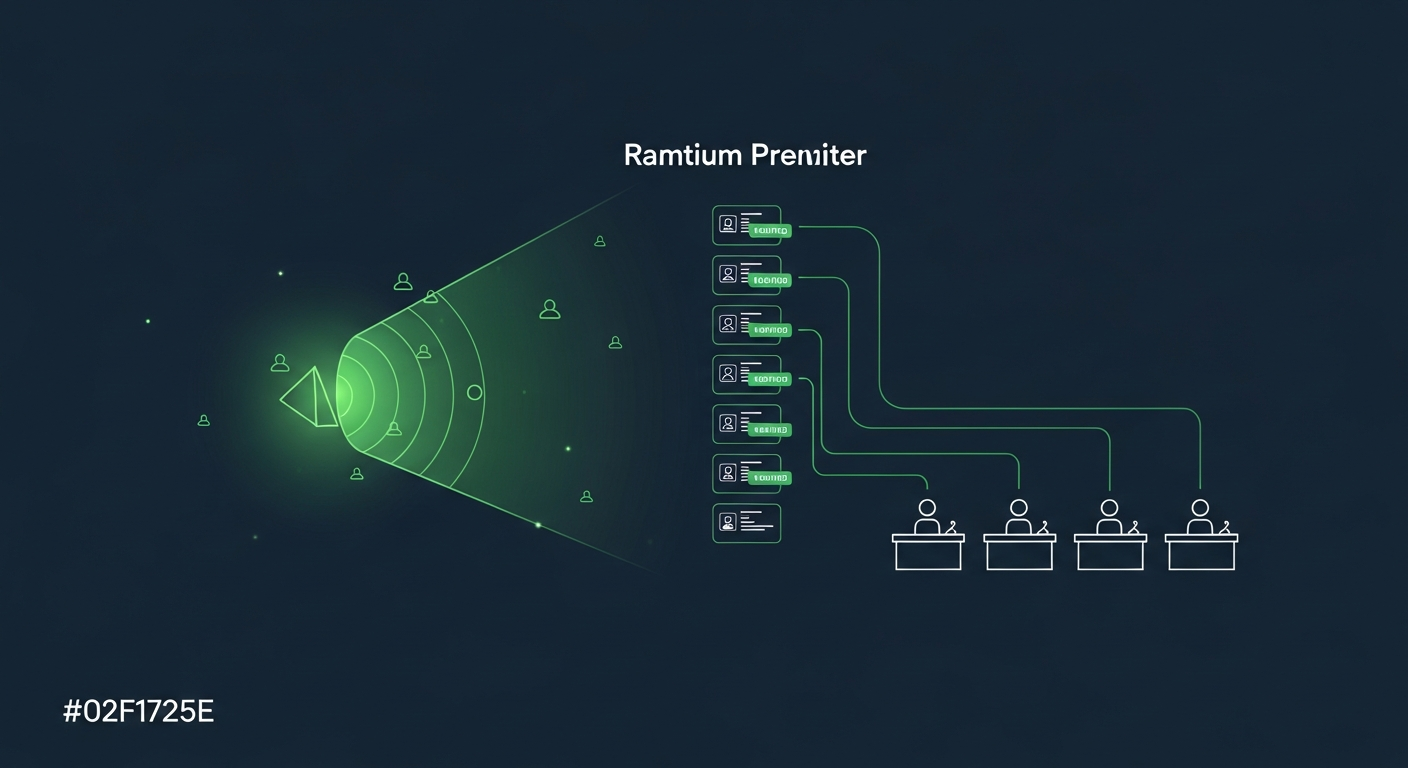
B2B intent leads for sales teams are only useful when they reach a rep as a ranked worklist with a verified contact and a reason to reach out — not as a dashboard of anonymous topic surges someone still has to decode. The gap between "we bought intent data" and "our reps booked more meetings" is an operational one: sourcing the right signals, prioritizing them against your ICP, routing them to the right rep fast, and arming the conversation with the trigger. This playbook walks a sales team — reps and leaders alike — through that whole loop, from signal to booked meeting.
If you're still deciding what to buy or how cheap it can be, pair this with the best B2B intent leads providers guide and the affordable B2B intent leads guide; this page assumes you have signals coming in and need to turn them into sales-team output. For the buyer-side definition of what makes a lead worth a rep's time, see high intent B2B leads.
B2B Intent Leads for Sales Teams: The Short Answer
- A lead is not a signal. A topic surge tells you an account is maybe researching; a sales-ready intent lead is a verified contact tied to a discrete event a rep can name out loud.
- Prioritize before you route. Most of a feed is noise. Score every triggered account on fit, trigger strength, and reachability, and only promote the intersection to the queue.
- Speed and ownership decide outcomes. A triggered account worked within 48 hours by a clearly-assigned rep converts far better than the same account routed slowly to no one in particular.
- Carry the "why now" all the way to the rep. The triggering event is the opening line of the outreach. Strip it out and you're back to cold spam with extra steps.
What "Intent Leads" Mean to a Sales Team
Marketing and sales consume intent data for different jobs, and conflating them is where most programs stall. Marketing uses intent to shape demand and prioritize campaigns at the segment level. Sales needs something far more concrete: a named account, a named person, a verified way to reach them, and a defensible reason the outreach is relevant today.
So for a sales team, "an intent lead" has a higher bar than "an account that surged on a topic." It has to survive a rep's first three seconds of skepticism. That means the signals worth a rep's time are the discrete, nameable events — a new buying-role hire, a funding round, a relevant job posting, a tech-stack change — far more than an anonymous third-party research score. The full company-discovery mechanics behind that roster live in B2B intent leads companies; here we pick up once the companies are surfaced and the question becomes how a sales team works them.
Where Sales Teams Source Intent Leads
A sales team rarely relies on one source. The durable programs blend three, in roughly this order of trust:
- First-party signals routed to sales. The buying activity already happening on your pricing and docs pages is the highest-converting, lowest-cost intent you have — but it only helps if it's resolved to an account and routed to a rep instead of dying in a marketing dashboard.
- Public, observable triggers. Hires into buying roles, funding rounds, job postings, and leadership or tech-stack changes are timestamped, hard to fake, and carry their own "why now." They're the backbone of a sales-led intent program because a rep can say the event out loud.
- Third-party topic surges. Aggregated "they're researching your category" signals add breadth, but a sales team should treat them as a tiebreaker on top of a real event — never as the sole reason to put an account in a rep's queue.
For the outbound-specific version of this — which signals actually justify a cold first touch — see B2B intent data for outbound sales. The point for any sales team is the same: lead with discrete events, verify the contact, and use topic surges only to break ties.
Prioritizing Intent Leads Before They Hit the Queue
A feed of triggered accounts is not a worklist. The single biggest lever a sales leader has is the scoring that decides which leads a rep ever sees. Score every triggered account on three axes and promote only the intersection:
- ICP fit. Size, industry, region, and stack. An off-ICP trigger produces an off-ICP customer who churns — drop it no matter how strong the signal.
- Trigger strength and recency. A nameable event (a new VP, a raise) beats an anonymous surge, and a two-day-old trigger beats a three-week-old one. Intent decays fast.
- Reachability. If you can't get a verified contact in the actual buying unit, it isn't a lead a rep can work — it's a research task.
What clears all three becomes the queue. Keep that queue short — roughly five to eight accounts per rep per day — because above that, reps stop researching each account and fall back on templates, which throws away the relevance the signal bought. The deeper weighting methodology is in how to prioritize buying signals for outbound.
Routing Leads to the Right Rep, Fast
Prioritization decides which leads matter; routing decides who works them and how fast. Both quietly cap conversion when they're sloppy:
- Assign clear ownership. A triggered account that lands in a shared pool with no owner gets worked by no one. Route by territory, segment, or round-robin — but every lead needs a name attached the moment it qualifies.
- Route in hours, not at the end of the sprint. A weekly batch with a multi-day lag means reps reach accounts after the trigger has cooled and a competitor may already be in the conversation. Insist on observation-to-rep measured in hours.
- Match the rep to the motion. A funding round at an enterprise account belongs with a different rep than a self-serve trial signal. Let the signal and account profile inform the assignment.
This is also where CRM hygiene starts: if the trigger and verified contact don't survive the hand-off into the rep's queue, attribution and follow-up both break later.
Arming Reps to Act on the Signal
The last mile is the conversation, and it's where intent either pays off or gets wasted. A perfect trigger with a bounced email or a generic opener is a story, not a meeting. Give every rep three things with each lead:
- The verified contact in the buying unit. Map the signal to the right person — a funding round points at the economic buyer, a new RevOps hire is the champion, a tooling change points at the practitioner — and confirm the email and phone are live before the rep touches it.
- The "why now," in plain language. Reference the event ("congrats on the new VP role," "saw the Series B"), never the surveillance ("our data says you've been researching us"). The first is welcome; the second is creepy.
- A trigger-anchored cadence. Lead with the event, add proof on the next touch, switch channels, then make a low-friction ask — all anchored back to the original signal, and run within 48 hours while it's warm.
A source-backed Prospect Dossier is built for exactly this hand-off: the triggering signal, the verified contacts, and the supporting context arrive together, so the rep opens the record with a defensible opener already in hand. Browse the full set of buying signals the platform tracks to see what feeds those records.
Measuring Intent Leads at the Team Level
If a sales leader can't prove the signals lifted results, they can't defend the spend or the workflow. Measure with a small scorecard built for a team, not a single rep:
- Positive-reply and meeting rate, triggered vs. control. Run triggered accounts against a matched control list worked without signals. The lift is the headline number; everything else is diagnostic.
- Speed to first touch. Median hours from trigger observed to first outreach, across the team. Slow routing quietly caps every other metric.
- Trigger-to-meeting rate by signal type. The cleanest read on which signals earn their place in the queue — prune the ones that don't.
- Contact verification rate. Share of triggered accounts where a rep reached a verified, role-correct contact. Low rates mean your "hot" accounts were never actually reachable.
If the triggered cohort doesn't beat the control over a quarter, change the signal mix, the routing speed, or the cadence before you renew. You can model the economics first against our transparent monthly pricing, or claim a free batch of verified, signal-backed accounts and run this loop on your own ICP this week.
Where Lead Seeker Fits for Sales Teams
Lead Seeker is a public-signal lead platform: it resolves intent from observable events — hires, funding rounds, job postings, leadership changes, and tech-stack moves — then attaches a verified contact, so a lead reaches a rep action-ready rather than as a raw score they still have to work. Every signal in a Prospect Dossier is source-backed, so a rep clicks straight through to the evidence instead of trusting a colored label. For a sales team specifically, that changes the daily reality in three ways:
- Reps get a worklist, not homework. The account, the verified contact, and the "why now" arrive together, so reps spend their hours on conversations instead of list-building.
- Leaders get defensible freshness. Public events carry their own timestamps, so prioritization and routing run on facts, not a vendor's batch schedule.
- The desk trusts the lead. Reps act on signals they can verify; black-box scores get ignored the first time a "hot" account turns out cold.
We don't pretend a single source covers every motion — a contact database still has a place for top-of-funnel breadth. The point is that source-backed, verified, ICP-filtered leads give a sales team a shortlist they'll actually work. See how it stacks up on our platform comparison, or browse more intent data insights for the wider playbook.
Frequently Asked Questions
What are B2B intent leads for sales teams?
B2B intent leads for sales teams are accounts and contacts surfaced by a buying signal and delivered in a form a rep can act on — a verified contact tied to a discrete, nameable event (a new buying-role hire, a funding round, a job posting, a tech-stack change) rather than an anonymous topic score. The distinction matters because a sales team needs a named person, a verified way to reach them, and a defensible "why now," not just a dashboard saying an account is researching your category.
How do sales teams prioritize intent leads?
Score every triggered account on three axes and promote only the intersection: ICP fit (size, industry, region, stack), trigger strength and recency (a nameable, fresh event beats an old anonymous surge), and reachability (whether you can get a verified contact in the buying unit). What clears all three becomes the rep's queue, kept to roughly five to eight accounts per rep per day so reps research each account instead of falling back on templates.
How should intent leads be routed to reps?
Route them with clear ownership and speed. Assign every qualifying lead to a named rep the moment it clears scoring — by territory, segment, or round-robin — so it never dies in a shared pool. Aim for observation-to-rep measured in hours, not a weekly batch, because a trigger cools fast and a competitor may already be in the conversation. Match the rep to the motion so an enterprise funding signal and a self-serve trial signal go to the right people.
How fast do sales teams need to act on an intent lead?
As fast as the trigger decays. A role change buys you a few weeks, a funding event a month or two, and a topic surge only days. Aim for a first touch within 48 hours of a strong trigger and observation-to-outreach measured in hours, so the rep reaches the account while the event is still fresh and before a competitor gets there first. Slow speed-to-lead quietly caps every other metric on the scorecard.
How do you measure whether intent leads are working for the team?
Run triggered accounts against a matched control list worked without signals and compare positive-reply rate and meetings booked over 90 days — that lift is the headline. Support it with team-level speed to first touch, trigger-to-meeting rate by signal type (to prune signals that don't earn their place), and contact verification rate. If the triggered cohort doesn't beat the control over a quarter, change the signal mix, routing speed, or cadence before renewing.
How is Lead Seeker built for sales teams?
Lead Seeker is a public-signal lead platform that resolves intent from observable, timestamped events and attaches a verified contact, so leads reach reps action-ready instead of as a raw score. Each signal is source-backed in a Prospect Dossier, so reps can click through to the evidence and open with a defensible "why now," while sales leaders get defensible freshness for prioritization and routing. ICP filtering keeps off-target accounts out of the queue, so the team works a shortlist rather than cleaning a list.
Sources
- Gartner — The B2B Buying Journey: https://www.gartner.com/en/sales/insights/b2b-buying-journey
- HubSpot Research — Marketing Statistics: https://www.hubspot.com/marketing-statistics
- ICO (UK) — Direct marketing guidance: https://ico.org.uk/for-organisations/direct-marketing-and-privacy-and-electronic-communications/
- California Attorney General — California Consumer Privacy Act (CCPA): https://oag.ca.gov/privacy/ccpa
Next Steps
The fastest way to see whether intent leads work for your team is to run the full loop on one ICP segment for a week: source signals, score them on fit, trigger, and reachability, route the survivors to a named rep, and reach out within 48 hours leading with the event — then check trigger-to-meeting rate against a control. If you'd rather not build the ingestion, resolution, and routing layers yourself, see how source-backed signals and verified contacts arrive together in a Prospect Dossier, then revisit the best B2B intent leads providers guide to pick the delivery model that fits your motion.