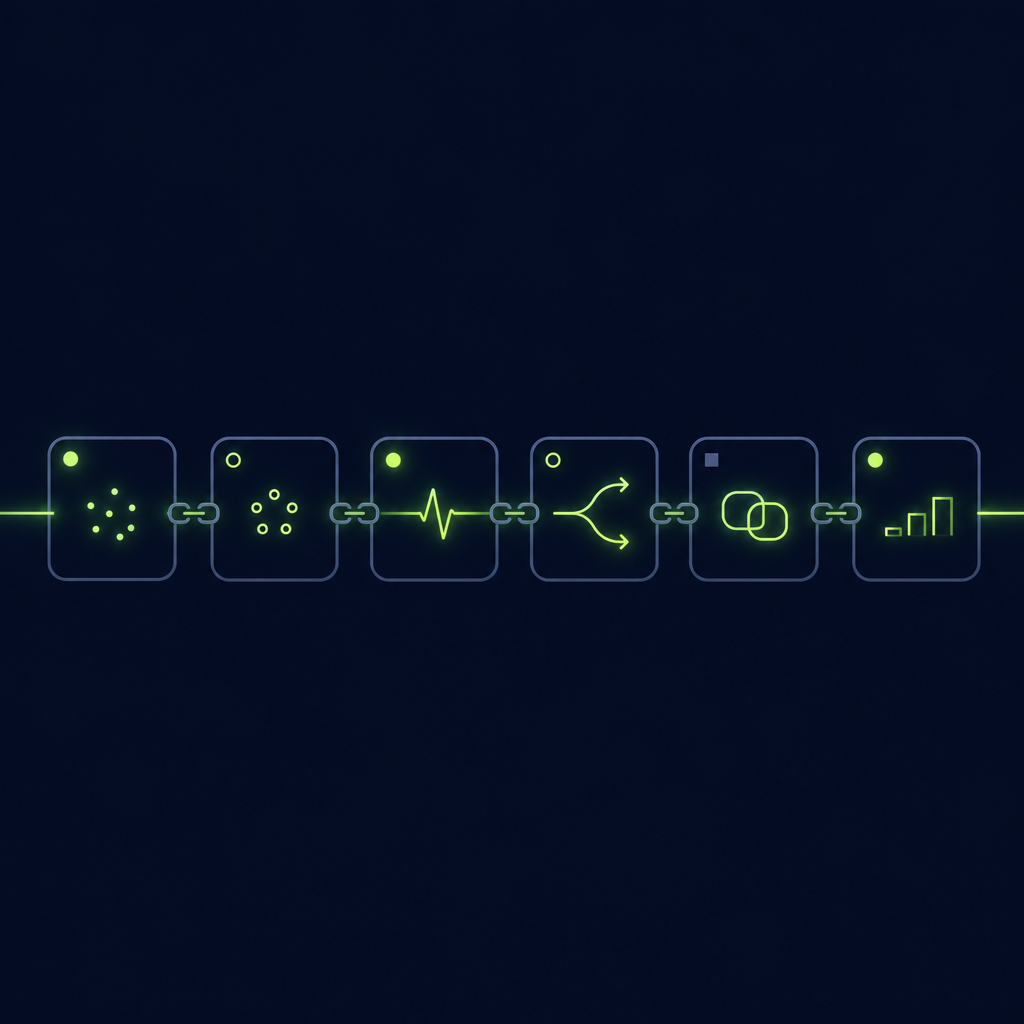
Account-based marketing lead generation data is the set of records an ABM programme uses to choose accounts, name the people in each buying group, find a reason to act, reach those people, hand accounts to sales and measure the result. Each record should carry its source and whether it was observed, modelled or asserted, because account activity on its own never qualifies an account for sales.
Account-Based Marketing Lead Generation Data: The Short Answer
- Six stages, six kinds of data. The ABM Data Chain below lists what each stage needs: fit data for account selection, named people for the buying group, dated events for the signal, matchable identifiers and a permission basis for the channel, a sourced package for the sales handoff, and decision records for measurement. Most guides that rank for this phrase describe ABM as a strategy and say it needs "data"; few say which data, from where, or how old it may be.
- Label every field Observed, Modelled or Asserted. An observed record can be opened and checked (a filing, a job post, a form fill, an opportunity in the CRM). A modelled record is a vendor's or a system's inference (an IP-to-company match, an intent surge, a predicted buying stage, a recommended buying-group member). An asserted record is what someone said (a seller's note, a contact's stated role). Modelled data can start a review; the reason sales is given to act should be observed or asserted.
- Account activity is a trigger, not a qualification. 6sense's default 6QA rule qualifies an account that reached the Purchase or Decision buying stage in the last 60 days with Strong or Moderate profile fit, and Demandbase's default MQA stage is a Pipeline Predict score of 85 percent or more, or 100 or more marketing engagement points in three months. Both are model or engagement thresholds. A seller still decides whether to accept the account, and that decision is the data the programme learns from.
- The join between leads and accounts decides what counts. ABM works at the account level, while forms, emails and ad audiences work at the person level. The Lead-to-Account Join (the rule that attaches each person to an account record) is where the two kinds of data meet, and where duplicate, misattributed and orphaned records start.
The ABM Data Chain: what each stage needs
The ABM Data Chain is a table marketing and sales fill in before buying or building any data. Each row is a stage. The columns record the data the stage needs, where the record of truth lives, the provenance label the data usually carries, how often it must be refreshed and who checks it. The stage order follows the planning sequence in our ABM strategy template; this page covers the data inputs, while the template covers the decisions.
| Stage | Data the stage needs | Record of truth | Usual provenance | Refresh | Checked by |
|---|---|---|---|---|---|
| 1. Account selection | Industry, size, location, ownership (parent and subsidiaries), technology in use where verifiable, existing relationship and open opportunities | CRM account record, with fit fields sourced | Observed for filed or published facts; Modelled for estimated revenue, headcount bands and technographics | Each planning cycle, and on any ownership change | Marketing proposes; sales adds and removes accounts with a written reason |
| 2. Buying group | The seats the purchase needs, the named person in each seat, the source of the name and its status | CRM contact records associated with the account | Observed when a dated public record places the person in the role; Asserted after a conversation; Modelled when a tool recommends the person or infers the role from a title | Before every handoff; roles change | Sales confirms; marketing researches |
| 3. Signal | The event, its date, its source link, whether it names a person or only an account, and how long it stays valid | Activity or signal object on the account, kept with the source | Observed for first-party activity by known people and for public events; Modelled for intent surges, de-anonymised visits and predicted stages | Continuous; each signal expires on its own shelf life | Marketing records; sales agrees which signal types count |
| 4. Channel | Matchable identifiers (company domain, company name, hashed business email), audience size against platform minimums, sender, permission or opt-out basis | Marketing automation and ad platform audiences, synced from the CRM | Observed for identifiers you collected; Modelled for platform match counts | On every sync; ad platforms purge or expire stale lists | Marketing operations |
| 5. Sales handoff | The account, the trigger, one reason a seller can cite with source and date, the confirmed seats, a proposed first action, and the seller's decision | CRM task or handoff record linked to the account | The reason and seats should be Observed or Asserted; the trigger may be Modelled | Per handoff | Sales decides; marketing owns the package |
| 6. Measurement | Accept, return or reject decisions with reasons, provenance of the reason, opportunities and stage movement on target accounts, a comparison set chosen in advance | CRM opportunity and handoff history | Observed | On a fixed review cadence | Joint |
Marketing and sales coordination sits in the last column. Sales has the final word at three points: which accounts stay on the list, which people count as confirmed in a seat, and whether a handed-off account is accepted. Marketing owns the evidence behind every field. A programme where marketing fills all six rows alone is a targeting list, not an ABM programme.
Stage 1: Account selection data
Selection data answers one question: does this account fit, and how do we know? Keep each fit field with its source and its label. A company's industry and location from its own filings or website is observed. Revenue and headcount figures from a data vendor are usually modelled estimates unless the company publishes them. Technographic fields are modelled unless you can see the technology yourself, for example on a careers page or in published documentation.
Two fields cause most selection errors: ownership and existing relationship. A subsidiary that buys centrally through its parent looks like a good account on firmographics and is not one in practice. An account with an open opportunity, a recent loss or an active customer contract should not enter a new-logo programme without a seller seeing it first. Both facts live in the CRM or in public ownership records, not in an intent feed.
Stage 2: Buying-group data
The buying-group stage needs people, not titles. Forrester's Buyers' Journey Survey, 2025, as reported in a February 2026 Forrester blog post, found that "73% of purchases involve three or more departments, with an average of 13 people inside the buyer's organization and nine from outside involved in making a purchase decision." That figure describes purchases in Forrester's survey; it does not tell you who those people are at a given account. The buying committee mapping guide covers how to define the seats; this stage records who sits in them.
For each seat, store four fields: the person, the source of the name, the date the source was checked, and the status. Demandbase's sales product labels each buying-group member as "recommended" or "confirmed", and a contact can carry recommendations that nobody has confirmed. That distinction maps directly onto provenance. A recommended member is modelled. A member confirmed by a seller after a conversation is asserted. A member placed in the role by a dated leadership page, filing or published statement is observed. Coverage reports should count the three separately, because a buying group made mostly of modelled members is a research task, not a set of people sales can call.
Stage 3: Signal data
Signal data records why an account deserves attention now. It splits into three groups with different provenance.
- First-party activity by known people: a form fill, a reply, a meeting booked, a webinar attended. Observed, and tied to a person.
- First-party activity by unknown visitors: website visits that a vendor attributes to a company from IP addresses, cookies and other identifiers. Modelled. 6sense's Company Identification API FAQ, updated July 22, 2026, says its match rate "depends on the type of traffic", that for a primarily B2B, software and tech, US-based website "it can be as high as 75%", and that traffic from VPNs, cloud servers, mobile networks and bots is classed as non-actionable. Demandbase's account identification FAQ describes "a probabilistic AI model atop a vast identity graph" and says its client-side integration "identifies about 20 percent of B2B traffic, translating to roughly 10 percent of all site traffic". Those two figures use different denominators and come from the vendors themselves, so they cannot be compared with each other or with your own traffic.
- Third-party research activity: intent data from publisher networks. Modelled. Bombora's Company Surge page says its data comes from a co-op of B2B publisher and brand sites using a "consent-driven tag", that it monitors research activity against "25,300+ topics", and that its scoring "compares the most recent three weeks of activity against a 12-week historical baseline". A surge says an account researched a topic more than usual. It does not say who, why, or whether the account is buying.
Public business events (a new executive, a funding round, a new site, a job post for a role your product supports) are observed when you keep the source. They are often the most useful reason to put on the handoff line, because a seller can say them out loud and the buyer can recognise them.
One Source, One Vote. Several ABM platforms resell or ingest the same third-party feed. Terminus's March 21, 2023 launch release for Prospect Engine states that "Intent topics and research spikes identified by Bombora are ingested into the Terminus identity graph." If the same research spike appears in two tools, it is one observation, not two. Record the original source on every signal so a scoring rule cannot count one event twice.
Stage 4: Channel data
Channel data is the part of the chain that has to match an outside system, so the fields are set by the platforms. LinkedIn's Matched Audiences documentation says users "can be matched with hashed email addresses and other identifiers", companies "can be matched on companyname, companydomain, and other identifiers", and capital letters and whitespace must be removed from an email address before it is hashed. The same page sets the minimum campaign audience at "300 members matched" and the maximum CSV upload at 300,000 hashed email addresses. Google Ads keeps a Customer Match list eligible only if "at least 100 members are added or updated within" 540 days. A one-to-one tier with a few dozen confirmed people cannot run as a standalone contact-list audience on either platform; company-list targeting, a merged tier or a different channel has to carry it.
Permission data belongs in the same row. The US Federal Trade Commission's CAN-SPAM guide states that the law "makes no exception for business-to-business email" and that each violating email can carry a penalty of up to $53,088. Under Article 14 of the UK GDPR, when personal data was not obtained from the person, the controller must tell them, among other things, "from which source the personal data originate", within a reasonable period and at the latest within one month, or at the first communication if the data is used to contact them. A contact record with no stored source cannot meet that requirement, which is a second reason to keep the source field on every person in stage 2.
Stage 5: Sales handoff data
The handoff is where account data becomes a lead a seller can work. The fields and the accept, return and reject decision are set out in the Handoff Contract in our ABM template; the data rule this page adds is that every field carries its provenance label.
Activity Is Not Acceptance, applied to data
Under the rule that Activity Is Not Acceptance, a platform flag such as a 6QA or an MQA goes in the Trigger field and is kept for measurement. It does not go in the Reason field. 6sense's support documentation describes 6QAs as "best used as a replacement for SQLs" and Demandbase's Journey Stages move an account to MQA on a model score or engagement points alone; both vendors let customers edit the definitions. What neither default supplies is a reason a seller can cite or a named person to contact. Percepture's guide to using intent data to identify sales qualified leads puts the same point as a formula ("ICP Fit + Intent Signal + Timing + Contact Relevance + Source Context + Next Action = Sales Qualified Lead") and warns that "A student, competitor, analyst, vendor, or low-fit company can create the same surface-level signal as a real buyer."
So the handoff package holds at least one observed or asserted reason with its source and date, at least one person in a required seat with their status, and a proposed first action. If the only reason available is modelled, the account stays in marketing's programme until an observed reason appears or the trigger expires.
Stage 6: Measurement data
Measurement data comes from decisions, not from engagement. Record every handoff decision with its reason, using the Return Codes from the template or your own fixed list, and record the provenance label of the reason that was handed off. Three measures follow:
- Acceptance rate by provenance label: the share of handed-off accounts sales accepted, split by whether the reason was observed, asserted or (where your rules allowed it) modelled. This tells you which kind of data sales trusts.
- Acceptance rate by source: the same split by signal source, so a feed that produces many triggers and few accepted accounts is visible.
- Stage movement on target accounts against a comparison set chosen before the programme starts, over a normal sales-cycle length. Vendor journey stages are useful here only if you record which definition was active, because the stage names are the vendor's and the thresholds can change.
The Lead-to-Account Join: where ABM data and lead generation data meet
The search results for this phrase are dominated by pages that compare account-based marketing with lead generation. The data answer is that both run on the same records and differ in the unit of decision. Lead generation decides person by person. ABM decides account by account. The Lead-to-Account Join is the rule that attaches each person record to the right account record, and it is the step most programmes leave to software defaults.
HubSpot's automatic association, for example, links a contact to a company by "matching the domain in the Email value of a contact with the Company domain name value of a company". Its documentation lists the edge cases that matter for ABM data. If a contact already has an associated company that differs from the email domain, the setting does not override the existing association. A form submission that includes company properties associates the contact regardless of the setting. Up to 1,000 domains can be excluded from automatic association. Three join problems follow, and each needs a written rule:
- Personal and shared email domains. A form fill from a personal mailbox carries no company domain, so a domain-based join cannot place the person (this is inference from how a domain match works, not a statement from HubSpot). Decide whether such records wait for enrichment, go to a review queue, or stay unassigned.
- Groups with several domains. Parents, subsidiaries and regional entities often use different domains. Decide which account record the ABM programme targets and map the other domains to it, or the same organisation will appear as several partial accounts with partial engagement.
- Agencies, partners and resellers. People at a partner can engage heavily with content about a target account's problem. Join them to their own company, and add a Return Code or exclusion so their activity cannot lift the target account's score.
Whatever the tool, write the join rule into the ABM Data Chain beside stage 2, and audit a sample of joined records each cycle. An ABM report that counts engaged contacts per account is only as accurate as the join that put them there.
Evidence table: what four ABM platforms and one intent source document about their data, read October 11, 2026
The table records what each vendor's own documentation or announcement says. These are vendor statements, quoted or summarised as published on the date read; they are not tested results and they change without notice.
| Vendor and source | How accounts are identified or sourced | Default qualified-account or stage logic | Buying-group data | Intent source | Provenance of the output |
|---|---|---|---|---|---|
| 6sense (support docs: 6QA page; Company Identification API FAQ, updated July 22, 2026) | IP-based company identification; match rate "depends on the type of traffic", up to 75% for a primarily B2B, software and tech, US-based site; VPN, cloud, mobile-network and bot traffic classed as non-actionable | Default 6QA: Purchase or Decision buying stage in the last 60 days, Strong or Moderate profile fit, no opportunity created or lost in 90 days, not qualified in 60 days; disqualified when a relevant opportunity opens | Not covered in the pages read | Combined in the platform; the 6QA page says 6QAs "enable combinations of many data sources" | Modelled (identification, stage, fit) |
| Demandbase (Help Center: Journey Stages; account identification FAQ; buying-group member labels) | "Probabilistic AI model atop a vast identity graph"; does not show IP addresses; client-side integration identifies "about 20 percent of B2B traffic" | Qualified at a qualification score of 70 or more; Aware on high intent strength in 30 days; Engaged at 10 or more engagement points in three months; MQA at Pipeline Predict of 85 percent or more, or 100 or more marketing engagement points in three months; accounts may skip stages | Members labelled "recommended" or "confirmed" | Intent strength used in the Aware stage | Modelled, except confirmed members (asserted) |
| AdRoll ABM, formerly RollWorks (Help Center: Journey Stages Overview; product page) | CRM integration plus the vendor's data; stage filters can find in-market accounts not yet in the CRM | Default stages run from Unaware to Won Deal, including Sales Ready; definitions can use website activity, advertising activity, intent and CRM data | Not covered in the page read | Intent is one of the stage data sources | Modelled stages built from mixed inputs; CRM stages observed |
| Terminus (Prospect Engine launch release, March 21, 2023) | A graph of companies and decision-makers the release describes as human-curated | Not covered in the release | Contacts at accounts outside the CRM that meet a company's ICP | Bombora intent topics and research spikes ingested into the Terminus graph | Contacts asserted by the vendor (check before marking anyone confirmed); intent modelled, from the same feed as Bombora |
| Bombora (Company Surge page) | Co-op of B2B publisher and brand sites with a consent-driven tag | Elevated intent from the latest three weeks against a 12-week baseline per account and topic | Not applicable | Its own co-op; 25,300+ topics | Modelled |
Four readings.
- Every platform's qualified-account output is modelled. The stage names differ, but each default is a threshold on predicted stage, model score, engagement or intent. None of them records a seller's decision, which is why the chain keeps the trigger and the reason in separate fields.
- Identification coverage is a vendor number with its own denominator. 6sense states a maximum for one kind of site; Demandbase states a share of B2B traffic for one integration method. Neither is a rate your site will see, and the two cannot be ranked against each other.
- Only one of the five separates recommended from confirmed people. Demandbase's labels are the closest any of these sources comes to a provenance field on buying-group members.
- Intent feeds are shared. Terminus's release names Bombora as its intent source. Before scoring, check whether two of your tools draw on the same feed.
What the pages ranking for this phrase cover, October 11, 2026
Logged-out US Google results for the exact phrase, read at 18:01 UTC, showed no AI Overview ("Can't generate an AI overview right now"). Google's AI Mode answer for the same phrase, read at 18:04 UTC, listed target account lists, intent data, contact mapping and first- and third-party data as the core components and cited LinkedIn, Leadfeeder, ZoomInfo and Headley Media. The table summarises the top five organic results and the Demandbase platform guide read for comparison.
| Page (date shown) | What it answers | Data it names | What it proves or cites | What it misses |
|---|---|---|---|---|
| Turtl, Account-Based Marketing vs. Lead Generation (February 17, 2025) | The difference between ABM and lead generation, and a hybrid approach | Engagement, deal progression and revenue for ABM; lead counts and click-through rates for lead generation | No sources | Which data each approach needs and how records are joined |
| Leadfeeder, Account Based Marketing guide (September 14, 2026) | ABM types, a six-step build process, metrics and an FAQ | Intent data and website visitor identification (its own product) | Foundry, Momentum ITSMA and Gartner figures | Provenance, refresh, and what sales receives |
| LinkedIn, Account-based Marketing (marketing terms page) | Benefits, a six-step implementation and best practices | A section titled "What data is needed to target prospects accurately?" that names performance data, segmentation data and real-time data | No sources | Specific fields, sources or sales acceptance |
| Improvado, Lead Generation Strategies: ABM Solutions for 2026 | ABM as one of seven lead generation strategies | Attribution and analytics data | A Gartner quote on engagement and MQL-to-SAL conversion | ABM-specific data beyond attribution |
| Salesforce, Account-Based Marketing guide | ABM principles, types, benefits and challenges | CRM and account insights in general terms | Win-rate, deal-size and ROI percentages with no source given on the page | Where any of the data comes from |
| Demandbase, 40 Best ABM Solutions for 2026 (September 18, 2026) | A vendor shortlist and evaluation criteria, including data management | Account identification, enrichment and intent processing as criteria | G2 review quotes; a "30-40% lower account match rates" claim for poor integration with no source given | How to judge the data itself once a platform is chosen |
Three readings. None of the six pages assigns data to stages, none distinguishes observed from modelled records, and none describes the data a seller receives or the record of a seller's decision. The LinkedIn page comes closest by asking the question in a heading; its answer stays at the level of "data tools". Statistics on these pages are either unsourced or cited to analyst firms without the underlying method on the page, so none is reused here.
Implementation: one tier through the ABM Data Chain
The example below is invented for this guide, including the company, the accounts and every number. It shows the order in which the chain is filled and where provenance changes the decision.
A cybersecurity training company runs a one-to-few tier of 42 healthcare providers. Marketing proposed 40 from fit data (observed: hospital count and location from public registers; modelled: revenue band from a vendor). Sales added five it knew were reviewing training and removed three that buy through a regional group, leaving 42.
Buying group. The tier needs four seats per account: security lead, compliance lead, HR or learning lead, and the budget holder, which is 168 seats. Research names a person for 97 of them. Of those, 31 are observed or asserted (a dated leadership page, a published statement, or a seller's conversation) and 66 are modelled (recommended by a tool from title data).
Signal. Over 30 days the ABM platform flags 12 accounts on intent surges or a predicted stage (modelled). Public events give observed reasons at seven accounts: four new security leaders and three job posts for compliance training roles. Four accounts appear in both groups, so 15 distinct accounts have a signal (12 + 7 − 4). For two of those 12 accounts the flag appeared in two tools from the same research spike; under One Source, One Vote it is recorded once.
Channel. The 31 observed or asserted people are far below LinkedIn's 300-member minimum, so the tier runs company-list ads to the 42 accounts and a seller-sent email sequence to those 31 people only, each with a stored source for Article 14 requests and an opt-out on every email.
Handoff. Marketing reviews the 15 accounts. Nine have an observed or asserted reason plus a person in a required seat, and go to sales: six with observed reasons and three with asserted reasons. Six have only a modelled trigger and stay in marketing's programme.
Measurement after the first month. Sales accepts six and returns three. By provenance, five of the six observed-reason accounts are accepted and one of the three asserted-reason accounts is accepted. The three returns carry codes: two for the wrong seat (the person had moved roles) and one for timing. The teams add a check-date rule to the asserted seat field and keep the modelled-only accounts out of the handoff. In this invented month, the measure that changed the plan was acceptance by provenance label, not engagement.
Where This Guide Stops
The guide reads vendor documentation, a vendor press release, a regulator's guide, legislation, one analyst blog post and the pages ranking for the phrase on October 11, 2026. It measures no ABM programme and makes no claim about the results the ABM Data Chain produces. Match rates, identification shares and topic counts are the vendors' own statements and carry their own denominators. The platform definitions are documented defaults, and every vendor named lets customers change them. The Terminus release is from March 2023, so its description of Prospect Engine and its intent source may have changed. The LinkedIn and Google audience rules come from the platforms' documentation on the same date. The CAN-SPAM reference covers US commercial email and the Article 14 reference is the UK GDPR text; other jurisdictions apply their own rules to business email and calls. The provenance labels are an editorial classification, not an industry standard, and the implementation example is invented.
Where Lead Seeker and Percepture fit
Lead Seeker supplies two links of the chain: buying group and signal. Lead Compass "uses your company website, ICP, and intent themes to surface opportunity picks, cite public sources where available, and generate ready-to-run search prompts". Running a search then returns verified people in the roles you describe at the accounts you choose, with the public signal that surfaced each person and source links where available, which gives the seat and reason fields an observed source. Lead Seeker does not decide whether sales accepts an account. For comparing third-party intent feeds, the best intent data providers guide covers the vendors, and the intent data for account based marketing playbook covers how to time plays once intent is in place.
For teams that want the chain designed and run with them, Percepture's B2B intent data services page lists intent signal mapping, ICP and account fit strategy, campaign activation and CRM and reporting workflows, and describes LeadSeeker as "Percepture's Action Layer for B2B Intent Data". Our view: start with the signal and buying-group links for one tier, because those are the fields sales sees first.
Frequently Asked Questions
How do you get data for account-based marketing lead generation?
Get it stage by stage. Account fit data comes from your CRM, public company records and data vendors. Buying-group data comes from public records, research and seller conversations, with each person marked confirmed or recommended. Signal data comes from your own website, forms and email, from intent providers and from public business events. Keep the source and date on every record so sales can check it.
What is an example of account-based marketing lead generation data?
A useful example is one handoff record: a target account in a named tier, a new security leader announced on the company's website last month (observed, with the link), that leader confirmed as the person in the security seat, an intent surge on a related topic kept as the trigger, and a proposed first email from the account's seller. Every field shows where it came from.
Can you get account-based marketing lead generation data for free?
Some of it. Your own CRM, website analytics, form fills and email replies are first-party data you already hold. Company websites, leadership pages, job posts, press releases and public filings are free observed sources for fit, people and signals. Third-party intent feeds, de-anonymised website visits and large contact databases are usually paid. Free sources take more research time per account.
How is account-based marketing different from lead generation?
Lead generation captures and qualifies individual people, usually through forms and content, and passes each lead on its own. Account-based marketing chooses a set of accounts first and coordinates marketing and sales on the buying group at each one. Both use person-level and account-level data; the difference is the unit of decision, which is why the rule joining people to accounts matters.
Do you need an ABM platform to run account-based lead generation?
No. A CRM with clean account and contact records, a written account list, a documented join between contacts and accounts, a short list of signals with sources, and an agreed handoff with sales are enough to start. ABM platforms add modelled data such as website visitor identification, intent and predicted buying stages, which is useful as a trigger once those basics exist.
Is account engagement enough to qualify an account for sales?
No. Engagement scores, intent surges and predicted stages show that something happened at an account, but not who, why, or whether the account is buying. Treat them as a trigger for review. Hand the account to sales only with a reason a seller can cite, its source and date, a person in a required seat, and a proposed first action, and let the seller accept or return it.
Sources
- 6sense support documentation, 6sense Qualified Accounts (6QAs) and Company Identification API FAQ (updated July 22, 2026). Read October 11, 2026.
- Demandbase Help Center, Getting Started with Journey Stages, FAQs: Account Identification and Understanding Recommended and Confirmed Buying Group Members. Read October 11, 2026.
- AdRoll ABM (formerly RollWorks) Help Center, Journey Stages Overview. Read October 11, 2026.
- Terminus, Prospect Engine launch release (PR Newswire, March 21, 2023). Read October 11, 2026.
- Bombora, Company Surge Intent data. Read October 11, 2026.
- HubSpot Knowledge Base, Automatically create and associate companies with contacts (last updated June 26, 2026). Read October 11, 2026.
- LinkedIn Marketing API documentation on Microsoft Learn, Matched Audiences FAQ. Read October 11, 2026.
- Google Ads Help, About Customer Match. Read October 11, 2026.
- US Federal Trade Commission, CAN-SPAM Act: A Compliance Guide for Business. Read October 11, 2026.
- UK GDPR, Article 14, information to be provided where personal data have not been obtained from the data subject (legislation.gov.uk). Read October 11, 2026.
- Forrester, Three Realities About B2B Buying Networks (February 23, 2026), reporting Forrester's Buyers' Journey Survey, 2025. Read October 11, 2026.
- Percepture, How to Use Intent Data to Identify Sales Qualified Leads and B2B Intent Data Services. Read October 11, 2026.
- Competitive review, October 11, 2026: Google results and AI Mode answer for the exact phrase (logged-out, US). Turtl; Leadfeeder; LinkedIn; Improvado; Salesforce; Demandbase, 40 Best ABM Solutions for 2026. Summarised, not audited.
- Lead Seeker product page: Lead Compass, quoted as published on October 11, 2026.
About the Author
Bob Generale is President of Percepture. He works across SEO, AI search, digital PR, sales intelligence and AI-powered revenue systems, with a focus on connecting visibility, buyer intent and sales action.
Next Steps
Copy the ABM Data Chain table into a shared document, add a provenance column to your CRM's buying-group and signal fields, and hand the next ten flagged accounts to sales only with an observed or asserted reason. After a month, acceptance by provenance label shows which part of your account-based marketing lead generation data to fix first. To see how Lead Seeker fits into that work as a prospect intelligence platform, start with one tier.