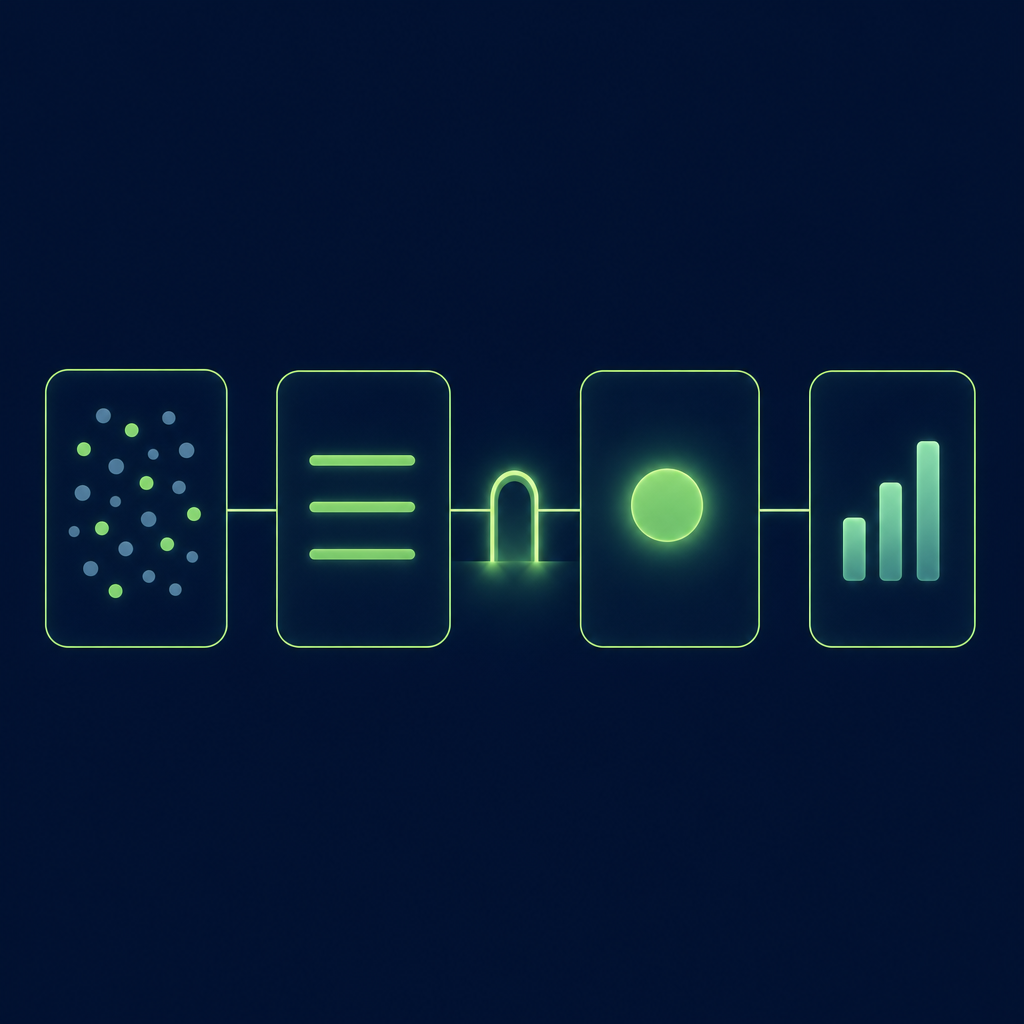
To evaluate the GTM automation software company Apollo on outbound sales, test three layers separately: whether its contact data and intent signals hold up on your own accounts, whether its sequences and CRM sync hand a clean, human-approved record to sales, and whether its deal reports agree with your CRM. Score each layer on evidence you can check, not on Apollo's headline figures.
How to Evaluate the GTM Automation Software Company Apollo on Outbound Sales: The Short Answer
- Split the product into three layers and give each an owner. Data and signal (RevOps), campaign and handoff (SDR lead, with the sales manager owning acceptance), pipeline measurement (RevOps reporting to the revenue leader). Apollo sells all three in one subscription; the Outbound Control Map below tests them one at a time, because a strong data layer does not prove a clean handoff.
- Grade every claim on the Claim Ladder before it enters the business case. Apollo's own pages give three different email-quality figures (an 84% match rate with more than 90% accuracy, a 91% accuracy rate with a 9% bounce rate, and "98% email accuracy"), and its headline outbound study was sponsored by Apollo. None of that is wrong to publish; all of it needs a label.
- Put a human at the First-Touch Gate. Apollo's sequences hold a contact at any manual step until a person completes or skips it, and its GTM Harness "Stays supervised until you determine it can act independently." Use both: a person approves the first email to each contact in a play; follow-ups inside the play run automatically.
- Decide with a Two-Week Proof Run, not a demo. Three seats of Professional cost $2,844 a year at the published annual price. Two weeks of your own accounts, mailboxes and CRM will tell you more than any rating, including the comparison pages Apollo's competitors publish.
What Apollo Sells for Outbound in October 2026
Apollo describes itself as "the AI go-to-market system" in its September 30, 2026 announcement, and the product now has three layers that map onto an outbound motion. The data layer is a database its home page sizes at "240M+ contacts and 30M+ accounts", built from a contributor network of "over two million" users, public sources and third-party providers, with buying-intent topics and website-visitor identification on top. The execution layer is sequences, a dialer on paid plans, tasks, automated workflows and a meeting scheduler. The measurement layer is deals, analytics dashboards and goals, with two-way sync to Salesforce and HubSpot.
The September announcement added an AI layer across all three. The Intelligence Layer (an Intelligence Profile per contact and account, plus the GTM Harness that "reasons over that information") is described as available now. Builder Studio, a natural-language builder for workflows and tools, and Messaging OS, which adds Email Campaigns and Google Ads audiences, "will be available soon". The same release says the Intelligence Layer is built to "take action with minimal human involvement", while the product page promises that the harness "Stays supervised until you determine it can act independently." An outbound evaluation has to establish which of those two sentences describes the configuration your team will run, and the First-Touch Gate below is how.
The Outbound Control Map: Data and Signal, Campaign and Handoff, Pipeline Measurement
The Outbound Control Map is the operating system this guide uses to test Apollo. Each layer has one owner, one question, a list of what Apollo automates according to its own documentation, what a person must review, and the test that settles the question on your data.
| Layer | Owner | The question | What Apollo's documentation says it automates | What a person reviews | The test |
|---|---|---|---|---|---|
| 1. Data and signal | RevOps | Are the right people at the right accounts, reachable, and is the intent real? | Email verification (a seven-step process), waterfall enrichment, weekly buying-intent refresh, website-visitor identification, CRM enrichment | ICP filters, intent topic choice, whether catch-all addresses enter sequences, the role match on a sample | Pull 300 contacts at your ICP accounts; check role and email status on a 50-record sample by hand |
| 2. Campaign | SDR lead | Do the plays send the right message, at a safe volume, with a person on every external first touch? | Automatic email steps (no task created), workflows that enrol contacts in sequences on a trigger, rolling 24-hour send limits | The first send of each play, any copy written from an AI read, the send limits per mailbox | Run one three-step sequence with a manual first email; hold sends at Apollo's recommended 50 a day per mailbox |
| 3. Handoff | SDR proposes; sales manager accepts | Does an accepted meeting arrive in the CRM with its source, owner and context? | Two-way CRM sync, a default lead source of "Apollo", deal creation by workflow | Field mapping inside the six-hour configuration window, the Created By owner, DNC status, the acceptance decision | Connect a Salesforce sandbox first; push five test records and read every mapped field |
| 4. Pipeline measurement | RevOps | Does pipeline by source match between Apollo and the CRM? | Deals analytics: pipeline generated, weighted forecast, average cycle length by stage, deals flagged for follow-up | Which system is the record of truth; stage definitions; forecast categories | Compare Apollo's deal analytics with a CRM report on the same cohort tag at day 14 |
Two rules keep the map honest. First, a record moves to the next layer only with its evidence attached: an email status and a check date at layer 1, a logged touch at layer 2, the prospect's stated need at layer 3. Second, layer 4 reads the CRM, not Apollo's dashboard, whenever the CRM is where sales forecasts; Apollo's deal analytics are a cross-check, not a second truth. The same station logic, applied to a ten-tool stack rather than one vendor, is in the Five-Station Sprint Line for a 90-day GTM sprint.
Decision Framework: Six Questions That Decide Apollo's Outbound Fit
The six questions below are the decision framework for anyone who needs to evaluate the GTM automation software company Apollo on outbound sales against a real quota. Each is answerable inside the proof run.
- Does the data cover your ICP, or only the market in general? A 240M-contact database says nothing about your 400 target accounts. The answer is a count: of the accounts on your list, how many return a person in the buying role with a Verified status.
- Which intent provider powers your topics, and at what grain? Apollo's knowledge base says Bombora supplies company-level scores refreshed weekly, with high intent at 75–100 and medium at 61–74, and that the people shown "may not be the individuals conducting the research". Apollo's buying-intent product page names LeadSift and "1600+ intent topics"; the knowledge base cites "more than 15,000" topics across providers. Ask which provider scores the topics on your plan.
- Is the plan's sending limit the safe limit? Professional and Organization list "Unlimited" daily sends. Apollo's own sending guidance starts at 50 emails per mailbox per day, recommends 10–20 an hour with a 60–300 second delay, and raises volume only after "at least a 5% reply rate". Budget mailboxes, not the plan ceiling.
- Where does a person approve an external send? Sequences support manual steps that wait for a person; the GTM Harness describes "Autonomy levels that expand as your confidence builds". Write down which plays run at which level before the first send.
- What will the CRM look like after sync? The Salesforce integration needs an admin and an integration user, connects to production or a sandbox but not both at once, and starts syncing automatically six hours after the first connection on paid plans. Records show the team sync user as Created By unless the created_by field is mapped.
- Can you report pipeline by source in the CRM on day 14? If the answer depends on an Apollo dashboard alone, layer 4 has not passed.
Score each question pass, partial or fail on proof-run evidence. A fail on question 1 or 5 ends the evaluation; a fail on question 3 or 4 is a configuration problem that can be fixed before purchase.
One Rubric for Apollo and the Platforms Compared With It
The comparisons Apollo's competitors publish set it against ZoomInfo, 6sense, Demandbase, Clay and Unify, and this guide adds Lead Seeker, which publishes it. Every row uses the same seven columns, filled from each vendor's official pages; prices and plan details are an October 2026 snapshot. "Not described" means the vendor's pages are silent, not that the capability is absent. Rows are ordered by the layer each product starts from, not ranked.
| Vendor | Layers its pages cover | Data or signal source its pages name | Automation described | Human control described | Pipeline measurement described | Published price (cadence as stated) | Relationship |
|---|---|---|---|---|---|---|---|
| Apollo | 1, 2, 3, 4 | "240M+ contacts and 30M+ accounts"; contributor network of "over two million"; third parties; Bombora (knowledge base) and LeadSift (product page) intent | Sequences, workflows (2 to 500 per team by plan), dialer on paid plans, CRM sync, GTM Harness | Manual sequence steps; "Stays supervised until you determine it can act independently"; "Usage controls" for credits | Deals analytics with pipeline generated, weighted forecast and cycle length by stage | Free $0; Basic $49, Professional $79, Organization $119 (min 3 seats), per seat per month billed annually; "Introductory pricing — features and pricing may change." | None |
| ZoomInfo | 1, 2, 3 | "500M+ contacts and 100M+ companies" (vendor-reported); its Apollo comparison cites "300+ human researchers" | "Automatically route leads to the right reps based on account fit, territory, and buying stage"; Agent Teams plays | Plays run "within the approvals and limits your team sets"; the credit cost is shown before an Agent Team runs a play | Conversation intelligence feeding scoring and forecasting (comparison page) | Packages without figures on the pricing page; its comparison page describes free start, data and AI credits, and about 500 AI credits ("around $25") to research 50 accounts | None |
| 6sense | 1, 4 | Intent signals; "Data Credits" that "unlock and export emails, phone numbers and enriched contact and company records" | "Predictive AI Model, Scores, & Dashboards" | "AI Recommended Actions" listed; approvals not described | Dashboards; its Apollo comparison claims revenue-outcome measurement | Sales Intelligence packages without figures | None |
| Demandbase | 1, 2, 4 (in its own three-pillar framework) | First- and third-party account data (its guide) | Not described on the pricing page | Not described | "Unified measurement and analytics" is pillar 3 of its guide | A platform fee plus a "flat fee per user"; no figures | None |
| Clay | 1, 2 | Data credits from providers; Claygent, "Clay's AI agent with access to web research" | Enrichment actions in tables | Bring your own API key; Enterprise lists a "workbook-level credit budget" | Not described | Free (500 actions a month); Launch "Starts at $60/mo" monthly, $54/mo annual; Growth "Starts at $205/mo" monthly, $185/mo annual; data credits priced separately | None |
| Unify | 1, 2 | Credits per seat and an account pool | Credit-consuming actions by agents | "credit-consuming actions pause rather than charge" when credits run out | Not described on the pricing page | Free $0; Base $20 per seat per month (800 credits per seat); Pro $60 per seat per month (2,400 credits per seat); Business custom | None |
| Lead Seeker | 1, and the CRM half of 3 | Public buying signals: hires, funding, posted roles, tech changes, earnings transcripts | Signal scanning and scoring against the ICP; dossier assembly; Salesforce or HubSpot push | "No auto-spend — Lead Units are only used when you choose to run that prompt." | Not described (no forecast view) | Pilot $99 one-time for 14 days (50 Lead Units); Starter $149/mo; Growth $499/mo; Scale $1,299/mo; Enterprise from $4,500/mo | Publishes this page |
Apollo is the only row of the seven whose official pages describe all four layers; four of the seven (Apollo, Clay, Unify and Lead Seeker) publish price figures and three (ZoomInfo, 6sense and Demandbase) do not. That is a statement about coverage and price transparency, not about quality at any layer, and it is why the proof run tests layers rather than the whole product at once. A feature-level view of the two largest databases is in the feature-by-feature comparison of Apollo.io and ZoomInfo.
Apollo's plan limits that change an outbound design
The limits that decide the design of an outbound motion are on the pricing comparison table, not on the plan cards.
| Plan (annual billing) | Price per seat per month | Credits per seat per year | Daily email sends | Automated workflows per team | Intent topics | Website visitors identified |
|---|---|---|---|---|---|---|
| Free | $0 | 900, granted monthly | 250 | 2 | 1 | 20 companies monthly |
| Basic | $49 | 30,000, granted upfront | 250 | 5 | 6 | 100 companies monthly |
| Professional | $79 | 48,000, granted upfront | Unlimited | 50 | 6 | 100 companies monthly |
| Organization (min 3 seats) | $119 | 72,000, granted upfront | Unlimited | 500 | 12 | 100 companies monthly |
A verified email costs 1 credit and a phone number 8, so a seat's credits go six times faster on a phone-first motion than on an email-first one: 48,000 credits buy 48,000 emails or 6,000 phone numbers. The free plan has no dialer and no call tasks. The 12-topic ceiling on Organization is the figure 6sense quotes in its own comparison when it says Apollo "limits you to 12 intent topics"; the fact is accurate for the top self-serve plan and the framing is a competitor's.
Evidence Table: Grading Apollo's Proof on the Claim Ladder
The Claim Ladder has five rungs: a fact you verified on your own data, a vendor statement of how the product works, a vendor-reported figure, a sponsored or vendor-commissioned test, and a review or competitor claim. Only the first rung belongs in a forecast; the others belong in the questions you ask during the proof run.
| Claim | Where it appears | Rung | What it shows | What it does not show |
|---|---|---|---|---|
| "240M+ contacts and 30M+ accounts" | Apollo home page | Vendor-reported figure | Database scale | Coverage of your ICP; a reviewer's page cites "275M+" |
| Over 600,000 companies use Apollo; "more than 5 million users" | Apollo pricing page; September 30, 2026 release | Vendor-reported figure | Adoption | Outcomes for any segment |
| Verified emails: "email match rate of 84% and an accuracy rate of more than 90%" | Email Status Overview (knowledge base) | Vendor-reported figure | Apollo's own quality claim with two denominators | Results on catch-all domains or your industry |
| "91% accuracy rate" and "Apollo's 9% bounce rate" | How Apollo Verifies Emails (knowledge base) | Vendor-reported figure | A bounce figure Apollo publishes against itself | Which sends or period it was measured on |
| "98% email accuracy" | Apollo enterprise page | Vendor-reported figure | A marketing figure | How it reconciles with the 84%, 90% and 91% figures above |
| Credit refunded if a verified email bounces within 30 days | Email Status Overview | Vendor statement of how the product works | The cost of a bad email is capped at its credit | The cost to sender reputation |
| Tolly campaign: 384 prospects at 205 companies; 169 completed the three-email sequence; 76 opened, 14 replied, 4 booked a meeting (2.37%); 361 of 384 delivered (94.01%) | Tolly publication page ("Sponsor: Apollo"); Apollo's April 8, 2026 release, which says Apollo "commissioned the Tolly Group" and calls it an "Independent study" | Sponsored test | One campaign run on Apollo, capped at 50 emails a day | A rate you can plan on: 4 meetings is the whole numerator, so one meeting more or fewer moves the 2.37% to 2.96% or 1.78% |
| 4.7/5 on 9,843 G2 reviews and 4.5/5 on 398 Capterra reviews; critiques of "phone and contact accuracy" and credit burn | ZoomInfo's Apollo comparison page | Competitor claim citing review sites | Breadth of reviewer satisfaction as reported by a competitor | Anything about the Intelligence Layer released on September 30, 2026 |
| 4.3/5 and observed bounce rates of "5-8%" | Artemis GTM review by a former founding SDR leader at Apollo, last reviewed May 3, 2026 | Review | One experienced practitioner's reading | A controlled measurement |
| "without built-in voice" | Turgo's Turgo-vs-Apollo page | Competitor claim | Turgo's positioning | Apollo's own documentation, which describes an Apollo dialer and call tasks on paid plans |
Three readings follow. Apollo's four quality figures use different measures (match rate, accuracy, bounce rate, a marketing headline), so a buyer should pick the one that matters to their motion, bounce rate on sends, and measure it on their own sends. The Tolly result is a real campaign with published counts and a disclosed sponsor; its meeting rate rests on four meetings, which makes it an example, not a benchmark. And the review ratings describe the product before the September 2026 launch, so they speak to layers 1 and 2 far more than to the GTM Harness.
Layer 1, Data and Signal: What to Check in Apollo
Apollo's data overview names four sources: the contributor network, data from its engagement suite, public crawling, and third parties supplying "over 200 million records monthly". The contributor network is the part buyers skip. Apollo's data-sharing article states that customers become part of the network under its terms of service, and only the Organization plan lists a route to "discuss data sharing requirements" with an account manager. If your security review asks whether your CRM and inbox data contribute to a shared database, that is the page to read before signing.
Email status is the field the proof run lives on. Apollo marks addresses Verified, Unverified, Update required, Unavailable, User managed or Catch-all. Catch-all domains accept any address, so a bounce check cannot confirm them; Apollo says it can distinguish valid from invalid catch-all addresses and lets users include or exclude them with a search filter. Run the first sequence with catch-all excluded, then add them in a second cohort, so that the bounce rate of each is visible separately.
Intent is the claim easiest to over-read. Apollo's intent is company-level research activity on topics you choose, refreshed weekly with a 12-week history, and the knowledge base says the people listed at a high-intent company "may not be the individuals conducting the research". That makes intent a reason to prioritise an account, not evidence that the person you email is in market. A two-week proof run sees two weekly refreshes, which is enough to test whether intent filters change the account list and too few to judge whether they change reply rates. For the qualification logic that sits on top of intent data, Percepture's guide on how to use intent data to identify sales qualified leads separates fit, timing and trigger strength.
Layer 2 and 3, Campaign and Handoff: Where Apollo Automates and Where a Person Signs Off
Apollo's workflow model is trigger, conditions and actions: a scheduled or event trigger, filters on the record, and an action such as enrolling a contact in a sequence. Inside a sequence, automatic email steps send without creating a task, while manual emails, calls, LinkedIn steps and action items create tasks, and a contact waits at a manual step until it is completed, skipped or auto-skipped. That documented behaviour is the human control that matters for outbound, because it lets a team decide step by step where a person is required.
Sending is the second control. Apollo's knowledge base is explicit that "Apollo doesn't send emails on your behalf": every email leaves through the connected mailbox, so mailbox-provider limits apply on top of Apollo's. Apollo's limits use a rolling 24-hour window rather than a midnight reset, and its guidance is to start at 50 a day per mailbox and raise only with a reply rate of 5% or more and a healthy domain. The "Unlimited" daily sends on Professional are a plan ceiling; the knowledge base is the operating limit.
The First-Touch Gate
The First-Touch Gate is the rule this guide applies to every Apollo play: any step visible outside the company that acts on an inference (an AI-drafted line, an intent score, a persona read) is approved by a person before it sends; steps that are internal, reversible and based on recorded facts run automatically.
| Step in an Apollo outbound play | Visible outside? | Acts on | Gate | Apollo feature that enforces it |
|---|---|---|---|---|
| Build the account list from ICP filters and intent | No | Facts plus a company-level score | Automatic; RevOps reviews topic choice weekly | Saved searches, intent filters |
| Reveal emails and phone numbers | No | Facts | Automatic within a credit budget | Usage controls; credit costs per item |
| Enrol contacts in a sequence on a trigger | No | Facts | Automatic | Workflows |
| First email to each contact in a play | Yes | Inference about relevance | Person approves | Manual email step (creates a task; contact waits) |
| Follow-up emails inside an approved play | Yes | Recorded engagement | Automatic | Automatic email steps; rolling send limits |
| Calls | Yes | Facts plus inference | Person by definition | Call tasks and the dialer (paid plans) |
| Agent actions proposed by the GTM Harness | Depends | Inference | Supervised until the team raises the autonomy level in writing | "Autonomy levels that expand as your confidence builds" |
| Create a deal when a meeting is booked | No | Facts | Automatic creation; sales manager accepts or returns | Workflow deal creation; CRM sync |
Apollo's own guidance for GTM engineers points the same way: it describes "SDR review queues for top-scored accounts before sequences fire". The gate turns that suggestion into a written rule with an owner.
The handoff into Salesforce or HubSpot
Handoff problems show up in the CRM, not in Apollo. The Salesforce integration documentation sets out the details that decide whether a sales manager trusts what arrives: a Salesforce admin and a dedicated integration user; production or sandbox, not both at once; a six-hour window on paid plans to configure field mapping and sync direction before syncing starts automatically; new contacts and leads written with a default lead source of "Apollo" unless changed; the team sync user shown as Created By unless each Apollo user's created_by is mapped to Salesforce; each phone type mapped separately; and a do-not-call field that "only syncs the DNC status already stored for the contact" with no live DNC check during sync.
Before the first sequence, the sales manager and RevOps should agree on the minimum an Apollo-sourced meeting carries into the CRM: the account and its fit reason, the person and role, the email status and its date, the touch history, the prospect's stated need in their own words, a proposed next step, and a cohort tag that layer 4 can report on. The sales manager accepts or returns each meeting with a reason code. Apollo's onboarding page lists CRM integrations and data syncing among the topics covered by the Onboarding Manager on its Professional onboarding track for teams of 20 or more, at no charge on paid plans; where that is not enough, the comparison of what vendor onboarding covers next to paid implementation services sets out the scope lines, and the failure points when a sales tool starts writing to a CRM are mapped in where CRM sync jobs collide after a sales tool is connected.
Layer 4, Pipeline Measurement: What Apollo Reports and What the CRM Must Own
Apollo's Deals analytics page lists ten pre-built reports, including deal stats (win rate, deal count, amount won, weighted forecast, average cycle length), a pipeline table (pipeline generated, weighted forecast, amount won, average deal size), average sales cycle length by stage, forecasted revenue by category, and "Deals for Follow-Up", which flags deals with less engagement, missed touches, negative sentiment or stagnation. Access to analytics depends on the plan, and deals sync with Salesforce and HubSpot.
6sense's comparison page says: "Where Apollo falls short is connecting those activities to revenue outcomes." Apollo's documentation shows pipeline and forecast reporting, so the honest version of the question is narrower: do Apollo-sourced deals carry a source and a cohort tag into the CRM, and do Apollo's pipeline figures match the CRM report on the same cohort? If the CRM is where the forecast is made, it is the record of truth and Apollo's deal analytics are a cross-check. If a small team runs deals in Apollo alone, Apollo becomes the record of truth, and the evaluation should include an export of deal history, because that is the data that would have to move if the team later left.
Implementation: The Two-Week Proof Run
The Two-Week Proof Run tests all four layers on a slice of your own market. It needs a written ICP, 100 to 150 target accounts, two or three warmed mailboxes, a Salesforce sandbox or a HubSpot test pipeline, and a named owner for each layer.
| Days | Layer | Work | Pass condition | Owner |
|---|---|---|---|---|
| 1–2 | 1 | Load the ICP filters and choose intent topics; pull contacts at the target accounts | A count of accounts with a Verified person in the buying role | RevOps |
| 3 | 1 | Check a 50-record sample by hand: current role, email status, phone | A written role-match count on the sample | RevOps |
| 3–4 | 3 | Connect the sandbox; map fields inside the six-hour window; push five test records | Every mapped field, the lead source and Created By read correctly | RevOps with a Salesforce admin |
| 5 | 2 | Build one three-step sequence: a manual first email, two automatic follow-ups; set 50 a day per mailbox, 10–20 an hour | Every first email approved at the First-Touch Gate | SDR lead |
| 6–12 | 2, 3 | Run the sequence; route replies; create deals on booked meetings; accept or return each meeting | Every meeting has a cohort tag and a reason code if returned | SDRs; sales manager |
| 13–14 | 4 | Compare Apollo's deal analytics with a CRM report on the cohort tag; count bounces by email status | The two reports agree on deal count and amount; bounce rate known for Verified and catch-all separately | RevOps presents; revenue leader decides |
A worked example (invented)
Marlow Fleet Telematics is an invented company selling vehicle-tracking software to regional logistics firms, evaluating Apollo with three SDRs and one account executive. Every figure below is invented to show how the proof run reads, not a result Apollo produced; prices are the published list prices.
- Days 1–4. RevOps buys three Professional seats ($79 per seat per month billed annually, $2,844 a year, with 144,000 credits across the three seats). Filters on 120 target accounts return 300 contacts in fleet, operations and finance roles: 231 Verified, 44 Catch-all and 25 Unavailable or Update required. Revealing 275 emails and 40 phone numbers uses 595 credits. The hand-checked sample finds 44 of 50 people still in the stated role and 6 who have moved. The sandbox push shows every record created by the team sync user, so RevOps maps created_by before connecting production.
- Days 5–12. The 231 Verified contacts enter one sequence across three mailboxes at 50 a day each. The three SDRs approve each first email at the gate as a manual task and edit 19 of the 231 AI-suggested opening lines, 12 of them because the line named the wrong product. Nine emails bounce (3.9% of 231) and 11 contacts reply (4.8%), below the 5% reply rate Apollo's guidance asks for before raising volume, so volume stays at 50. Three meetings are booked; the sales manager accepts two and returns one with the code "no budget owner".
- Days 13–14. Apollo's deal analytics and the Salesforce cohort report both show two deals, $38,000 of pipeline. Intent filters changed 31 of the 120 accounts on the list, but two weekly refreshes cannot show whether they changed replies, so the intent test continues for six more weeks. The decision is to keep Apollo for layers 1 to 3, keep Salesforce as the record of truth for layer 4, and run catch-all addresses as a separate cohort in month two.
The numbers are invented; the shape is the point. Every decision came from a count the team made on its own records, and none came from a headline figure.
Where Lead Seeker, Percepture and Pyra Fit
Lead Seeker, which publishes this page, is a layer 1 tool with a CRM push, not an Apollo replacement for sequencing or deal reporting. It fits beside Apollo when the gap the proof run exposes is the trigger: accounts that fit the ICP but have no dated reason to buy now. In how Lead Seeker works, the ICP comes first, Lead Compass turns public signals into a source-backed brief and a search-ready prompt, and each search returns a verified dossier that syncs to Salesforce or HubSpot. Spend happens only when someone runs a search. For teams deciding whether to move off Apollo entirely, the guide on how to choose a replacement when a team outgrows Apollo covers that decision.
Percepture, where I am President, runs B2B intent data services as a managed programme for teams whose constraint is people rather than software: choosing topics and signals, reading them against the ICP and running the outreach. That is a service, not a rubric row.
Pyra, which I co-founded, builds and runs an AI agent for one specified workflow, priced at $1,900 a month per production agent, with human-in-the-loop controls listed on its pricing page. It is not a data source or a sequencer and does not compete with Apollo's layers; it fits only where a team wants one repeatable outbound or follow-up workflow run by a dedicated agent on top of the data it already has.
Frequently Asked Questions
What is Apollo GTM?
Apollo GTM is how Apollo describes its product since its September 30, 2026 announcement: "the AI go-to-market system", one platform combining B2B contact data, sales engagement and deal management. For outbound teams that means a database Apollo sizes at 240M+ contacts and 30M+ accounts, buying-intent topics, sequences and a dialer, automated workflows, two-way Salesforce and HubSpot sync and deal analytics, with the GTM Harness as an AI layer across them. The Intelligence Layer was described as available at launch; Builder Studio and Messaging OS were described as coming soon.
Does Apollo AI really work?
The evidence available is a vendor-commissioned test and vendor statements, so the answer has to come from your own proof run. The Tolly campaign, sponsored by Apollo, booked 4 meetings from 169 contacts who completed a three-email sequence (2.37%) and delivered 361 of 384 emails; four meetings is too small a numerator to plan on. Apollo's GTM Harness is described as supervised until a team raises its autonomy, so the practical test is to run one play with a manual first step for two weeks and count bounces, replies, accepted meetings and edits to AI-drafted lines.
What are the reviews like for Apollo intelligence?
Review ratings for Apollo are high and describe the data and engagement product more than the new intelligence features. ZoomInfo's comparison page cites 4.7 out of 5 from 9,843 G2 reviews and 4.5 from 398 Capterra reviews, with critiques of phone and contact accuracy and of credits running down under heavy use; Apollo's own pages display 4.7 out of 5 from 9,690 reviews. An Artemis GTM review by a former founding SDR leader at Apollo rates it 4.3 out of 5 and reports bounce rates of 5 to 8 percent. None of these ratings can yet reflect the Intelligence Layer launched on September 30, 2026.
How does Apollo fit into a GTM stack?
Apollo can be the whole outbound stack for a small team or one layer of a larger one. A small team can run data, sequences and deals in Apollo with a CRM sync; a larger team can use it as a data and sequencing layer feeding Salesforce or HubSpot, which stays the record of truth for pipeline. The deciding questions are which system owns the contact record, which owns the forecast, where a person approves external sends, and whether Apollo-sourced deals carry a source tag into the CRM. The Outbound Control Map in this guide assigns an owner to each of those layers.
Sources
- Apollo, Apollo reveals the AI GTM system, September 30, 2026: Builder Studio, Intelligence Layer, Messaging OS, availability statement, user and MCP figures.
- Apollo, home page, Pricing, Enterprise, Intelligence, Buying Intent and Onboarding: database figures, plan prices, credits, limits and costs, the 98% figure, GTM Harness governance statements, LeadSift and topic count, onboarding tracks.
- Apollo Knowledge Base: Apollo Data Overview, How Data Sharing Works with Apollo's Living Contributor Network, Email Status Overview, How Apollo Verifies Emails, Buying Intent Overview, Configure Email Sending Limits, Workflows Overview, Tasks Overview, Integrate Salesforce with Apollo, Map Default Apollo Fields to Salesforce, Deals Overview, Report on Deals and Analytics Overview.
- Apollo, Best sales automation platform for a GTM engineer managing outbound workflows: the review-queue guidance.
- Tolly, Apollo Go-To-Market Solution Data Quality and Cold Email Outreach Evaluation, sponsor Apollo, and Apollo, New report: Apollo exceeds industry benchmarks, April 8, 2026: campaign counts and the commissioning statement.
- ZoomInfo, home page, Pricing and Apollo vs ZoomInfo, last updated October 2026: routing and approvals statements, database figures, credit model and example, review figures cited.
- 6sense, Pricing and 6sense vs Apollo, March 2, 2026: package contents and the comparison claims quoted.
- Demandbase, Pricing and 20 best GTM orchestration tools with AI, March 17, 2026: pricing model and the three-pillar framework.
- Clay, Pricing, and Unify, Pricing: plan figures, Claygent description, credit budgets and the hard-cap statement.
- Artemis GTM, Apollo review, last reviewed May 3, 2026, and Turgo, Turgo vs Apollo, April 9, 2026.
- Lead Seeker, Pricing, How it works and Lead Compass: plan figures and the "No auto-spend" statement.
- Pyra, Pricing: Production Agent price and controls. Pyra is a company the author co-founded.
- Percepture, B2B Intent Data services and How to Use Intent Data to Identify Sales Qualified Leads. Percepture is the company where the author is President.
About the Author
Bob Generale is President of Percepture. He works across SEO, AI search, digital PR, sales intelligence and AI-powered revenue systems, with a focus on connecting visibility, buyer intent and sales action.
Next Steps
Before you evaluate the GTM automation software company Apollo on outbound sales, write the four owners of the Outbound Control Map and the First-Touch Gate into your CRM notes, then book the Two-Week Proof Run on your own accounts. To put a trigger-led data source beside Apollo in that run, see how Lead Seeker works end-to-end, read how Lead Compass turns market signals into prospecting direction, or start a free Lead Seeker trial and compare five records against Apollo's on the same accounts.