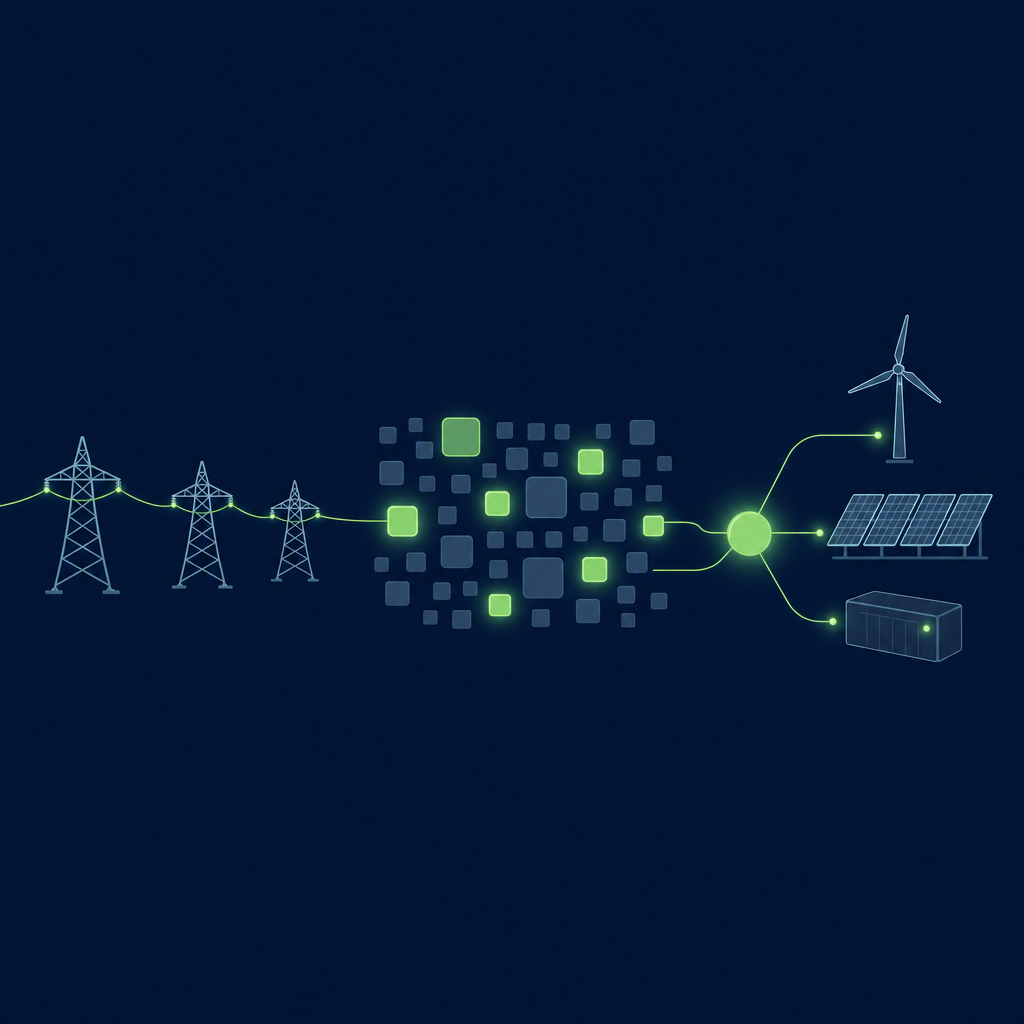
There is no single best b2b prospect database for energy and utilities; the right choice depends on which record you are short of. Broad databases such as ZoomInfo, Cognism, Lead411 and D&B Hoovers sell named people across thousands of companies. A specialist such as Industrial Info Resources sells plant- and project-level records with contacts attached. And the company list itself is free: the U.S. Energy Information Administration (EIA) publishes a census of electric utilities and a monthly inventory of planned power plants that any vendor's company list can be checked against. Score each option on the one rubric below, then test it on 50 of your own accounts before you buy.
Best B2B Prospect Database for Energy and Utilities: The Short Answer
- Build the company list first, from public records. The final 2025 Form EIA-861 files list 3,399 utility numbers: 1,820 municipal, 861 cooperative and 174 investor-owned among them. A vendor's "Utilities" industry filter is a sample of that census. The Ownership-First Filter below segments by owner type before anyone searches for a title.
- Most new power capacity is not being built by utilities. In EIA's inventory of planned generators as of August 2026, 1,865 of 2,311 generators (81%) and 229,474 of 288,544 megawatts belong to independent power producers. If you sell into new build, "utility" is the wrong segment label.
- Keep three record types apart. An asset record (the company, plant or project), a seat record (the person in a role) and an event record (a status change, a filing, a hire) come from different sources and go stale at different speeds. The Asset–Seat–Event Record gives each one fields, a source, a freshness rule and a confidence grade.
- No vendor here wins every column. Of the 12 rows in the Energy Database Rubric, one states plant-level energy coverage, two publish an energy list count, five publish prices and three contradict themselves on a headline figure. Pick by the record you are short of, not by a ranking.
What "Energy and Utilities" Means in a Prospect Database
This guide is for teams selling to energy and utility companies: equipment makers, engineering and construction firms, software vendors, consultancies and service providers. Some vendor pages answer a different question, how a utility markets to its own households and businesses; that is a consumer and small-business data problem and is not covered here.
The segment splits into buyers that a single industry code merges. Electric utilities differ by owner: investor-owned companies, city-owned municipal utilities, member-owned cooperatives, public power districts and federal and state agencies. Independent power producers (IPPs) and developers build and run plants without a retail service territory. Oil and gas companies, gas distributors and water utilities sit beside them in most vendor taxonomies. The registry examples in this guide are electric power, where federal census data is the most complete; the same three-record test applies to oil and gas, where the company layer goes stale through acquisitions, as the Programmatic B2B example in the rubric shows.
How to read the labels: Observed means the fact is on a vendor page or in a public file, with the source in the Sources list. Inference is a reading of observed data that you should test. Our view is the opinion of Lead Seeker, which publishes this page, and of the author, who is President of Percepture.
The Ownership-First Filter: 3,399 Utilities by Owner Type
The final 2025 Form EIA-861 data splits into a long form (1,721 utility numbers) and a short form, Form EIA-861S, which EIA uses for smaller utilities (1,678 utility numbers). No utility number appears in both. Counted together, by the ownership type each utility reports:
| Ownership type (Observed, EIA-861 2025) | Utility numbers | Of which short form | Buying route to confirm before outreach (Inference) |
|---|---|---|---|
| Municipal | 1,820 | 1,359 | A city-owned utility; check whether purchases above a threshold go through public bids and council or utility-board approval |
| Cooperative | 861 | 256 | Member-owned and board-governed; check whether a generation and transmission cooperative buys on its members' behalf |
| Retail Power Marketer | 251 | 0 | Sells energy, often without owning wires; a different buyer for grid hardware than a distribution utility |
| Investor Owned | 174 | 11 | Corporate procurement, with supplier qualification and rate-case scrutiny of spend |
| Political Subdivision | 137 | 48 | Public power districts and similar bodies; treat like municipal for procurement |
| Wholesale Power Marketer | 40 | 0 | Trading and supply; rarely a buyer for distribution equipment |
| Transmission | 29 | 0 | Transmission-only companies |
| Community Choice Aggregator | 26 | 0 | Local-government energy buyers |
| State | 24 | 2 | State power authorities |
| Municipal Marketing Authority | 14 | 0 | Joint-action agencies serving member municipal utilities |
| Behind the Meter | 13 | 0 | On-site generation providers |
| Federal | 10 | 2 | Federal power agencies |
| Total | 3,399 | 1,678 |
Three readings follow. First (Observed), 2,681 of the 3,399 utilities (79%) are municipal or cooperative, and half of all utility numbers file the short form. Second (Observed), EIA's 2017 analysis counted 168 investor-owned distribution utilities serving 72% of customers, against 1,958 publicly owned utilities averaging about 12,100 customers each. Third (Inference), a database priced or ranked by contact count will be deepest at the investor-owned companies, which are few and large, and thinnest at the municipal and cooperative utilities, which are most of the accounts. Test that on your own list before buying: sample 25 municipal or cooperative utilities from EIA-861 and count how many return a named person in the role you sell to.
Ownership also changes. The 2025 EIA-861 mergers file records ALLETE, Inc. with a merge date of December 15, 2025 and Alloy Parent LLC as the new parent. A company record built before that date carries the wrong parent, and any vendor field derived from the parent (revenue, headcount, procurement contacts) goes with it.
Where the New Projects Are: 2,311 Planned Generators by Owner and Status
Form EIA-860M is EIA's monthly update of generators of 1 megawatt or more. The release dated September 24, 2026 carries the inventory of planned generators as of August 2026; the next release is scheduled for October 23, 2026. Counting the planned tab:
- Scale (Observed): 2,311 generators at 1,581 plants, reported by 974 entities, totalling 288,544 MW of nameplate capacity.
- Owner (Observed): independent power producers (EIA's "IPP Non-CHP" sector) report 1,865 generators and 229,474 MW from 866 entities; electric utilities report 396 generators and 58,747 MW from 88 entities; commercial and industrial sectors report the other 50 generators.
- Timing (Observed): 985 generators at 524 entities, 83,774 MW, have a planned operation month between September 2026 and August 2027.
- Technology (Observed): solar photovoltaic 1,075 generators (122,059 MW), batteries 480 (64,403 MW), natural gas combined cycle 236 (47,146 MW), natural gas combustion turbines 172 (21,341 MW) and onshore wind 77 (18,665 MW).
Every generator carries a status code, and the status is the most useful field in the file for timing outreach. The Status-to-Seat Map pairs each status with the seat most likely to own a decision at that stage. The status and counts are observed; the seat and the action are our inference and should be tested on your own pipeline.
| EIA-860M status (Observed) | Generators | MW | What the record shows | Seat likely to own the next decision (Inference) | Sales action (Our view) |
|---|---|---|---|---|---|
| (P) Planned, regulatory approvals not initiated | 682 | 99,874 | A project exists on paper | Development and origination | Site, interconnection, permitting and study services |
| (L) Regulatory approvals pending, not under construction | 393 | 62,758 | Approvals are in process | Permitting, regulatory and environmental leads | Regulatory, environmental and engineering support |
| (T) Regulatory approvals received, not under construction | 224 | 27,180 | Cleared to build, not started | Procurement, project finance, engineering-procurement-construction (EPC) selection | Major equipment and EPC conversations |
| (U) Under construction, 50% complete or less | 486 | 54,707 | Building has started | Construction management and the EPC contractor | Construction services, balance-of-plant supply, site logistics |
| (V) Under construction, more than 50% complete | 371 | 25,207 | Late construction | Commissioning and the incoming operations team | Commissioning, operations software, training, hiring |
| (TS) Construction complete, not yet in commercial operation | 155 | 18,817 | Built, not yet operating | Operations and asset management | Operations and maintenance services, monitoring, spares |
Two limits sit inside this data. EIA excludes facilities below 1 MW of total nameplate capacity, which its own note says can be a large share of solar capacity. And the reporting entity is not always the employer of the people you will email: 755 of the 974 entity names include "LLC", Entergy Louisiana LLC among them, so the name alone does not tell you whether the record is a utility subsidiary, a developer or a single-project company. Mapping each entity to the company that staffs the project is a separate step, and it is the step most vendor databases skip because they start from people, not plants.
The Asset–Seat–Event Record: Fields, Source, Freshness, Verification, Confidence
A usable energy prospect record joins three records that age at different speeds. The table assigns each field a source, a freshness rule and a verification step, and grades it with the Confidence Grade from the guide to B2B contact verification methods: A for an accountable record checked within 30 days, B for one checked 31 to 90 days ago, C for a single secondary source or an accountable record older than 90 days, D for no source or no date. A record's overall grade is its lowest link.
| Record | Field | Best source | Freshness of that source (Observed) | How to verify | Typical grade at use (Inference) |
|---|---|---|---|---|---|
| Asset | Utility identity, ownership type, state, NERC region, RTO, activities (generation, transmission, distribution) | Form EIA-861 | Annual; final 2025 data | Match the EIA utility number to the company's own site | C for ownership and parent (annual); B or better after checking the mergers file and a company release |
| Asset | Plant, generator, capacity, technology, status, planned operation month | Form EIA-860M | Monthly; next release October 23, 2026 | Compare status month to month; confirm with the developer's announcement or a state siting docket | A in the month of release |
| Asset | Registered reliability functions | NERC Compliance Registry files | Registry matrix, change activity and deregistered files dated 09/28/2026 | Read the change activity file each month | A for registration; it says nothing about who buys |
| Asset | Parent company and acquisitions | Company releases; the EIA-861 mergers file | Event-dated | Read the acquirer's release; Chevron's October 5, 2020 release closed the Noble Energy acquisition | A on the release date |
| Seat | Name, title, function | Vendor database row | The vendor's stated cadence (rubric below) | Employer page, filing or a reply from the person | C until checked against an accountable record |
| Seat | Vendor row plus your own send | The vendor's stated cadence | Bounce result on your own send | B after a delivered send | |
| Seat | Persona and seniority labels | Vendor classification of the title | Changes when the title changes | Read with the title it came from; see the Four-Tier Persona Ledger in the persona-level intelligence contact summary | Mapped, not Recorded |
| Event | Status change, new plant, retirement | Form EIA-860M | Monthly | Two consecutive releases | A in the month of change |
| Event | Hire, posted role, funding, executive change | Employer careers page, press release, filing | Event-dated | The primary page | A within 30 days of the event |
| Event | Project probability and plant contacts | Industrial Info Resources | "Data Updated - Jul 2026"; plant contacts carry a QC date | Read the QC date on each contact | Grade from the QC date |
The rule that follows is short. Store the EIA utility number and the EIA plant ID as external keys on the CRM account, so that each monthly 860M release can be matched to the right account without a fuzzy name match. Then personalise only on fields graded A or B, and send only to seats whose role has been checked against an accountable record. The EIA files used here carry no named contacts, so the seat layer always comes from somewhere else: a vendor, the employer's own pages or your own research.
The Energy Database Rubric: 12 Vendors on the Same Columns
The rubric covers the vendors that appear when buyers look for the best b2b prospect database for energy and utilities: the broad databases ZoomInfo, Cognism, Lead411 and D&B Hoovers; the account-based platforms Demandbase and 6sense; the orchestration tool Clay; the energy and industrial specialist Industrial Info Resources; the list sellers LakeB2B, Programmatic B2B and Salesgenie; and Lead Seeker, which publishes this page. Every cell comes from the vendor's official pages; prices and plan details are an October 2026 snapshot. "Not described" means the vendor's pages are silent, not that the capability is absent. Rows are grouped by function and are not ranked.
| Vendor | Function | Energy coverage its pages state | Record unit and scale | Source its pages name | Freshness statement | Verification statement | Published price (cadence as stated) | Relationship |
|---|---|---|---|---|---|---|---|---|
| ZoomInfo | Broad database | Not described | "500M+ verified professional profiles, 158M+ locations, 122M+ company records"; one credit per exported profile | AI and machine learning plus researcher validation | "Always-on streaming updates" | "SMTP-level validation"; a "Researcher Validates" step | Packages without figures | None |
| Cognism | Broad database | Not described | One credit per contact reveal, reused for the contract unless the contact changes jobs | Not described beyond its data programme | A "popularity score" decides "which profile to prioritise for freshness and accuracy checks" | "Phone-verified mobile numbers"; data scientists "manually verify our outputs" | No figures | None |
| Lead411 | Broad database | Not described on product pages; its blog ranks itself first for energy and cleantech | Exports | Not described | Emails "re-verified every 3-6 months" | "SMTP, human-verified, and email open validation"; "97% verified" (a deliverability average) and "96%+ accuracy" on the same site | $49/month for 1,000 exports; $490/year for 12,000 exports; higher tiers $150/month and $1,500/year; 7-day trial with 50 exports | None |
| D&B Hoovers | Broad database | Not described | Company and contact records | Dun & Bradstreet data; intent, triggers and website engagement listed | Not described | Not described | No figures | None |
| Demandbase | Account-based platform | Not described | "200M+ AI-curated contacts" on its contact-data page; its July 15, 2026 blog says 176M+ | Not described beyond AI curation | "We verify email addresses every 30 days" | A "wrong info" flag checked by people | Platform fee plus a "flat fee per user"; no figures | None |
| 6sense | Account-based platform | Not described | Data credits that "unlock and export emails, phone numbers and enriched contact and company records" | Intent signals | Not described | Not described | No figures | None |
| Clay | Orchestration across providers | Depends on the providers a table calls | Actions and data credits | Multiple providers in "multi-provider waterfalls" | Depends on the provider | Depends on the provider | Free: 500 actions and 100 data credits a month; Launch "Starts at $60/mo" monthly, $54/mo annual; Growth $205/mo monthly, $185/mo annual; data credits priced separately | None |
| Industrial Info Resources | Energy and industrial specialist | 338,406 operational plants and 253,395 active projects across the industries it covers; projects of 5 MW and up from investor-owned, cooperative, municipal and government utilities and from non-utility and merchant power producers; transmission lines and substations of 69 kV and up | Plant, project and contact records; 1,402,884 contacts | "Primary research since 1983" by human researchers | "Data Updated - Jul 2026"; "Plant contacts carry a QC date" | Human research; contacts with phone, email and LinkedIn "where available" | Not published | None |
| LakeB2B | List seller | "Energy and Utilities Professionals" list: 792,886 US records (634,309 with email) and 908,666 international (454,333 with email); the same page also shows "739K+" | List records | "Permission based" | "Last updated September 12, 2026"; "SMTP verified on a quarterly basis" | "1.2 million" verification calls a month | Quote only | None |
| Programmatic B2B | List seller | 101 energy companies drawn from the Fortune 1000 | 20,311 US email records (36,637 global); 18,865 US data-license records | The Fortune 1000 energy list | Not described; its company table still lists Noble Energy, acquired by Chevron in October 2020 | Not described | $210 per 1,000 emails; $30 per 1,000 display records; $350 per 1,000 data-license records | None |
| Salesgenie | List seller | Energy and utility lead lists | Business and contact records | "Public sources, other data providers, user submitted data, and our own powerful research" | Not described | Refund for undeliverable data | From $149/mo | None |
| Lead Seeker | Signal-led dossiers | Not described as a fixed list; searches run against the accounts and roles you describe | Lead Units, one per dossier | Public buying signals: hires, funding, posted roles, tech changes, earnings transcripts | Lead Compass refreshes weekly; a saved contact is refreshed only when a user asks (1 Lead Unit) | A verified contact in each dossier, with the source linked | Pilot $99 one-time for 14 days (50 Lead Units); Starter $149/mo; Growth $499/mo; Scale $1,299/mo; Enterprise from $4,500/mo | Publishes this page |
Four readings follow, all Observed. One row, Industrial Info Resources, states plant- and project-level energy coverage; three rows (LakeB2B, Programmatic B2B and Salesgenie) sell an energy list; the broad databases and account-based platforms state no energy-specific count. Five rows publish price figures (Lead411, Clay, Programmatic B2B, Salesgenie and Lead Seeker) and seven do not. Four rows give a dated or periodic freshness statement (Lead411, Demandbase, Industrial Info Resources and LakeB2B). Three vendors contradict themselves on a headline figure: LakeB2B's two list counts, Lead411's 97% and 96% figures, and Demandbase's 200M+ and 176M+ contact counts.
The Programmatic B2B row is the clearest case for checking the company layer. Its energy table lists Noble Energy, which Chevron finished acquiring on October 5, 2020; any contact sold under that company name is attached to an employer that no longer exists as an independent buyer. The general argument for checking records at the moment of use, rather than trusting a list's build date, is set out in real-time lead data vs a static database.
Decision Criteria: Which Database Fits Which Energy Sales Motion
Seven criteria decide which is the best b2b prospect database for energy and utilities for your team, and each is a count or a document you can collect in a week:
- Company coverage against the census. Of 50 utilities or power producers sampled from EIA-861 or EIA-860M, how many does the vendor recognise as companies?
- Seat coverage at small accounts. Of 25 municipal or cooperative utilities, how many return a named person in the role you sell to?
- Record unit. Does the vendor sell people, plants, projects or lists? Buy the unit that matches your sale.
- Freshness statement. Is there a stated cadence, and does it cover the role or only the email?
- Verification statement. What exactly is checked: mailbox, phone, role, employer?
- Price you can model. A published price, or a quote you can compare per working contact. The best B2B contact database guide ranks general-purpose vendors by workable contact cost.
- Relationship. Does the publisher of the comparison sell one of the products? Lead411's energy and cleantech roundup, for example, ranks Lead411 first.
Our view, by situation:
| Situation | The record you are short of | Start with | Check it with |
|---|---|---|---|
| Enterprise sale to large investor-owned utilities and IPPs, under 200 named accounts | Seats and buying-group context | A broad database or an account-based platform (ZoomInfo, Cognism, D&B Hoovers, Demandbase, 6sense) | Employer pages and filings for each seat; EIA-861 for parent and ownership |
| Volume sale to municipal and cooperative utilities | Seats at small organisations | EIA-861 as the account list, then a broad database for people | The 25-account seat test above; utility websites and board pages |
| Selling into power projects (equipment, EPC, services) | Project stage and site contacts | Industrial Info Resources for project records; EIA-860M status for timing | Two consecutive 860M releases; the developer's announcements |
| Small team with a fixed budget | A modelled cost per working contact | A row with published prices (Lead411, Clay, Lead Seeker) plus the free EIA files | A 50-record test with bounces and role checks counted |
| A one-off email campaign from a rented list | Permission, freshness and the company layer | A list seller only after a sample check | The Noble Energy test: look for acquired or renamed companies in the sample |
From Clean Data to a Sales Action
A clean record earns a touch only when it carries a reason. The sequence below turns the three records into one action, and each step has an owner.
- Account list (RevOps). Filter EIA-861 by ownership type, state, RTO and activity, or EIA-860M by status and planned operation month. Store the EIA utility number or plant ID on the CRM account.
- Entity to employer (RevOps). Map each 860M entity or LLC to the company that employs the decision makers; record the source of the mapping.
- Seats (SDR lead). Pull people for the seats in the Status-to-Seat Map from a database, then check each role on the employer's own page. Grade each link.
- Event (SDR). Attach a dated event: a status change between monthly releases, a hire, a posted role, a registration change. For how intent and trigger strength combine into a qualification decision, Percepture's guide on how to use intent data to identify sales qualified leads separates fit, timing and trigger.
- First line (SDR). Write the opening from the A- or B-graded event only. "Your Pine Ridge battery project moved to under construction in the August EIA inventory" (an invented project) is checkable; a persona read is not.
- Send (SDR, with a compliance owner). The FTC states that CAN-SPAM "makes no exception for business-to-business email"; each separate email in violation can draw a penalty of up to $53,088, and opt-outs must be honoured within 10 business days. Public power entities may also publish their own vendor-contact rules during an open solicitation; read the solicitation before writing to anyone named in it.
A worked example (partly invented)
Halvard Grid Sensors is an invented company selling distribution-line monitoring sensors. Only the EIA counts below are real; every other figure is invented to show how the record reads.
- Account list (real). The 2025 EIA-861 long-form file lists 98 cooperatives that report operating in MISO and doing distribution. Halvard stores each utility number on a CRM account.
- Seat test (invented). A broad database returns a named operations or engineering manager at 61 of the 98. A rep checks 25 of those on the cooperatives' own staff and board pages: 19 match the stated role, 4 have moved and 2 cannot be confirmed. The 61 enter the CRM graded C; the 19 confirmed seats move to A.
- Events (invented). Three of the 98 cooperatives posted a grid-modernisation engineering role in the past 30 days, and one appears in a member generation and transmission cooperative's announcement of a new substation. Those four accounts get a first email that names the event.
- Result (invented). Of the 19 A-graded seats, 2 bounce, 3 reply and 1 meeting is booked, from the account with the posted role. The decision is to keep the broad database for people at cooperatives, keep EIA-861 as the account list, and re-run the role check before each new sequence.
The point of the example is the order: the census fixes the accounts, a vendor supplies people, and only checked roles and dated events reach a prospect.
What Each Source Type Cannot Tell You
- Public registries are complete for what they cover and silent on people. EIA-861 is annual, so ownership and parent fields lag events such as the ALLETE transaction; EIA-860M excludes plants under 1 MW and reports planned dates that are the respondent's own plans.
- Broad databases state global scale but no energy-specific count, and their freshness statements cover the email or the profile, not always the role.
- Account-based platforms sell intent and account context; their contact data is sold through credits, and none of the pages in the rubric states an energy count.
- Specialists such as Industrial Info Resources cover plants and projects across several industries and do not publish prices; contacts carry phone, email and LinkedIn "where available".
- List sellers publish counts and update dates, but two of the three energy lists in the rubric show either conflicting counts or a company layer that includes an acquired company.
Where Lead Seeker Fits
Lead Seeker, which publishes this page, is not an energy list and has no plant or project records. It fits the event and seat layers: in how Lead Seeker works, the ideal customer profile comes first, Lead Compass turns public signals (hires, funding, posted roles, technology changes, earnings transcripts) into a source-backed brief, and each search returns a verified dossier that syncs to Salesforce or HubSpot. For an energy team, that means pairing it with the EIA files for the account list and, for project timing, with EIA-860M or a project database. Plan prices are on the Lead Seeker pricing page; Lead Units are spent only when someone runs a search.
Frequently Asked Questions
What is the best B2B contact database right now?
No single database is best for every motion, and for energy and utilities the answer depends on the record you are short of. Broad databases such as ZoomInfo, Cognism, Lead411 and D&B Hoovers sell people across industries; Industrial Info Resources sells plant and project records with contacts; the free EIA-861 and EIA-860M files give the company and project list. For general-purpose vendors ranked by cost per workable contact, see the best B2B contact database guide linked in this article.
What are some reputable B2B database companies for energy and utilities?
The vendors in the rubric above publish verifiable facts about their data: ZoomInfo, Cognism, Lead411, D&B Hoovers, Demandbase, 6sense, Clay, Industrial Info Resources, LakeB2B, Programmatic B2B, Salesgenie and Lead Seeker. Reputation is best judged on what each states about source, freshness and verification, and on a 50-record test with your own accounts, rather than on a ranking published by one of the vendors being ranked.
How much does B2B data cost?
Among the vendors in the rubric, published prices run from Clay's free plan with 100 data credits a month, through Lead411 at $49 a month for 1,000 exports, Salesgenie from $149 a month and Lead Seeker's Starter plan at $149 a month, to Programmatic B2B at $350 per 1,000 data-license records. ZoomInfo, Cognism, D&B Hoovers, Demandbase, 6sense, Industrial Info Resources and LakeB2B do not publish figures. Compare on cost per working contact after your own test, not on list price.
Is there a free B2B contact database available?
For the company layer, yes: EIA's Form EIA-861 and EIA-860M files and NERC's compliance registry files are free to download, and EIA states that U.S. government publications are in the public domain, with an acknowledgment requested. They contain no named contacts. For people, free access is limited to trials and free tiers, such as Clay's 100 data credits a month and Lead411's 7-day trial with 50 exports.
Sources
- U.S. Energy Information Administration, Form EIA-861 detailed data files: final 2025 Utility Data, Short Form, Sales to Ultimate Customers and Mergers files; ownership counts in this guide are computed from these files.
- U.S. Energy Information Administration, Form EIA-860M, Preliminary Monthly Electric Generator Inventory, released September 24, 2026: Inventory of Planned Generators as of August 2026; owner, status, timing and technology counts computed from the planned tab.
- U.S. Energy Information Administration, Form EIA-860 detailed data: generator-level scope of 1 MW and above.
- U.S. Energy Information Administration, Investor-owned utilities served 72% of U.S. electricity customers in 2017, August 15, 2019.
- U.S. Energy Information Administration, Copyrights and Reuse.
- North American Electric Reliability Corporation, Compliance Registry Files: registry matrix, change activity and deregistered entities, dated September 28, 2026.
- Federal Trade Commission, CAN-SPAM Act: A Compliance Guide for Business.
- Chevron, Chevron Completes Acquisition of Noble Energy, October 5, 2020.
- ZoomInfo, Data and Pricing.
- Cognism, Diamond Data and Pricing.
- Lead411, home page and Pricing; Top 5 B2B Data Providers for Energy / CleanTech Companies in 2026, December 17, 2025.
- Dun & Bradstreet, D&B Hoovers.
- Demandbase, What is a B2B Contact Database?, Pricing and 15 best B2B data vendors and providers for 2026, July 15, 2026.
- 6sense, Pricing.
- Clay, Pricing.
- Industrial Info Resources, home page, Industrial Project Database & PEC Reports and Global Electric Power Database & Market Intelligence.
- LakeB2B, Energy and Utilities Professionals Email List, last updated September 12, 2026.
- Programmatic B2B, Energy Prospect Database.
- Salesgenie, Energy Leads and Utility Prospect List.
- Lead Seeker, Pricing, How it works and Lead Compass.
- Percepture, How to Use Intent Data to Identify Sales Qualified Leads. Percepture is the company where the author is President.
About the Author
Bob Generale is President of Percepture. He works across SEO, AI search, digital PR, sales intelligence and AI-powered revenue systems, with a focus on connecting visibility, buyer intent and sales action.
Next Steps
Before you choose the best b2b prospect database for energy and utilities, download the EIA-861 and EIA-860M files, pull 50 accounts in your segment, and run the seat test on two vendors from the rubric. To add dated public triggers and verified seats to that list, see how Lead Seeker works end-to-end, read how Lead Compass turns market signals into prospecting direction, or talk to sales about running the 50-account test on your own energy accounts.