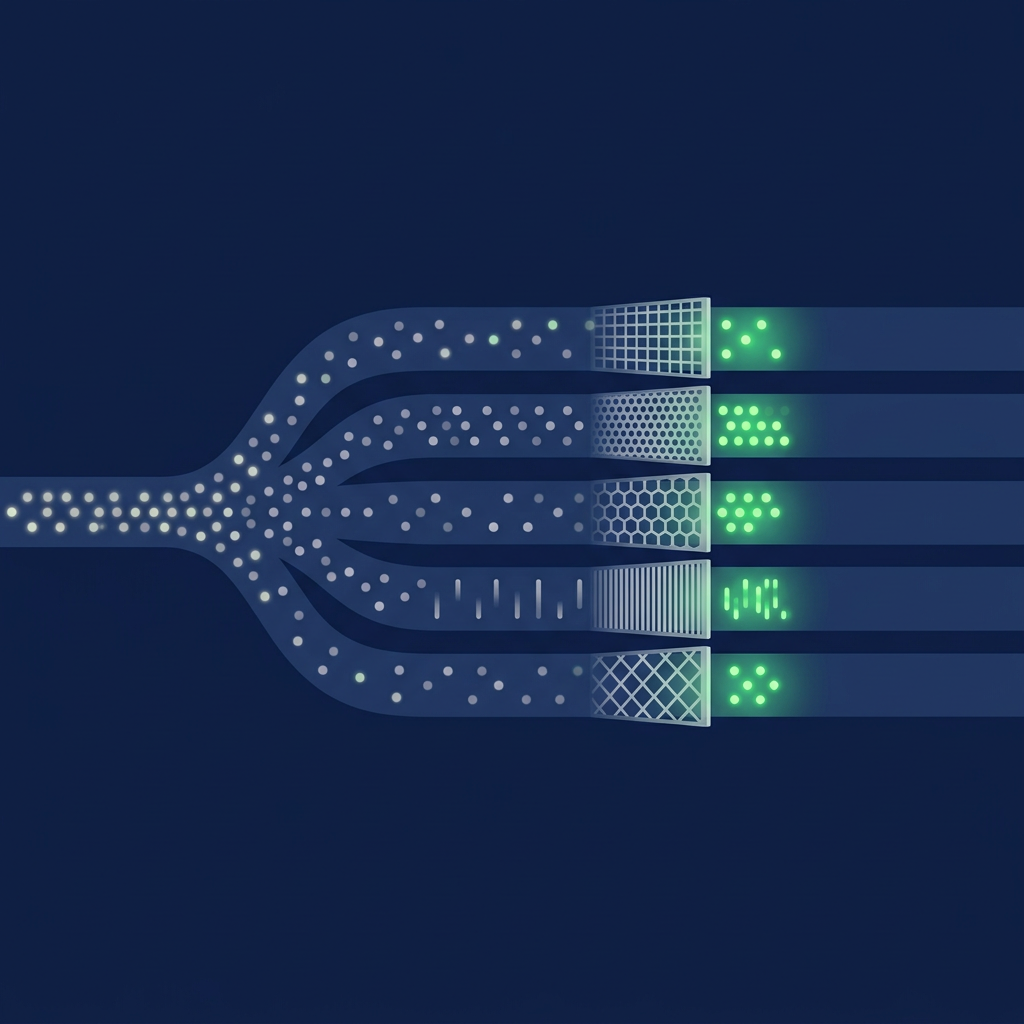
A website visitor identification vendors comparison holds up when every vendor is lined up on the same four facts: the identity it returns (a company or a named person), the unit it bills (identified companies, resolutions, credits, seats or a platform fee), the visitors it covers by geography, and the coverage figure it publishes with that figure's own base. On those facts the eight vendors below fall into three groups, five of them publish prices, and no published match rate ranks them against each other. A pilot on your own traffic does.
Website Visitor Identification Vendors Comparison: The Short Answer
- Company-level vendors that bill per identified company. Leadfeeder (free Lite plan up to 100 identified companies a month; Discover from $79 a month billed annually), Snitcher (€49 a month billed annually for up to 50 company IDs) and Factors.ai (Lite at $199 a month after trial, up to 1,500 companies identified a month).
- Person-level vendors. RB2B bills per "resolution" and states that "Contact-level (person) ID is US only"; its Starter plan is $79 a month for 300 resolutions. Warmly returns names and work emails, and the pages cited here publish no price. On June 30, 2026, Warmly announced an agreement to be acquired by HubSpot.
- Platforms with visitor identification inside a larger contract. 6sense lists "Web Visitor Identification" in all three of its Sales Intelligence packages without a price; Demandbase prices with "a clear platform fee" plus "a flat fee per user"; Unify resolves companies through 6sense, Clearbit Reveal, Demandbase and Snitcher and sells seats with credits from $20 a seat a month.
- Coverage claims do not compare. RB2B's home page says "70-80%" of your traffic, its own pricing table shows "15-20% Coverage" or "35-45% Coverage" by plan, and Factors.ai says it identifies "up to 40% of the US visitors via RB2B integration". Three figures, three bases. The Holdout Bake-Off below is how to get one number that applies to your site.
Lead Seeker, which publishes this page, is not one of the eight and does not identify website visitors. It works in the step after a vendor names a company, and the section near the end says how.
What You Are Buying: a Signal, Not Proof of Intent
Every vendor in this comparison sells the same signal type: a first-party observation (a page load on your own site, with its IP address, cookie, path and time) joined to an identity the vendor infers from its own database or graph. The visit is recorded. The identity is a probability; Demandbase's help centre calls its model "probabilistic" and says such models "involve some margin of error". Any reading of purchase intent is a second inference on top of that.
A buying signal is an observation consistent with buying and with other explanations: a competitor benchmarking your pricing, a candidate reading your careers page, a current customer checking documentation. Proof of purchase intent is a declared act: a demo request, a trial started with a work email, a reply that asks a question. No vendor below turns a visit into proof. The Resolution Stack in our guide to website visitor identification platforms labels which layer produced an identity, and its Five-Gate Visit Test sets what a visit must pass before a rep acts on it. This page assumes both and deals with the purchase: which vendor, on what terms, tested how.
Among the sources set out in how intent data sources differ, visitor identification is the one observed on your own property, which is why it pairs with, rather than replaces, the third-party topic data covered in best intent data providers. For the vocabulary underneath both, Percepture's primer on what is B2B intent data is a useful starting point.
Decision Criteria to Settle Before Price
Price is the last column to read. These seven criteria decide whether a price is even comparable.
- Identity level. Company-level vendors match an IP address to an organisation. Person-level vendors match a cookie or device identifier to a contact record. Leadfeeder states that "Individual visitors are not shown by default"; 6sense says it identifies companies "even if the individual visitors remain anonymous". If your next step is account research, company-level is the product. If your next step is a named touch, you are buying person-level, and its geography limits.
- Billing unit. One identified company, one delivered visitor ("resolution"), one credit, one seat or one platform fee. The units are not interchangeable; the Billing-Unit Ladder below converts the published ones.
- Geography and consent. RB2B: "Contact-level (person) ID is US only" and "Company-Level ID is global on every plan", with consent capture required for global company-level identification under GDPR. Snitcher states that it processes data "under the legitimate interest basis (Art. 6(1)(f) GDPR)". Demandbase says coverage is "limited in India, the Middle East, and APAC". Where your visitors sit decides which vendors can serve you before any trial starts.
- Where the output lands. Slack alerts, a CRM record, a sequence or an ad audience. Unify's Pro plan syncs HubSpot and Salesforce "Read-only"; its Business plan is "Read / Write". RB2B's Free plan pushes to Slack, and its Starter plan pushes LinkedIn URLs to Slack or Teams with "No Other Integrations".
- History and retention. Leadfeeder's free plan keeps "7 days of visitor history". Factors.ai retains free-plan data for one month and paid-plan data for 90 days after cancellation.
- Contract and trial. Trial length, card requirement, and whether annual billing is required. Leadfeeder's Scale plan is "Billed annually only"; Snitcher states "no long-term contracts or cancellation fees"; Factors.ai says "We typically bill on annual contracts".
- Coverage claim and its base. Ask what the numerator and the denominator are. The Coverage Claim table below lists eight published figures; none shares a base with another.
Evidence Table: Eight Vendors on One Rubric
Prices and terms are an October 2026 snapshot of each vendor's own pricing or product page, cited in Sources. A cell reads "Not described" where the cited pages do not say. Vendors are listed alphabetically; the order is not a ranking.
| Vendor | Identity level, in the vendor's words | Billing unit | Entry price as published | Free plan or trial | Geography and consent statement | Where output lands |
|---|---|---|---|---|---|---|
| 6sense | Company: identifies companies "even if the individual visitors remain anonymous" | Package plus "Data credits" | No price; three Sales Intelligence packages each list "Web Visitor Identification" | Not described | "obtain consent where necessary and provide clear opt-out options" | "CRM, SEP, Web App" integrations listed in each package |
| Demandbase | Company; the help centre says it "identifies which companies and employees are browsing your website" | "a clear platform fee" plus "a flat fee per user" | No price; request form | Not described | Coverage "limited in India, the Middle East, and APAC"; "does not show IP addresses for identified accounts" | Demandbase One; the pricing page says its data solutions can "integrate our B2B data and AI-driven insights into your existing systems" |
| Factors.ai | Company; person-level through a "User identification (RB2B)" add-on, "US traffic only" | Monthly tracked users, companies identified per month, seats | Lite "$199/mo after trial" (up to 1,500 companies a month, 3 seats); Basic "$6K per year"; Growth "$20K per year" | Trial with "No credit card required" | "We're fully GDPR-compliant"; free-plan data kept 1 month | Slack and Microsoft Teams alerts on Lite; audience sync to Google and LinkedIn Ads on the Enterprise plan |
| Leadfeeder (Dealfront) | Company: "Individual visitors are not shown by default" | Identified companies a month, plus credits | Lite $0 (up to 100 companies a month); Discover from $79 a month billed annually or $113 monthly; Activate from $369 or $527; Scale from $599, annual only | 14-day trial of every feature, no card | "Visitor data processed in line with GDPR legislation" | Discover lists real-time alerts, CRM push, and outreach and retargeting automation |
| RB2B | Person (US) and company (global) | "Monthly Resolutions": "one identified website visitor that RB2B delivers to you" | Free $0 (150 company-level resolutions, Slack); Starter $79/mo (300, LinkedIn URLs, no emails); Pro from $149/mo (600, business emails) | 7-day trial, no card | "Contact-level (person) ID is US only"; consent capture required for global company-level ID under GDPR | Slack and Teams; Pro adds "All Other Integrations" |
| Snitcher | Company; "Contact-level identification" listed as a feature | "unique companies we ID each month" | €49/mo billed annually (€79 monthly) for 0–50 company IDs, up to €529/mo annually for 4,001–5,000 | 14-day trial, no card | "legitimate interest basis (Art. 6(1)(f) GDPR)" | CRM sync with HubSpot, Salesforce and Pipedrive on every plan |
| Unify | Company through "6sense, Clearbit Reveal, Demandbase, and Snitcher"; person from your own identify events | Seats plus credits | Free $0; Base $20 a seat a month (800 credits); Pro $60 a seat a month (2,400 credits) | Free plan; 14-day Pro trial | Not described; SOC 2 Type II stated | HubSpot and Salesforce, read-only on Pro, read/write on Business |
| Warmly | Person and company: "name, work email, job title, and LinkedIn profile" | Not described on the pages cited | Not described on the pages cited | Not described | "GDPR Compliant" shown on the use-case page | Auto-sync to HubSpot and Salesforce; rep alerts |
Three points follow from the table.
- Five of eight publish a price you can use without a call: Factors.ai, Leadfeeder, RB2B, Snitcher and Unify. 6sense, Demandbase and Warmly do not, which makes the pilot terms the negotiable part of those three deals.
- Person-level identification has a geography in every case the pages describe it. RB2B's person-level product and Factors.ai's RB2B add-on are both stated as US-only. A team whose buyers sit in Europe is choosing among company-level products.
- Warmly's buyers should read the acquisition notice. Warmly's announcement of June 30, 2026 says "Today, your existing contract, pricing, account team, product experience, and integrations remain unchanged." The word "today" is the term to ask about in a multi-year renewal.
The Billing-Unit Ladder: What One Unit Costs at Each Vendor's Cap
The Billing-Unit Ladder divides each published price by the number of units it includes, so that a euro-per-company plan and a dollar-per-resolution plan can sit in one table. It is arithmetic on the vendors' own figures, at the plan cap; your real cost per useful record is higher, because some identified companies will fail your ICP filter.
| Vendor and plan | Published price | Units included | Price per unit at the cap | What one unit is |
|---|---|---|---|---|
| Factors.ai Lite | $199/mo | 1,500 companies identified | $0.13 | One company identified in the month |
| Factors.ai Basic | $6,000 a year | 3,000 companies a month | $0.17 | One company identified in the month |
| Snitcher, 0–50 band | €49/mo annual; €79 monthly | 50 company IDs | €0.98 annual; €1.58 monthly | A company identified "for the first time within your billing period"; "Return visits from the same company don't count" |
| Snitcher, 4,001–5,000 band | €529/mo annual; €779 monthly | 5,000 company IDs | €0.11 annual; €0.16 monthly | Same as above |
| RB2B Starter | $79/mo | 300 resolutions | $0.26 | One identified visitor delivered, as a LinkedIn URL without an email address |
| RB2B Pro | $149/mo | 600 resolutions | $0.25 | One identified visitor delivered, with a business email address |
| Leadfeeder Lite | $0 | 100 identified companies | $0 | One identified company; 7 days of history |
| Leadfeeder Discover | From $79/mo annual | "Tiered"; the cap is not on the page | Cannot be computed | One identified company |
| Unify Base | $20 a seat a month | 800 credits | $0.025 per credit | Credits are spent per action; the page puts "web intent" at "a 1 credit average" |
Two readings matter more than the per-unit figures. First, a company ID and a person resolution are different goods: one tells you a building, the other a name, so the cheaper unit is not the cheaper outcome. Second, the counting rules differ. Snitcher counts a company once per billing period however many times it returns; RB2B counts each delivered visitor. A site whose accounts return many times a month will spend units very differently on the two.
Coverage Claims and What They Count
The Denominator Check in our platforms guide set out the first published rates. The table below adds the figures that appear on pricing and product pages in this comparison, with the confidence this page assigns to each. "Vendor claim" means a figure published by the vendor it describes and not audited here. "Unsourced summary" means a third party states a figure without naming its source.
| Published figure | Publisher and page | Date on source | What it counts | Confidence |
|---|---|---|---|---|
| "Identify 70-80% of your website traffic" | RB2B, home page | Undated | Website traffic, people and companies | Vendor claim |
| "15-20% Coverage" (Free to Pro) and "35-45% Coverage" (Pro+), for contact-level US and company-level global | RB2B, pricing table | Undated | Coverage per plan; base not stated | Vendor claim |
| "capturing over 75% of anonymous traffic" at company level; "up to 40% of the US visitors via RB2B integration" | Factors.ai, website visitor identification product page | Undated | Anonymous traffic; US visitors | Vendor claim |
| "up to 45% of your B2B visitors on a company-level" | Leadfeeder, web visitors page | Undated | B2B visitors | Vendor claim |
| "about 20 percent of B2B traffic, translating to roughly 10 percent of all site traffic" | Demandbase, help centre FAQ | Undated | B2B traffic, client-side integration | Vendor claim |
| "identify more than half of the visitors who never filled out a form" | Warmly, acquisition announcement | June 30, 2026 | Visitors who did not fill out a form | Vendor claim |
| "15-30% of B2B website traffic at the company level" for IP-based tools | ZoomInfo, 12 Best Website Visitor Tracking Tools in 2026 | Updated June 14, 2026 | B2B traffic, IP-based tools in general | Unsourced summary |
| "only 3-4% of B2B visitors fill out forms" | 6sense, anonymous visitor identification page | Undated | Form-fill rate; the page cites unnamed studies | Vendor claim |
The RB2B rows are the sharpest case. The same vendor publishes "70-80%" on its home page and "15-20%" to "35-45%" by plan on its pricing page, and a partner page gives "up to 40%" for the same person-level product. They may all be accurate on their own bases. None of them is your base.
The Holdout Bake-Off: How to Test Two Vendors on Your Own Traffic
The Holdout Bake-Off scores vendors against identities you already know to be true: the visitors who later declared themselves through a form, a demo request, a trial or a login. Because you hold those identities independently, you can check whether a vendor named the right company or person from the anonymous sessions before the declaration.
- Shortlist two vendors, at most three, from the groups your criteria allow. Install the tags on the same pages for the same weeks, inside your consent flow where your visitors' jurisdictions require one.
- Write the rules first. The trial window, the pages in scope, the exclusions (customers, employees, competitors, suppliers, candidates) and the decision rule, all written before the tags go live.
- Build the holdout. At the end of the window, list every declared identity whose earlier anonymous sessions fall inside the window. Do not push these records into the vendors' tools during the trial.
- Score each vendor on the measures below, using the vendor's export rather than its dashboard summary.
- Price your volume. Apply the Billing-Unit Ladder to the number of identified records each vendor produced, not to the plan cap.
| Measure | How to compute it | What it tells you |
|---|---|---|
| Holdout recall | Holdout identities the vendor resolved from pre-declaration sessions ÷ all holdout identities | How much of your known traffic the vendor sees |
| Holdout precision | Correct resolutions (same company domain, or same person) ÷ all resolutions the vendor made for holdout sessions | The share of its answers that are right |
| ICP pass share | Identified companies that pass your ICP filter ÷ all identified companies | How much of the bill is usable |
| Cost per usable record | Your monthly cost at trial volume ÷ ICP-passing records | The number that belongs in the budget |
| Time to destination | Minutes from session to Slack alert or CRM record | Whether output arrives inside your response window |
| Confidence field | Whether each record carries a confidence value you can export | Whether you can set a threshold after purchase |
Holdout recall and precision measure the vendor on visitors who later declared, who are not a random sample of all visitors; treat the scores as a comparison between vendors on the same traffic, not as a general match rate. A site with few declarations in the window will produce a small holdout, and a longer window is the fix.
Matching a Vendor to Your ICP, Timing, Contact Step and Next Action
The table maps the buying situation to the identity level it needs, the vendors whose published terms meet the condition, and what happens after the reveal. "Meets the condition" means the cited pages state the capability; it is not a recommendation.
| Your situation (ICP and geography) | Identity level needed | Vendors whose pages meet the condition | Timing the output must meet | Contact relevance step | Next action |
|---|---|---|---|---|---|
| Buyers in the EU or UK; account-based outbound | Company | Leadfeeder, Snitcher, Factors.ai (company level), 6sense, Demandbase | Days | Name the role that owns the pages read; find the person through a contact source | Account research, then a first line on a public trigger, not on the visit |
| Buyers in the US; rep-led outbound wanting names | Person | RB2B, Warmly, Factors.ai with its RB2B add-on | Same day | Compare the title with the pages read; a title that does not own the decision is a door into the account | A relevant touch that does not cite the visit |
| ABM programme already running 6sense or Demandbase | Company | The platform you already license | Days | Buying-group roles from the platform's account record | Ads plus SDR research on accounts that pass your gates |
| Team already on Unify for sequencing | Company through providers | Unify Reveal, or your connected 6sense, Demandbase or Clearbit Reveal account | Hours to days | Unify's own contact data or your contact source | A Play triggered by the account's visits |
| Low-traffic site testing whether visitor identification earns a budget line | Company | Leadfeeder Lite (100 companies a month), RB2B Free (150 company-level resolutions) | Weekly review | Manual | Decide after one sales cycle whether identified accounts reached pipeline |
When a company-level reveal passes your gates, the open question is the person. Percepture's guide to using intent data to identify sales qualified leads covers the qualification rule between an identified account and a rep, and teams that want first-party visits, third-party topics and public triggers joined into one qualification step can look at Percepture's B2B intent data services. For how account-level scores are built before any visit is attached, see account intent data; for where a visit sits next to other evidence, see buying signals vs intent data.
A worked example (invented)
Harrowgate Metrology, an invented company, sells calibration software to manufacturers in the United States and Germany. Its buyers are quality managers. It writes its rules before the trial: pricing, integrations and security pages in scope; customers and suppliers excluded; a four-week window; the decision goes to the vendor with the higher holdout precision unless the other vendor's cost per usable record is lower by more than a third.
The criteria narrow the field before any trial. German visitors rule out person-level identification for half the market, because the person-level products in this comparison are stated as US-only. Harrowgate's next step is account research, so company level is enough. It trials Leadfeeder and Snitcher in parallel, both on 14-day free trials, and extends with a paid month on whichever passes the first two weeks. At the end it compares the two exports against the quality managers who requested demos during the window, applies the Billing-Unit Ladder to the identified companies that pass its manufacturer filter, and takes the result to procurement with its own numbers instead of the vendors' coverage claims.
When a Visitor Identification Vendor Is the Wrong Purchase
A visitor identification vendor sees the traffic that already found you. If your site draws few visits from your ICP, the vendor has little to identify, and the budget belongs to discovery sources described in how intent data sources differ. If your buyers sit outside the United States and your process needs a named person, the person-level products here do not cover them. If your team has no rule for what happens after a reveal, an alert in Slack becomes a list nobody works. Each of these is cheaper to establish before signing than after.
Where Lead Seeker Fits
Lead Seeker does not identify anonymous website visitors and installs no pixel. Once a vendor in this comparison names a company that fits your profile, Lead Seeker returns verified decision makers in the roles you describe at that account, each with the public signal that surfaced the person and the freshness date on the record. In the table above, that is the contact relevance step for the company-level rows. Current plans are on the transparent monthly pricing page.
Frequently Asked Questions
Which website visitor identification vendor has the best match rate?
No published figure answers that, because each vendor states its rate over a different base. RB2B publishes 70-80% on its home page and 15-20% to 35-45% coverage by plan on its pricing page; Leadfeeder publishes up to 45% of B2B visitors at company level; Demandbase publishes about 20 percent of B2B traffic for its client-side integration. Run two vendors on the same traffic for the same weeks and score them against visitors who later declared themselves.
How much does website visitor identification software cost?
In October 2026, the published entry prices were Leadfeeder Discover from $79 a month billed annually, Snitcher from €49 a month billed annually, RB2B Starter at $79 a month, Factors.ai Lite at $199 a month and Unify Base at $20 a seat a month. Leadfeeder and RB2B also publish free plans with monthly caps. 6sense, Demandbase and Warmly do not publish prices on the pages cited here.
Can visitor identification vendors identify individual people outside the US?
Not among the person-level products in this comparison. RB2B states that "Contact-level (person) ID is US only", and Factors.ai describes its RB2B-based person identification as US traffic only. Company-level identification is offered for visitors in other regions, subject to the consent and lawful-basis requirements each vendor describes.
What is the difference between a resolution and an identified company?
A resolution, in RB2B's definition, is "one identified website visitor that RB2B delivers to you", so a person can count each time they are delivered. An identified company, in Snitcher's definition, is counted the first time a company is identified within the billing period, and return visits from that company do not count again. The two units measure different things, so their prices cannot be compared directly.
What happens to Warmly customers after the HubSpot acquisition announcement?
Warmly's announcement of June 30, 2026 states that it "has entered into an agreement to be acquired by HubSpot" and that "Today, your existing contract, pricing, account team, product experience, and integrations remain unchanged." Customers renewing should ask in writing how pricing, integrations and data handling will be treated after the transaction.
Is a free website visitor identification plan enough to start?
A free plan answers whether your traffic contains enough ICP accounts to justify a budget. Leadfeeder Lite covers up to 100 identified companies a month with 7 days of history, and RB2B Free covers 150 company-level resolutions a month delivered to Slack. Neither includes CRM sync, so a free plan tests coverage, not the workflow after the reveal.
How to Read the Comparison
Each row restates the vendor's own pricing, product or help page, cited below. Quoted phrases are verbatim. Where a page offers monthly and annual billing, the billing option is named next to the price; where a page shows a price without a toggle, it is given as written. "Not described" means the cited pages do not cover the point, not that the vendor lacks the capability. Per-unit figures in the Billing-Unit Ladder are division on published numbers at the plan cap. The worked example is invented.
Sources
- 6sense, Sales Intelligence pricing: packages, data credits and the Web Visitor Identification line. Anonymous Website Visitor Identification: company-level statement, form-fill figure and consent guidance.
- Demandbase, Pricing: platform fee and per-user fee. FAQs: Account Identification: probabilistic model, client-side coverage figure, regional limits, IP addresses withheld.
- Factors.ai, Pricing: plans, tracked users, companies identified, seats, the RB2B add-on, contract terms and retention. Website visitor identification: coverage figures and US-only person identification.
- Leadfeeder, Pricing: plans, monthly and annual prices, Lite caps and trial. Web visitors: company-level statement, coverage figure and GDPR processing statement.
- RB2B, Pricing: plans, monthly resolutions, the resolution definition, coverage by plan and geography. Home page: coverage figure and compliance paragraph.
- Snitcher, Pricing: company-ID bands, monthly and annual prices, the unique-identification rule, trial, contract terms and lawful basis.
- Unify, Pricing: plans, credits, CRM sync and security. Website visitors documentation: Unify Reveal providers and identify events.
- Warmly, Website visitor identification use case: person-level fields and CRM sync. Warmly Is Joining HubSpot, Max Greenwald (June 30, 2026).
- ZoomInfo, 12 Best Website Visitor Tracking Tools in 2026, Dennis Sevilla (updated June 14, 2026).
- Percepture, What Is B2B Intent Data, How to Use Intent Data to Identify Sales Qualified Leads and B2B Intent Data Services. The author is President of Percepture.
- Lead Seeker, Pricing. Lead Seeker publishes this page.
About the Author
Bob Generale is President of Percepture and a co-founder of Pyra AI. He works across SEO, AI search, digital PR, sales intelligence and AI-powered revenue systems, with a focus on connecting visibility, buyer intent and sales action.
Next Steps
Settle the seven criteria for your own traffic, cut the shortlist to two vendors, and run the Holdout Bake-Off before you sign. If you are weighing visitor identification against contact and signal platforms more broadly, the prospect intelligence platform comparison sets out how Lead Seeker differs from the contact databases it is compared with.