What are the best Clay automation agencies? On published evidence, ten firms appear on at least two of the five shortlists that rank for this question. All ten describe sourcing, enrichment and CRM work. They differ on three things a buyer inherits: whether each stage is documented for your team, whether a person approves messages before they send, and whether the Clay tables and CRM fields stay with you.
What Are the Best Clay Automation Agencies? The Short Answer
- Ten firms meet the selection rule. Frontal, Growth Engine X, RevPartners and The Kiln (Clay Elite Studio tier); demandDrive, Growth Today and Workflows.io (Studio); frontBrick and Understory (Advanced Artisan); The GTM Engineering Company (Artisan). None is ranked here, because no published evidence compares their builds on the same accounts.
- Published floors start at $5k a month. Five firms list "$5k+ a month" on Clay's directory and The Kiln lists "$10k+ a month". RevPartners publishes $25,000 for a 60-day build; The GTM Engineering Company publishes $5k and $7k monthly plans. Minimum engagements run from one month (demandDrive) to six (Understory). Prices and plan details are an October 2026 snapshot.
- Three of the ten describe a human check before outreach sends. Frontal says an operator reviews every play, Understory says you approve all copy before launch, and Growth Today offers to push drafts into your sequences for final edits. The other seven pages do not describe one.
- The Clay plan is part of the purchase. Clay's CRM integrations are "Not included" on its Free and Launch plans; Growth lists from $495 a month in Clay's FAQ. Table version history keeps 30 days on Launch and Growth and does not version cell values, so written documentation is the only full record of how a build works.
What a Clay Automation Agency Builds: The Clay Chain Audit
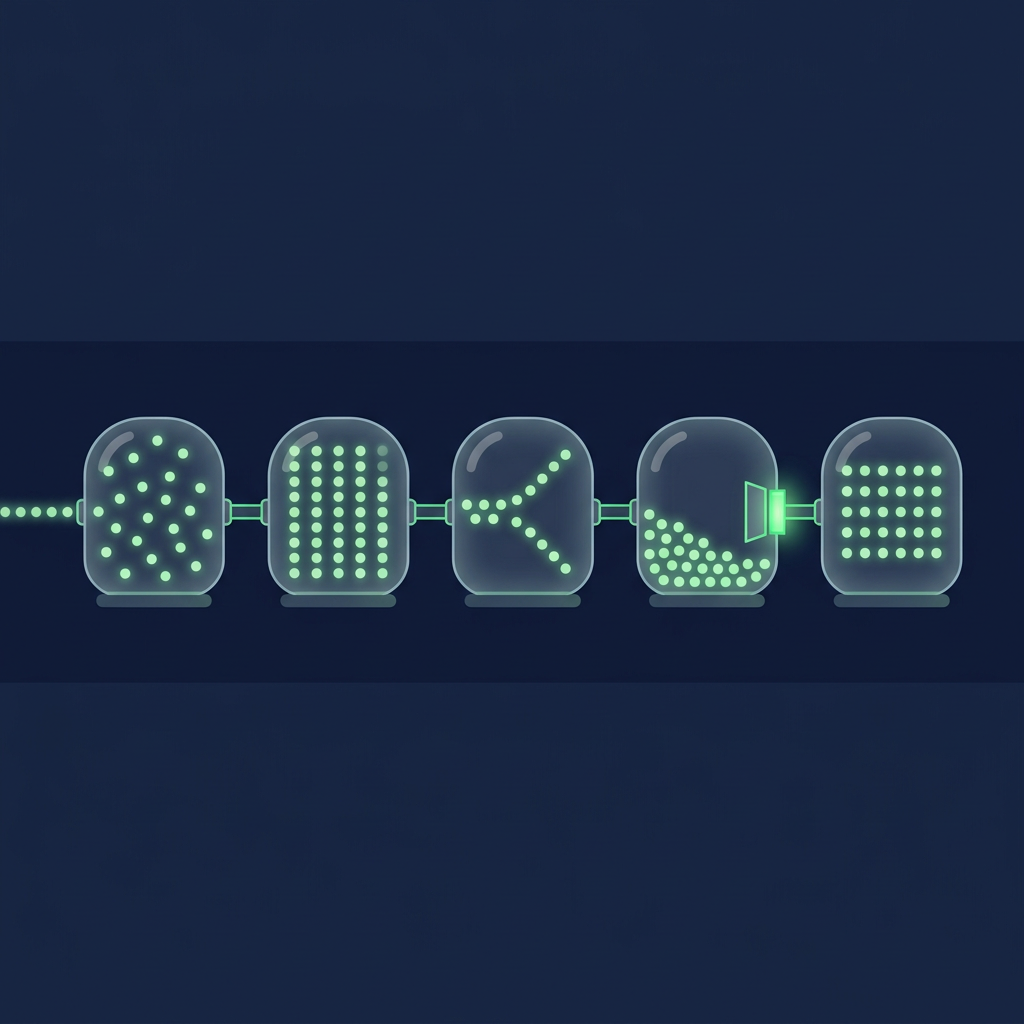
A Clay automation agency builds a chain of five stages inside your Clay workspace and the tools around it: source data, enrichment, routing, human-approved outreach and CRM write-back. The Clay Chain Audit lists, for each stage, the Clay setting that decides how it behaves and the asset you should hold when the agency leaves. Every setting below is taken from Clay's own documentation or pricing page.
| Stage | What the agency configures | Clay setting that decides the behaviour | Human check worth keeping | Asset you should hold at handover |
|---|---|---|---|---|
| 1. Source data | Lists of accounts and people, signal feeds, inbound webhooks | Row limits per table (200 on Free, up to 50,000 on Launch); HTTP API and webhooks on Growth | Approve the ICP filter and the exclusion list (customers, competitors, open deals) | Written ICP and exclusion rules; list of every source feeding the table |
| 2. Enrichment | Waterfalls that try providers in order for emails, phones and firmographics | The waterfall runs providers in sequence, "stopping as soon as one returns a valid result"; the validation strategy is Conservative, Balanced ("including catch-alls"), Aggressive or Advanced | Choose the validation strategy yourself; it decides whether catch-all addresses reach a sequence | Provider order, validation setting and credit cost per row |
| 3. Routing and scoring | Fit and signal scores, owner assignment, suppression | Auto-run, auto-dedupe and conditional runs in table settings; "Update Existing: OFF" adds net-new rows only | Review the score rules and the owner-assignment logic before auto-run is switched on | Score definitions and the routing table, in plain language |
| 4. Human-approved outreach | Message drafts, sequence enrolment | Clay's Sequencer "drafts the follow-up and posts it in Slack for reps to approve or edit before sending"; Clay also integrates with Smartlead, Instantly, Salesloft, Outreach and HubSpot | A named approver for every new segment's first send | Prompt text, approval rule and the sequencer each segment feeds |
| 5. CRM write-back | Creates and updates CRM records from Clay | CRM integrations are on Growth and Enterprise only. HubSpot updates need the record's Object ID and "Ignore blank values" is on by default. Salesforce upserts need an external ID, and with the blank-value setting disabled, "blank values are sent to Salesforce and overwrite existing values with blanks" | Test write-back on ten of your own records before it runs on all of them | Field map, match key, blank-value setting and the CRM user the integration runs as |
Two facts make stage 5 the costly one to get wrong. Fact: Clay's Salesforce connection needs the "Approve uninstalled connected apps" permission, so your Salesforce administrator is part of the build whether or not the agency says so. Inference: an agency that cannot name its match key and blank-value setting for your CRM has not yet designed the write-back. Our guide to GTM engineering agencies with Clay and HubSpot experience sets out the seven write-back decisions to get in writing for HubSpot.
Four Criteria Applied to Every Firm
The rubric scores what each firm's pages say on four criteria. It does not score results, because no firm publishes results on a common base.
- Maintainability. Does the firm say it documents the build, writes SOPs or trains your team? Clay's version history cannot replace this: per Clay's docs, "Cell value data is not versioned", and history is kept for 30 days on Launch and Growth and 180 days on Enterprise.
- Accuracy. Does the firm name a validation step for contact data, or only "enrichment"? The validation strategy and provider order are the settings that decide accuracy in a Clay waterfall.
- Integration burden. Which CRM does the firm name, and how does data reach it: Clay's native integration, a third-party sync, or a bi-directional build? Each route needs a Clay Growth plan or a separate tool, and someone on your side to grant CRM permissions.
- Operational ownership. Does the firm say the Clay tables, CRM fields, domains and inboxes belong to you? Ownership and exit terms are covered in depth in our guide to GTM engineering agencies and consultants for B2B SaaS; this page records only what each firm states.
A Clay partner tier is not one of the criteria. Clay's Solutions Partner page defines each tier by the kind of firm (Artisan: "producing repeatable success for several clients"; Elite Studio: "solving the toughest go-to-market problems for the largest enterprises around the world") and says applicants "submit Clay builds and request client testimonials", with applications "reviewed monthly on a rolling basis". Fact: the tier records Clay's review of the firm. Inference: it says nothing about how a build will be maintained after the firm leaves your account.
Evidence Table: Ten Clay Agencies on One Rubric
Rows are grouped by Clay directory tier and listed alphabetically within each tier; the order is not a ranking. "Not described" means the firm's Clay listing and own site do not cover the point, not that the firm lacks the capability.
Tier, price and terms
| Firm | Clay directory tier | Price and minimum as published | Notes from the firm's pages |
|---|---|---|---|
| Frontal | Elite Studio | "$5k+ a month"; 3 months (Clay listing) | Formerly ColdIQ. Home page says "1 of 4" Clay Elite Studio partners worldwide; its Clay listing says "1 of 5". Refund offer if accounts are not "mapped, scored, and enriched by week 4" |
| Growth Engine X | Elite Studio | No price published; 3 months | Offers a free test campaign before commitment |
| RevPartners | Elite Studio | Listing "any budget", 3 months; own page lists Allbound Foundations at $25,000 (60 days) and Allbound-as-a-Service at "$12,900+/mo." | Acquired by Walker Sands (announced June 10, 2026); also a HubSpot Elite partner |
| The Kiln | Elite Studio | "$10k+ a month"; 3 months | Site states "The Kiln has been acquired by 2X!" |
| demandDrive | Studio | "$5k+ a month"; 1 month | |
| Growth Today | Studio | "$5k+ a month"; 3 months | Own site says it is "among the 20-ish of Clay Enterprise agency partners globally"; Clay's directory lists it as Studio |
| Workflows.io | Studio | "$5k+ a month"; 3 months | Runs a separate "Paid educational program" (Workflows Academy) |
| frontBrick | Advanced Artisan | "any budget"; 3 months | Serves "B2B teams above $1M in annual revenue" |
| Understory | Advanced Artisan | "any budget"; 6 months | |
| The GTM Engineering Company | Artisan | Own site: Starter $5k/mo, Growth $7k/mo, Enterprise custom; 3 months (Clay listing) |
Stages each firm describes
| Firm | Source data | Enrichment and accuracy | Routing | Human check before send | CRM write-back |
|---|---|---|---|---|---|
| Frontal | Signal feeds (funding, job change, CRM data) | "Combine multiple data providers"; no validation step named | "scored and routed to your CRM and Slack" | "A Frontal operator reviews every play before it sends." | HubSpot and Salesforce tasks and owner alerts |
| Growth Engine X | LinkedIn data and list building | Validation step named: "Claygent + Prospeo.io" | Not described | Not described; its "AI Review" step is "Batch API scoring" | "CRM Integrations Through OutboundSync" |
| RevPartners | Lists "sourced via Clay" | "Cleanse and validate your existing CRM records" | Lifecycle-stage assignment and guardrails for active customers | Not described | "bi-directional revenue data flow" with HubSpot |
| The Kiln | Signals and lists | Enrichment and CRM refresh; no validation step named | Scoring only ("Inbound lead enrichment & account scoring") | Not described | Systems that "automatically enrich and refresh your CRM" |
| demandDrive | Signals for hiring, funding and tech changes | "100+ data providers in a single waterfall" | "route the right leads to the right reps" | Not described | Enriched data pushed to "all your GTM tools" |
| Growth Today | "50+ data sources including LinkedIn and Google Maps" | Scheduled enrichment and deduplication | Inbound leads "researched, scored, and worked" | Optional: drafts pushed "to your sequences where your team can make final adjustments" | HubSpot and Salesforce |
| Workflows.io | "120+ data providers" | "CRM workflows to fix your broken HubSpot or Salesforce data" | Not described | Not described | HubSpot and Salesforce named |
| frontBrick | "105+ tools" and intent triggers | Enrichment and waterfalls; no validation step named | "the routing, attribution, and handoffs that turn replies into revenue" | Not described | CRM cleaning and sync |
| Understory | Lists and signals | "every email is double-validated before sending" | Conversations handed to your sales team | "You review and approve all copy before launch" | "Every outbound send, open, reply, and meeting lands on the contact record with source attribution." |
| The GTM Engineering Company | Accounts scored on "live buying signals, job postings, funding data, and tech stack insights" | Fixes "broken records" and fills missing fields | "wire enrichment, routing, and multi-channel outreach" | Not described | CRM clean-up and HubSpot |
Maintainability and ownership
| Firm | Maintainability, in the firm's words | Ownership, in the firm's words |
|---|---|---|
| Frontal | "The whole engine, documented, inside your own tools." | "Yours to run, or have us run it." |
| Growth Engine X | Not described | "All Work is Transferable to You (Domains, Inboxes, Clay Tables, Lists, etc.)" |
| RevPartners | "comprehensive live training and custom documentation so your internal team can operate the system" | Not described |
| The Kiln | "SOPs, templates, and internal enablement" | Not described |
| demandDrive | "ongoing optimization" (the firm runs it) | Not described |
| Growth Today | Enablement "so what we build is not gonna become a black box right after handover" | "Build into your systems - everything stays yours" |
| Workflows.io | Not described for client engagements; Academy sold separately | Not described |
| frontBrick | "Complete SOP library (fully documented process)" | "Build by frontBrick, managed and owned by your team." |
| Understory | Trains your team and will "hand over the keys" | Assets not itemised |
| The GTM Engineering Company | "Collaborative sessions designed to upskill your internal team" | Not described |
What the tables show
- Every firm describes sourcing, enrichment and CRM work; seven describe routing. The Kiln describes scoring without routing, and Growth Engine X and Workflows.io do not describe routing.
- Two firms name a contact validation step. Understory says every email is "double-validated", and Growth Engine X names its validation tools. None of the ten names which Clay waterfall validation strategy it uses, which is the setting that decides whether catch-all addresses reach a sequence.
- Three firms describe a human check before sending, and one describes client approval. Frontal's review is by its own operator; Understory's is by you; Growth Today's is optional. Growth Engine X's review step is automated scoring.
- Four firms state that the build belongs to you. Frontal, Growth Engine X, Growth Today and frontBrick. Understory uses the phrase "hand over the keys" without listing assets. Five pages do not address ownership.
- Two firms' own tier statements differ from Clay's directory. Frontal gives two different Elite Studio counts on its own pages, and Growth Today calls itself an Enterprise partner while the directory lists it as Studio. Ask each firm which programme its statement refers to.
Related Options on the Same Rubric: Percepture, Pyra and Lead Seeker
Bob Generale, who wrote this page, is President of Percepture and a co-founder of Pyra; Lead Seeker publishes the page. None of the three is a Clay agency, and none of their pages mentions Clay. They appear here because a buyer searching for Clay automation is buying one or more of the same five stages, and each covers part of the chain.
| Option | What it covers in the chain | Human check before send | Maintainability and ownership, in its words | Price as published |
|---|---|---|---|---|
| Percepture AI sales agents | Prospecting, research, outreach and CRM updates, built on Pyra | Workflow-level: "You approve every workflow before it goes live." Its agents follow up "without human intervention" once live | "ongoing support and optimization"; "The agents are yours. You control how they work." | "$5,000-50,000 (custom build) + $1,000-5,000/month (support)" |
| Pyra AI | One agent on one workflow, built "on your own data" | "run it with your approval gates in place" | Not described | No price published; scoped as a paid pilot |
| Lead Seeker | Stage 1, source data: public buying signals, a verified contact and a dossier per account | Not applicable; it does not send messages | Records sync natively to Salesforce and HubSpot on every paid plan, with spreadsheet export | 5 free leads; $99 one-time 14-day Pilot; Starter $149/mo |
Fact: Percepture's approval is set per workflow, not per message. Inference: a team that wants a person to read each message before it sends needs that rule written into the agent's design, in the same way it would ask a Clay agency for it. For Pyra AI, the paid pilot measures one workflow against "success criteria we agree before we start". For the source stage, see how Lead Seeker works, and for the database choices that feed any Clay table, our guide to the best B2B contact database compares the main options. Percepture's guide to using intent data to identify sales qualified leads covers the qualification rule that stage 3 should encode.
The Inheritance Test: Ten Questions for the Scoping Call
The Inheritance Test checks whether your team could run the build on the day the agency leaves. Ask each shortlisted firm to answer in writing.
- Whose Clay workspace and plan does the build run on? CRM integrations need Clay Growth or Enterprise. Clay's FAQ lists Launch from $185 a month and Growth from $495 a month; the plan cards show $167 and $446 with annual billing selected.
- How are Clay Actions and Data Credits budgeted? Per Clay's pricing page, Actions "reset each billing cycle and don't roll over", while Data Credits roll over up to twice the monthly amount on Launch and Growth.
- Which validation strategy does each waterfall use, and why? Conservative, Balanced, Aggressive or Advanced. Balanced includes catch-all addresses.
- What is the provider order in each waterfall? Clay charges credits only "for the provider that finds a match", so order sets cost as well as coverage.
- Which tables auto-run, and which conditional runs gate them? A table that auto-runs on every new row spends credits on every new row.
- What is the CRM match key, and what is the blank-value setting? HubSpot updates need the Object ID; Salesforce upserts need an external ID.
- Which CRM user does the integration run as, and who granted its permissions?
- Who approves the first send to each new segment? Name the person and the place (Slack, the sequencer, a review queue).
- Where is the build documented beyond Clay's version history? Clay keeps 30 days of table history on Launch and Growth, and cell values are not versioned.
- Which assets transfer at exit? Clay tables, prompts, CRM fields and workflows, domains and inboxes, by name.
A firm that answers all ten in writing has designed for handover. The Stage Automation Scorecard for outbound implementation programs applies the same handover question to non-Clay programmes, and our guide to B2B SaaS marketing automation setup challenges covers the record and field problems a Clay write-back inherits from the CRM.
A Worked Example: Hiring a Clay Agency for a 90-Day Build (Invented)
Quarrymoor Systems, an invented company, sells maintenance software to logistics operators in the United States. It runs HubSpot Sales Hub, has one RevOps manager and three SDRs, and has a Clay Launch plan nobody uses. It wants signal-triggered outreach and clean company records in HubSpot.
- Shortlist from the tables. It needs HubSpot write-back, client approval of copy and documented handover. Understory and Frontal describe a human check; RevPartners describes bi-directional HubSpot sync and documentation. It shortlists those three.
- Fix the plan first. HubSpot write-back needs Clay Growth, so the RevOps manager budgets the upgrade alongside the agency fee. At the listed floors, three months at $5k a month is $15,000 before Clay costs; arithmetic on published minimums, not a quote.
- Run the Inheritance Test. All three firms receive the ten questions and ten of Quarrymoor's own HubSpot company records, including two with subdomain websites, and are asked how their write-back would treat each.
- Write the approval rule into the contract. The RevOps manager approves the first send to each new segment in Slack; SDRs approve replies before they go out.
- Book the handover. Week 12 is a walkthrough in which the RevOps manager runs each table and explains each score without the agency on the call.
The example sets out a process; it reports no results.
When a Clay Agency Is the Wrong Purchase
A Clay agency builds automation around data you already decided to buy. If your team has not settled its ICP and exclusion rules, the agency will encode a guess, and every later stage inherits it. If your CRM has no agreed match key or field owner, start with the CRM work, because a Clay write-back multiplies existing duplicates. If you have fewer than one person who will own the tables after handover, the build will drift once the version history window passes; a managed service, where the firm runs the system, is the more honest purchase. And if the gap is only stage 1, a contact source that delivers verified, signal-dated records may be all you need.
Frequently Asked Questions
How much does a Clay automation agency cost?
On Clay's partner directory in October 2026, five of the ten firms here listed "$5k+ a month" and The Kiln listed "$10k+ a month"; three listed "any budget" and Growth Engine X published no price. RevPartners publishes $25,000 for a 60-day build and $12,900 or more a month for a managed service, and The GTM Engineering Company publishes $5k and $7k monthly plans. Minimums ranged from one month to six. Your Clay plan is a separate cost.
What does a Clay partner tier mean?
Clay's Solutions Partner programme has four tiers: Artisan, Advanced Artisan, Studio and Elite Studio. Clay defines each by the kind of firm, from one "producing repeatable success for several clients" to one "solving the toughest go-to-market problems for the largest enterprises around the world". Applicants submit Clay builds and client testimonials, and Clay reviews applications monthly. A tier records Clay's review of the firm; it does not test a specific build.
Which Clay plan does an agency build need?
If the build writes to a CRM, Clay Growth or Enterprise, because CRM integrations are not included on Free or Launch. Clay's FAQ lists Growth from $495 a month with 6,000 Data Credits and 40,000 Actions, and also lists the HTTP API and webhooks on Growth. Launch, from $185 a month, suits builds that export rows without CRM sync.
Does Clay have a CRM?
Clay's pages describe syncing with a CRM, not acting as one. CRM integrations with HubSpot and Salesforce are Growth-plan features, and Clay's FAQ says "Clay doesn't replace your email sequencer" and integrates with Smartlead, Instantly, Salesloft, Outreach and HubSpot. Your CRM stays the system of record, and the write-back settings decide what Clay changes in it.
Can my own team run Clay instead of hiring an agency?
Yes, if one person owns the tables. Clay's documentation covers waterfalls, table settings and the HubSpot and Salesforce integrations in detail. Growth Today's own FAQ estimates 4-6 months for a team to learn Clay, which is a vendor estimate. An agency shortens the build; it does not remove the need for an internal owner after handover.
Who should own the Clay workspace and tables?
The buyer. Four of the ten firms here state that the build stays with the client, and five do not address ownership. Ask for the workspace, tables, prompts, CRM fields, domains and inboxes to be listed by name in the contract, and for the Clay plan to be billed to your account from the start.
How to Read the Rubric
Firms qualify if at least two of five published shortlists for this question name them, not counting a publisher's entry for itself; the five lists are from Frontal, Salesforge, Kiin, Sculpted and Nebor. Each cell restates the firm's own Clay directory listing or website, and quoted phrases are verbatim. Tiers come from Clay's directory. "Not described" means those pages do not cover the point. Agency performance figures on those pages are vendor-reported and are not repeated here. Fact, inference and opinion are labelled where they sit side by side. The worked example is invented.
Sources
- Clay, Pricing: plans, FAQ prices, Data Credits, Actions, CRM integrations, rows per table and table version history. Solutions Partner Program: tier definitions and application process. Sequencer: Slack approval of reply drafts. FAQ: sequencer and CRM integrations.
- Clay University: Table versions, Table management settings, Work Email waterfall, HubSpot integration, Salesforce integration.
- Clay partner directory listings: Frontal AI, Growth Engine X, RevPartners, The Kiln, demandDrive, Growth Today, Workflows.io, frontBrick, Understory, The GTM Engineering Company.
- Firm websites: Frontal, Growth Engine X, RevPartners Clay agency, The Kiln, demandDrive Clay services, Growth Today, Workflows.io, frontBrick Clay consulting, Understory GTM engineering, The GTM Engineering Company.
- Shortlists used for selection: Frontal, Best Clay Automation Agencies, Kenny Damian (updated September 21, 2026); Salesforge, Top 10 Best Clay Agencies in The US, Niels Ouwens (last updated September 26, 2026); Kiin, 17 Best Clay Agencies and Solutions Partners, Phil Ilic (updated September 2026); Sculpted, 5 Best Clay Agencies for Every Use Case (undated); Nebor, 15 Best Clay Sales Automation Agencies, Yannick Kok (June 12, 2026).
- Walker Sands, Walker Sands Acquires RevPartners to Expand RevOps and GTM Engineering Capabilities (June 10, 2026).
- Percepture, AI Sales Agents and How to Use Intent Data to Identify Sales Qualified Leads. The author is President of Percepture.
- Pyra, Home and Contact and paid pilot. The author is a co-founder of Pyra.
- Lead Seeker, How it works and Pricing. Lead Seeker publishes this page.
About the Author
Bob Generale is President of Percepture and a co-founder of Pyra AI. He works across SEO, AI search, digital PR, sales intelligence and AI-powered revenue systems, with a focus on connecting visibility, buyer intent and sales action.
Next Steps
Pick two or three firms from the tables, send each the Inheritance Test with ten of your own CRM records, and compare the written answers before you compare prices. For who publishes this page and how its data product fits stage 1, see what Lead Seeker is and who builds it.